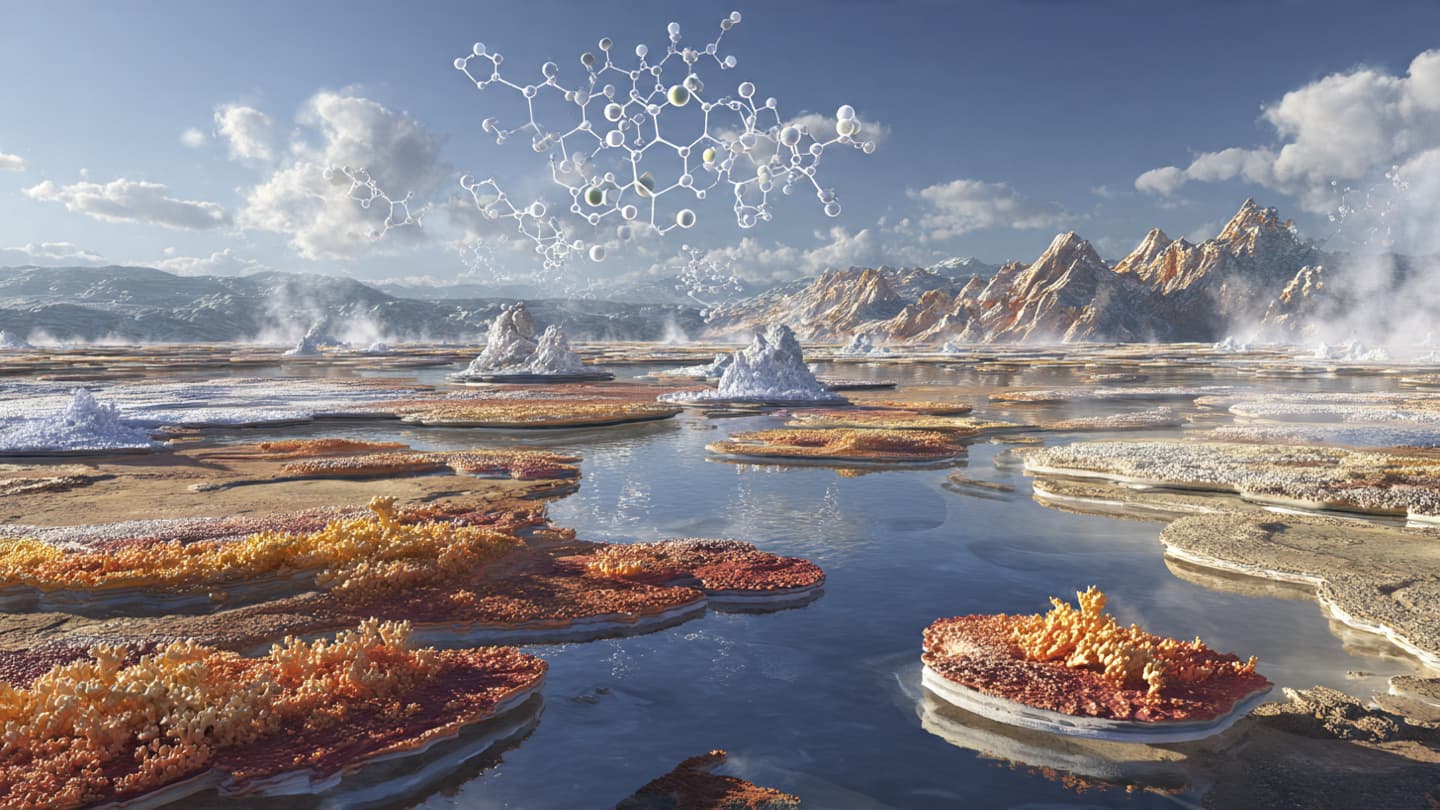
The question of how life began has often resembled a river disappearing into fog. Scientists can trace many parts of the journey, yet the earliest steps remain among the most challenging puzzles in modern research. A new study has now illuminated one section of that hidden path, offering fresh evidence about how life's earliest genetic molecules may have reproduced themselves.
Researchers from the MRC Laboratory of Molecular Biology and University College London have reported experimental results that address a longstanding obstacle in origin-of-life studies. Their work focuses on RNA, a molecule widely believed to have played a central role before DNA and proteins became dominant components of biology.
The idea, often called the RNA World hypothesis, proposes that early life relied on RNA both to store information and to perform chemical functions. However, demonstrating how RNA could repeatedly copy itself under realistic early-Earth conditions has proven difficult.
One major challenge involves strand separation. When RNA forms a double-stranded structure, the strands tend to remain attached, making repeated replication difficult. Scientists have long regarded this as a significant bottleneck in understanding how primitive replication cycles could have operated.
In the new work, researchers used three-letter RNA building blocks along with cycles involving heat, acidity, and freezing conditions. The approach helped separate RNA strands and created circumstances in which replication could continue more effectively.
Importantly, the researchers describe these conditions as potentially plausible on the early Earth. Rather than relying on complex biological machinery, the process depends on relatively simple chemical and physical mechanisms.
The study does not claim to fully explain the origin of life. Many questions remain regarding how self-replicating systems became increasingly complex and eventually gave rise to cellular organisms. Nevertheless, solving one major obstacle represents meaningful progress.
Scientists in the field view origin-of-life research as a process of assembling numerous interconnected pieces. Advances in chemistry, geology, and molecular biology continue to narrow the gaps between theory and experimental evidence.
The new findings provide a clearer framework for investigating how simple molecular systems might have evolved into the earliest forms of life, helping researchers explore one of science's most enduring questions.
AI Image Disclaimer: The visual illustrations featured here are AI-generated depictions intended to support scientific storytelling.
Sources (verification check): Nature Chemistry, University College London (UCL), MRC Laboratory of Molecular Biology, Astrobiology Magazine
Published by Banx Network. This article is part of the Banx decentralized media programme, powered by the BXE token on the XRP Ledger.