The story of evolution is often written in fragments of stone, waiting patiently beneath layers of earth. Occasionally, a fossil emerges that seems to connect different chapters of natural history, revealing creatures that appear both familiar and remarkably unusual. A newly described dinosaur from ancient China offers such a glimpse into a world where feathers, flight, and predation were evolving together.
Scientists have identified a new species called Jian changmaensis, a close relative of the famous velociraptor lineage. The dinosaur belonged to a group known as microraptors, small feathered predators that lived during the Early Cretaceous Period approximately 120 to 124 million years ago.
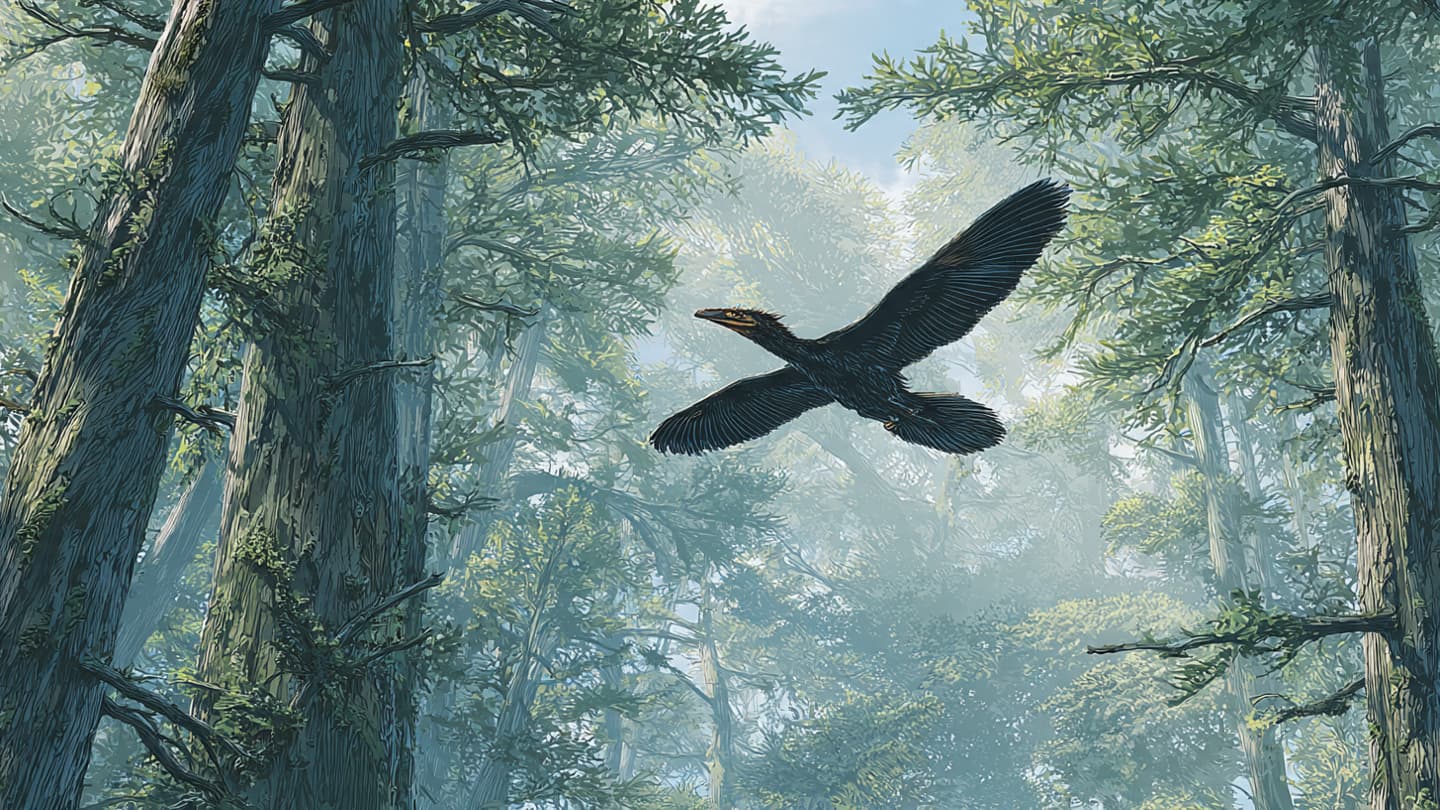
Unlike the popular image of scaly predatory dinosaurs, microraptors possessed extensive feather coverings. Fossil evidence indicates that Jian changmaensis carried long feathers on both its forelimbs and hindlimbs, creating the appearance of four wings. Researchers believe these structures may have enabled gliding between trees.
The fossil was discovered in the Changma Basin of northwestern China, an area already known for preserving numerous early bird remains. Among hundreds of avian fossils found there, this specimen stands out as the only known non-avian dinosaur identified from the site.
Scientists have long wondered what predator hunted many of the birds preserved in the region's fossil beds. Broken bones and pellet-like remains suggested the presence of a capable hunter. The discovery of Jian changmaensis may help answer that question.
Researchers propose that the dinosaur likely occupied forest canopies, moving through trees and potentially ambushing prey from elevated positions. Its anatomy suggests agility rather than brute force, making it well suited to a complex woodland ecosystem.
The find contributes to a broader understanding of how flight-related adaptations evolved among dinosaurs. Many paleontologists view microraptors as important examples of evolutionary experimentation, demonstrating multiple pathways that may have contributed to the emergence of modern birds.
Although the fossil remains incomplete, it provides valuable information about a group that continues to illuminate the transition between non-avian dinosaurs and birds. Each new specimen helps refine that evolutionary picture.
Scientists expect continued study of the Changma Basin to reveal additional details about the ecosystem in which this feathered predator once lived and hunted.
AI Image Disclaimer: Images used with this article are AI-generated visual reconstructions based on scientific descriptions and fossil evidence.
Sources (verification check): Live Science, Phys.org, EurekAlert!, Annals of Carnegie Museum
Published by Banx Network. This article is part of the Banx decentralized media programme, powered by the BXE token on the XRP Ledger.