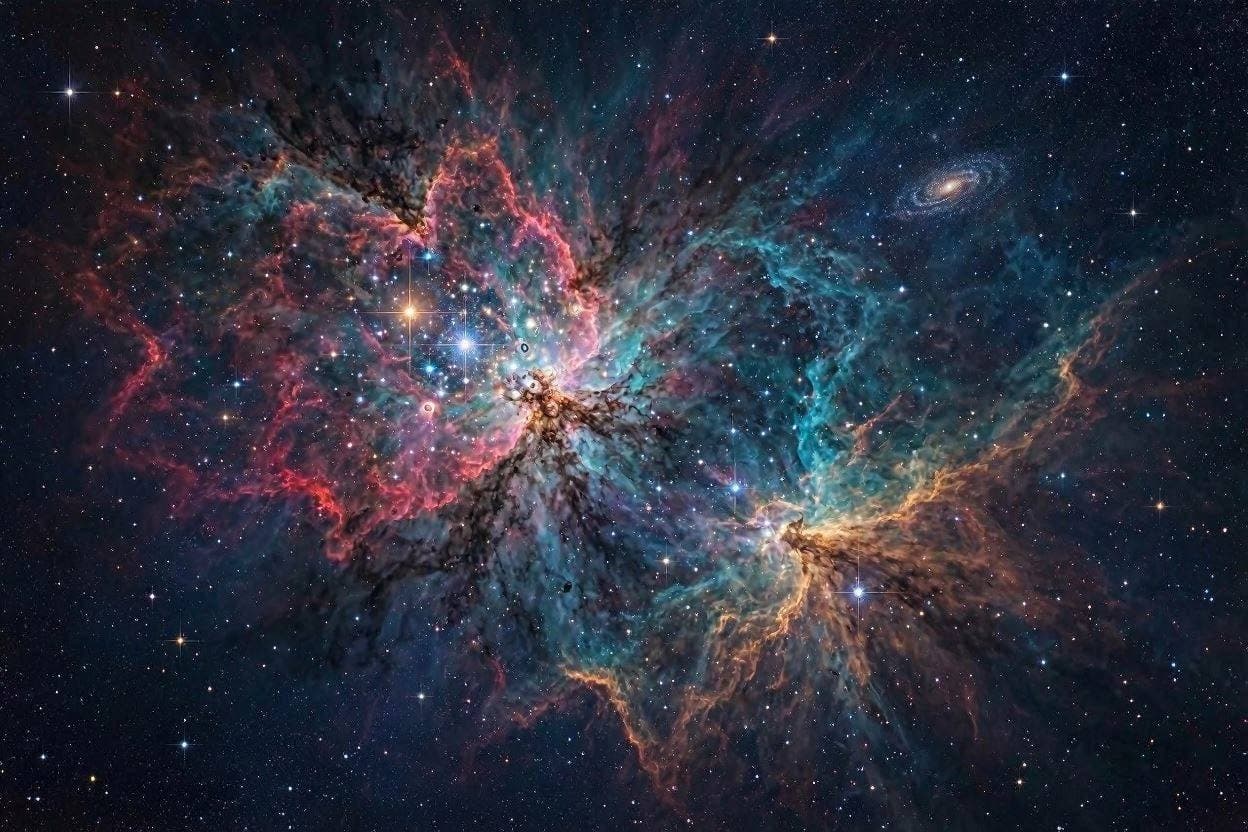
In the swirling, star-dense heart of our galaxy, where cosmic clouds churn and new suns are born, scientists have detected a familiar yet profound ingredient: sugar. Specifically, glycolaldehyde, a simple sugar molecule, has been identified in a stellar nursery near the center of the Milky Way. This discovery adds a sweet layer to our understanding of the chemical complexity of space and the potential origins of life.
The detection was made using the Atacama Large Millimeter/submillimeter Array (ALMA) in Chile, which picked up the unique radio signature of glycolaldehyde emanating from a gas cloud surrounding a young, forming star. This molecule is a precursor to ribose, a key component of RNA, which is essential for life as we know it. Finding it in such a distant and harsh environment suggests that the building blocks of life may be more common in the universe than previously thought.
The location of this discovery is particularly significant. The galactic center is a region of intense radiation and gravitational forces, conditions that were once thought to be too hostile for complex organic molecules to survive. The presence of glycolaldehyde here indicates that these delicate structures can form and persist even in extreme environments, expanding the potential habitats for prebiotic chemistry.
For astrobiologists, this finding is a piece of the puzzle in understanding how life might arise on other planets. If sugar molecules can form in the interstellar medium and be incorporated into protoplanetary disks, they could eventually end up on rocky planets like Earth. This process, known as chemical inheritance, suggests that the ingredients for life may be delivered to worlds from the very beginning of their formation.
The study also highlights the capabilities of modern radio astronomy. ALMA’s high sensitivity and resolution allow astronomers to peer into dense clouds of gas and dust, identifying specific molecular fingerprints that were previously invisible. This technological advancement is opening new windows into the chemical diversity of the cosmos, revealing a universe rich in organic complexity.
While the presence of sugar does not mean there is life in the galactic center, it does suggest that the conditions for life’s emergence may be widespread. It invites us to reconsider the rarity of Earth and to look with fresh eyes at the myriad of exoplanets being discovered around other stars. Each detection of a prebiotic molecule brings us closer to answering the age-old question of whether we are alone.
As research continues, astronomers hope to find more complex organic molecules in similar regions. The journey from simple sugars to living cells is long and complex, but each step discovered in space brings us closer to understanding our own origins. The galaxy, it seems, is brewing the ingredients for life in its deepest corners.
Closing: The discovery of glycolaldehyde near the Milky Way’s center is a reminder of the interconnectedness of the cosmos. From the dust of stars to the cells of living beings, the universe shares a common chemical heritage, waiting to be explored and understood.
AI Image Disclaimer: Please note that the images included in this article are AI-generated visualizations created to complement the narrative and are not actual photographs of the molecular cloud.
Sources: National Radio Astronomy Observatory ScienceDaily Space.com Astrobiology Magazine
Published by Banx Network. This article is part of the Banx decentralized media programme, powered by the BXE token on the XRP Ledger.