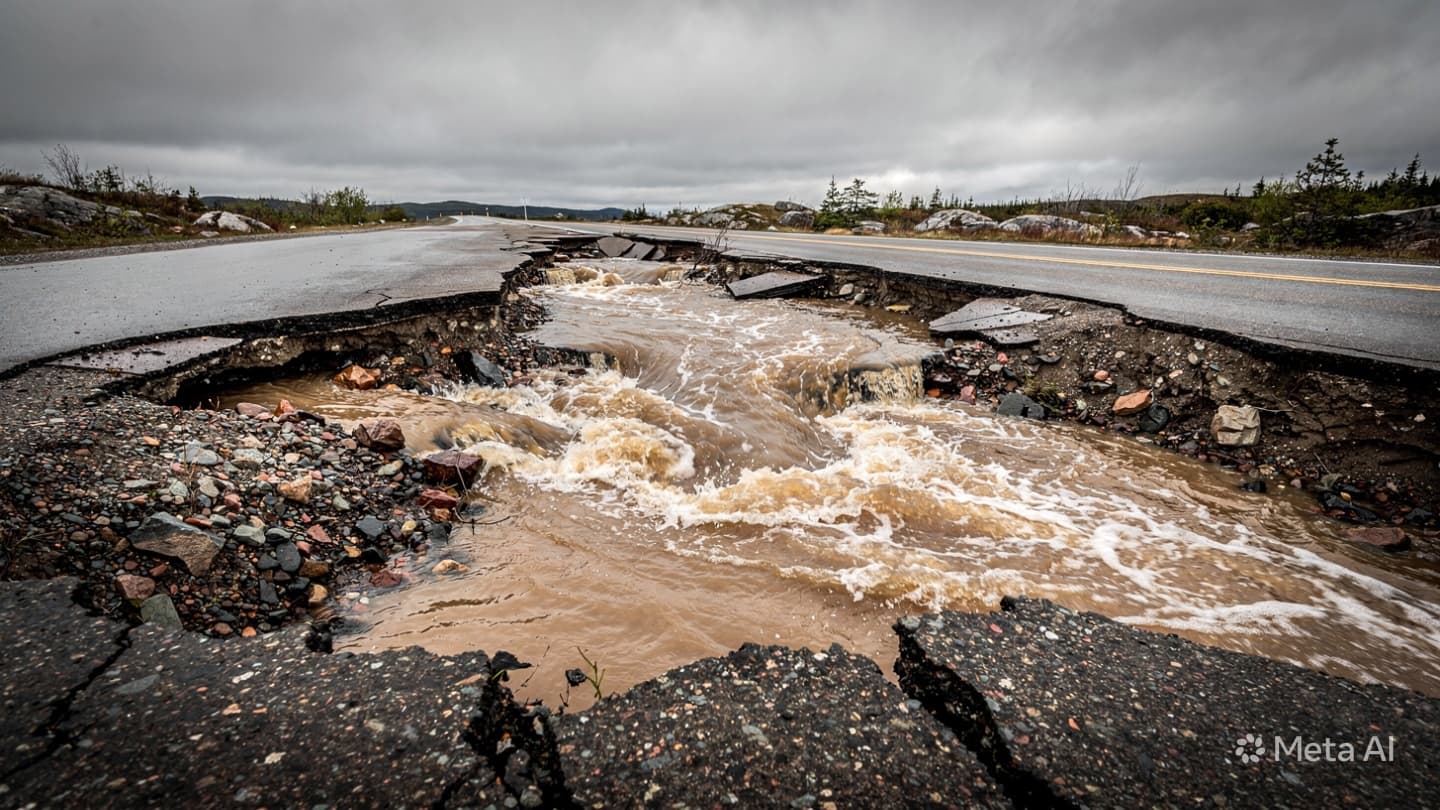
Halifax, Canada—The Atlantic coast remains under emergency watch this morning as flash floods continue to rip through residential and transit corridors across Nova Scotia. Heavy rainfall moved into the province late yesterday, turning local streams into violent torrents that quickly overwhelmed aging drainage systems. Local officials confirmed one fatality early this morning after a victim was swept away by rising water levels near a compromised culvert.
The damage is widespread. Asphalt on secondary highways has buckled under the hydraulic pressure, leaving several rural communities effectively cut off from emergency services. Municipal maintenance crews are currently unable to reach the most severely affected zones until water levels recede from the primary access roads. Heavy machinery lies idle near bridges, waiting for geotechnical assessments that cannot happen while the ground remains saturated and unstable.
Premier Tim Houston addressed the province in a brief, grim statement from the emergency operations center. He described the destruction of public works as a catastrophic blow to the region. He noted that the cost of rebuilding will reach into the hundreds of millions. His tone suggested little patience for the bureaucratic delays that have previously stalled essential flood-mitigation projects across the province.
Emergency responders are currently prioritizing the evacuation of low-lying areas where the risk of secondary mudslides remains high. Specialized water rescue teams have been deployed from neighboring provinces to assist local fire departments. They face difficult conditions as the water is thick with debris, including parts of guardrails and sections of torn pavement. Search efforts for any other potential missing persons continue despite the poor visibility.
Utility providers are struggling to restore power to thousands of residents left in the dark. Fallen trees and power poles have tangled with debris, creating dangerous electrical hazards for cleanup crews. Halifax Water has already issued strict warnings to avoid any contact with standing water due to the risk of raw sewage contamination. The health department is monitoring the situation for potential waterborne illnesses as systems fail.
Local residents are describing scenes of total chaos. Many spent the night moving furniture to second floors as basements flooded in minutes. Some families were forced to abandon their vehicles on highway shoulders when roads vanished beneath the rising current. The reality is that for many in these neighborhoods, the recovery process will take years rather than weeks.
Federal authorities are coordinating with provincial counterparts to fast-track disaster relief funding. Initial assessments indicate that the current infrastructure is simply not built to handle the frequency of these extreme weather events. The focus is shifting toward how to reinforce critical routes before the next heavy storm system moves into the Atlantic corridor. There is no timeline for when the major arteries will be fully reopened to standard traffic.
State-of-emergency protocols remain in place throughout the hardest-hit counties. Public schools and municipal offices are closed today while the province assesses the integrity of building foundations damaged by the soaking. Engineers warn that the soil saturation level is at a record high. The instability of the landscape means that even minor rainfall over the next forty-eight hours could trigger additional catastrophic failures.
Published by Banx Network. This article is part of the Banx decentralized media programme, powered by the BXE token on the XRP Ledger.