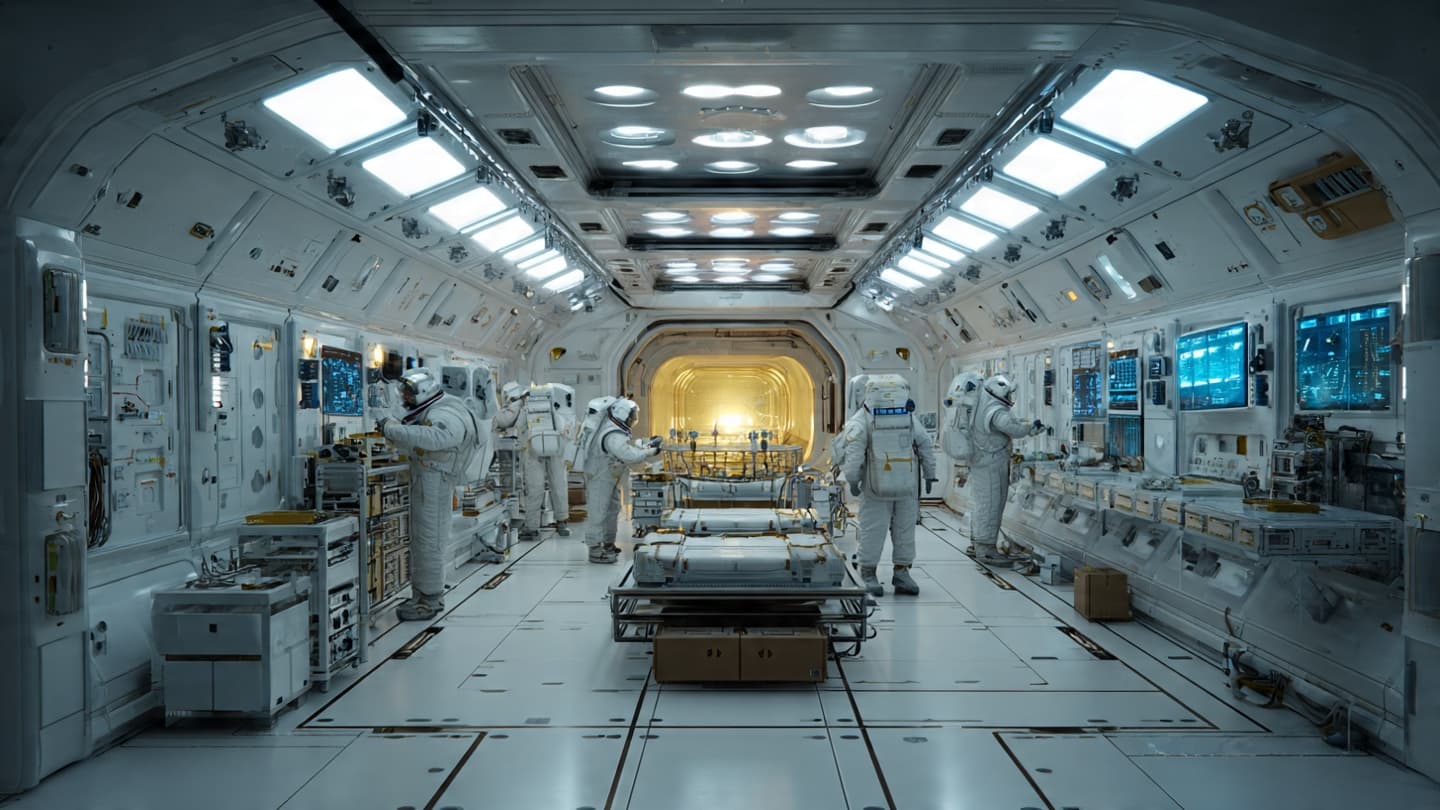
Far above Earth, aboard the International Space Station, scientists continue to explore questions that have fascinated humanity for generations. In the quiet environment of orbit, where gravity loosens its familiar grip, researchers are investigating some of the universe's most unusual forms of matter.
NASA has recently expanded experiments using the Cold Atom Lab aboard the International Space Station (ISS). This unique facility allows scientists to cool atoms to temperatures only fractions of a degree above absolute zero, creating conditions rarely found naturally in the universe.
At such extremely low temperatures, matter behaves in unexpected ways. Atoms can form what is known as a Bose-Einstein condensate, a state of matter first predicted by physicists nearly a century ago. In this condition, particles begin acting collectively as if they were a single quantum entity.
Researchers believe that studying these ultra-cold states could improve scientific understanding of quantum mechanics, one of the fundamental frameworks describing the behavior of matter and energy.
Conducting these experiments in space offers significant advantages. Microgravity aboard the ISS enables scientists to observe cold atomic clouds for longer periods than would be possible on Earth, producing more precise measurements.
NASA officials say findings from the Cold Atom Lab could eventually contribute to advances in quantum technology, including highly sensitive sensors, improved navigation systems, and next-generation computing applications.
Scientists are also interested in how these experiments may help answer broader questions about the universe. Ultra-cold matter studies could provide insights into dark matter, gravity, and the underlying principles governing cosmic evolution.
International collaboration continues to play a major role in the program, with researchers from universities and laboratories around the world participating in the analysis of experimental results.
As exploration extends beyond our planet, laboratories orbiting Earth continue to demonstrate that space is not only a destination for astronauts, but also a frontier for scientific discovery.
AI Image Disclaimer: Some illustrations accompanying this article were generated using artificial intelligence to visually represent scientific concepts.
Source Verification Check: NASA, ScienceDaily, Nature, NASA Jet Propulsion Laboratory, Physical Review Letters
Published by Banx Network. This article is part of the Banx decentralized media programme, powered by the BXE token on the XRP Ledger.