London often moves with the rhythm of weather. Rain gathers lightly on bus windows, bicycle tires hiss along wet streets, and crowds flow beneath station clocks with practiced urgency. Phones glow in nearly every hand — on sidewalks, in cafés, under theater marquees, inside late-night trains moving beneath the city. They have become small extensions of memory itself: maps, conversations, photographs, bank cards, routines. To lose one is no longer merely inconvenient. It can feel strangely personal, as though part of daily identity has slipped into unknown hands.
In recent months, a growing number of theft victims in London have described a more unsettling pattern after their phones disappeared. The theft itself, often swift and almost invisible, was only the beginning. Soon afterward came threatening messages, intimidation attempts, and demands aimed at extracting passwords, disabling security systems, or gaining access to financial accounts tied to the stolen devices.
Some victims reported receiving aggressive texts or emails warning them to unlock phones remotely. Others described threats directed toward family members or claims that personal information would be exposed if access was not granted. What once resembled opportunistic street theft has increasingly taken on the atmosphere of organized digital coercion, where the stolen object is valuable not only for resale, but for the private world stored inside it.
Across London, phone snatching has become a visible feature of urban life. Cyclists or scooter riders move quickly through crowded districts, targeting pedestrians whose attention drifts briefly toward a screen. In busy neighborhoods such as Westminster, Camden, and the West End, thefts can occur in seconds — a hand reaching out from motion, disappearing again into traffic before the victim fully understands what has happened.
But the emotional aftermath often lingers longer than the theft itself. Victims describe evenings spent changing passwords, contacting banks, freezing accounts, and warning relatives. The silence after a stolen phone can feel oddly loud, filled with uncertainty about what fragments of private life remain exposed elsewhere.
Police in London have acknowledged increases in mobile phone thefts and warned that organized criminal groups are exploiting both the hardware and the data contained within devices. Modern smartphones contain layers of financial access, biometric information, private correspondence, and cloud-linked identities that can extend far beyond the device itself. A stolen phone, once dismantled for parts or resold abroad, now also represents a potential pathway into a person’s digital existence.
Technology companies have continued introducing stronger security protections, including remote locking systems, biometric verification, and theft-detection tools. Yet the race between security and exploitation moves continuously, much like the city itself — fast, adaptive, difficult to fully control. Criminal networks learn quickly where convenience creates vulnerability.
There is also something deeply modern in the fear these thefts produce. Earlier generations might have lost wallets or keys; today, people lose archives of themselves. Messages from years earlier, photographs tied to memory, banking access, professional records, travel histories — all carried quietly in a pocket while walking through ordinary streets.
London remains a city defined by movement: tourists gathering along the Thames, commuters descending escalators, markets unfolding beneath gray skies. Yet beneath that motion runs a quieter tension shaped by digital dependence. The more life compresses into devices, the more fragile everyday routines can suddenly become when those devices disappear.
Authorities continue urging residents to enable advanced security protections, avoid displaying phones openly in crowded areas, and report threats immediately after theft incidents. Investigations into organized theft networks remain ongoing. Still, across the city each evening, countless screens continue glowing against rain-darkened windows — small lights carried through a metropolis where technology offers both connection and, increasingly, vulnerability.
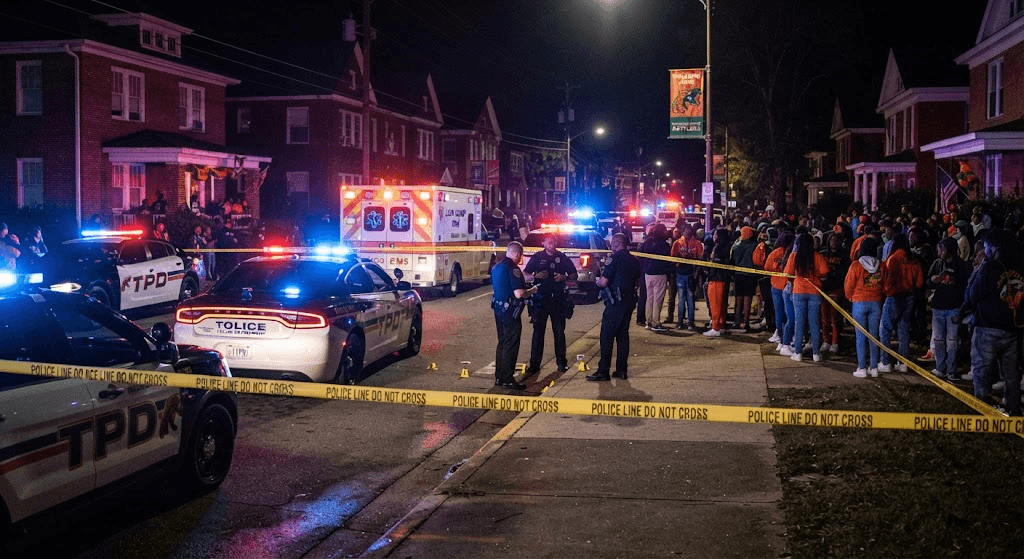
AI Image Disclaimer These visuals were created with AI assistance and serve as artistic representations rather than documentary images.
Sources
BBC News Reuters The Guardian Metropolitan Police Financial Times
Published by Banx Network. This article is part of the Banx decentralized media programme, powered by the BXE token on the XRP Ledger.