Black holes have long been the stuff of science fiction, monstrous entities that devour light and matter with insatiable hunger. Yet, recent experiments suggest that these cosmic giants may also be sources of immense energy. Physicists have successfully recreated the theoretical process of extracting energy from a rotating black hole in a laboratory setting. This breakthrough does not involve actual black holes, but rather clever analogs that mimic their properties. It is a triumph of human curiosity, bringing the most extreme phenomena of the universe within the reach of scientific inquiry.
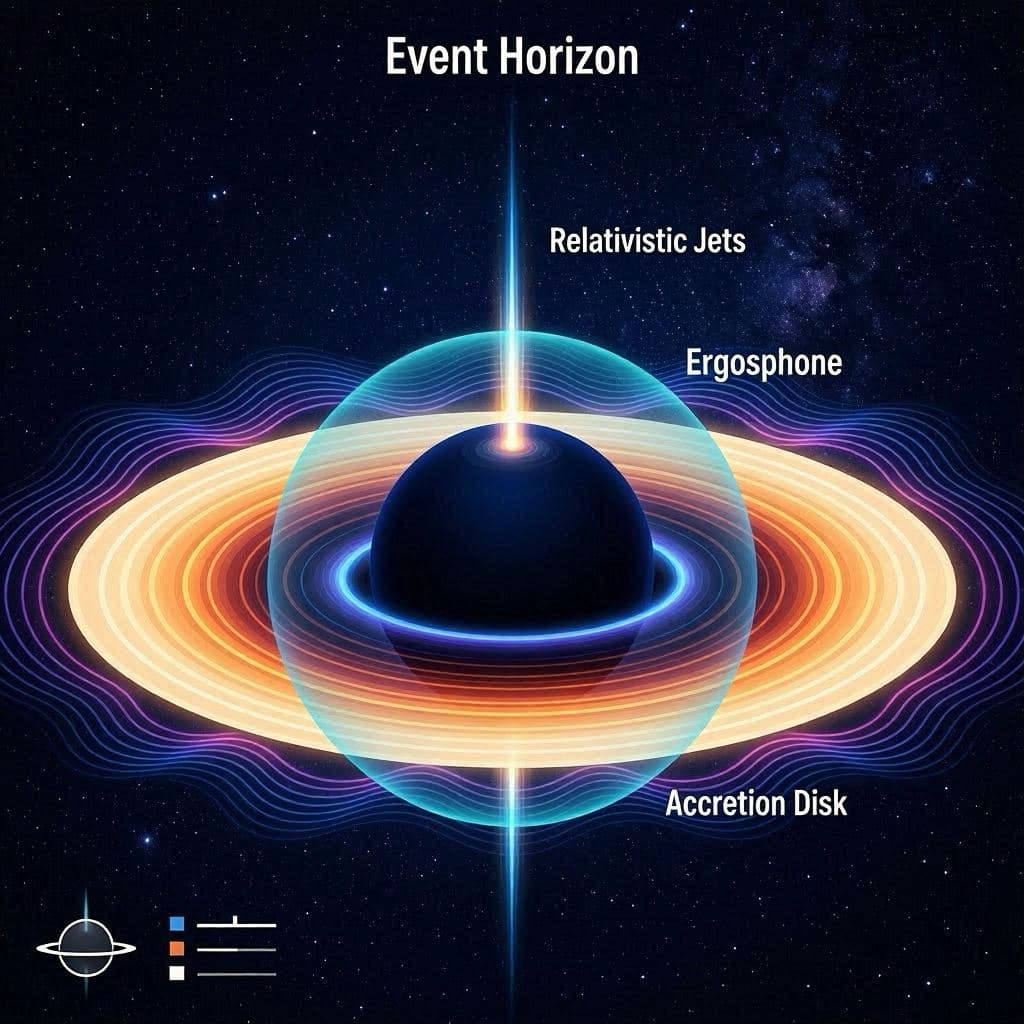
Body: The theory behind this phenomenon, known as the Penrose process, was proposed by Roger Penrose in 1969. It suggests that energy can be extracted from the ergosphere, the region just outside a black hole’s event horizon where space-time is dragged along with the black hole’s rotation. By splitting a particle in this region, one part can fall into the black hole with negative energy, while the other escapes with more energy than the original particle possessed. This seemingly impossible feat is now demonstrated in controlled conditions.
In the laboratory, researchers used a rotating cylinder made of special materials to simulate the dragging of space-time. Sound waves were sent toward the cylinder, and as they interacted with the rotating surface, they gained energy, emerging louder than they entered. This acoustic analog provides a tangible way to study the mechanics of energy extraction without the dangers of actual gravitational singularities. It validates decades of theoretical work with empirical evidence.
The implications for physics are profound. It confirms that rotational energy can indeed be tapped from compact objects, offering insights into how astrophysical black holes might power jets and other high-energy phenomena observed in space. It also opens new avenues for understanding the fundamental laws of thermodynamics and quantum mechanics in extreme environments. The experiment bridges the gap between abstract theory and observable reality.
While this does not mean we will soon be powering cities with black holes, it expands our understanding of energy dynamics in the universe. It suggests that nature has mechanisms for recycling energy in ways we are only beginning to comprehend. For scientists, it is a reminder that the universe is not just a place of destruction, but also of transformation and potential.
The experimental setup required precision and innovation. Creating a system that accurately mimics the complex geometry of a black hole’s ergosphere is no small feat. The team had to account for various factors, including wave interference and material properties, to ensure the results were reliable. Their success is a testament to the collaborative and meticulous nature of modern scientific research.
This achievement also highlights the power of analog systems in physics. By studying simpler, controllable models, scientists can gain insights into phenomena that are otherwise inaccessible. It is a method that has proven useful in many areas of physics, from fluid dynamics to quantum computing. The black hole analog adds another tool to this growing toolkit.
Closing: In the end, the recreation of black hole energy extraction in the lab is a milestone in theoretical physics. It demonstrates that even the most exotic concepts can be tested and understood through careful experimentation. As we continue to probe the mysteries of the cosmos, such breakthroughs remind us that the universe is full of surprises, waiting to be uncovered by the persistent human mind.
AI Image Disclaimer: The visual representations associated with this article are AI-generated artistic interpretations designed to illustrate the themes of theoretical physics and laboratory science.
Sources: Nature Physics University of Glasgow ScienceDaily
Published by Banx Network. This article is part of the Banx decentralized media programme, powered by the BXE token on the XRP Ledger.