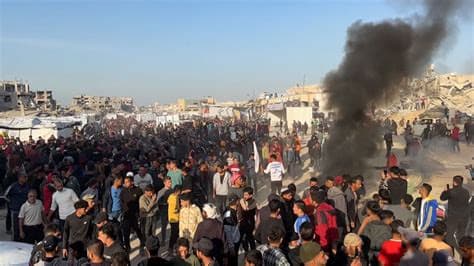
In Gaza, small but growing crowds have begun holding protest-style gatherings that signal rising wartime frustration, placing Hamas’s grip on power under strain. The demonstrations are unusual in a place where public dissent has historically been suppressed, and where people speaking out risk harsh retaliation.
Supporters of the protests say their anger is aimed at the broader conditions of the war—daily insecurity, displacement, and worsening shortages—and some messages explicitly distinguish between Hamas as the governing authority and the wider population suffering under the conflict. Organizers and participants describe the rallies as a way to tell the world that “the people of Gaza are not Hamas,” and to press for change in how Gaza is governed and how the war’s impact is addressed.
Hamas, meanwhile, remains focused on maintaining control and managing the optics of dissent during wartime. Reporting notes that Hamas has often kept a low profile in streets during the current phase of the war, but it has continued enforcing authority through internal security mechanisms. Even where protesters have avoided direct confrontation, the mere appearance of organized opposition is portrayed as a meaningful pressure point for Hamas, especially when the public mood is volatile and civilians are increasingly desperate.
Overall, the protests are framed less as a near-term challenge to Hamas’s existence and more as a public stress test: whether Hamas can contain dissent without visibly undermining its authority, and whether wartime frustration can translate into sustained political pressure.
Published by Banx Network. This article is part of the Banx decentralized media programme, powered by the BXE token on the XRP Ledger.