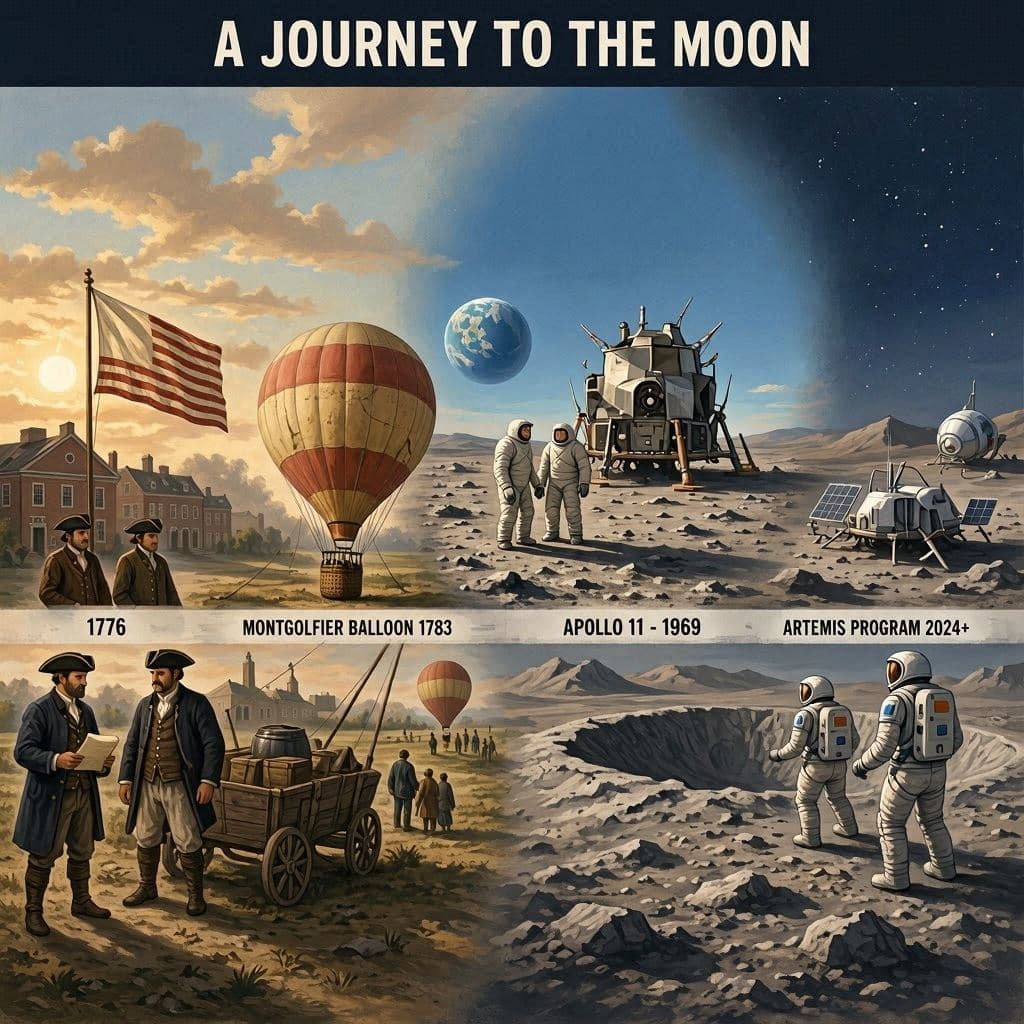
History often moves in quiet increments before revealing how far humanity has traveled. In 1776, the idea of people leaving Earth would have belonged more to imagination than engineering. Even powered human flight had not yet been achieved, and the sky itself remained a distant frontier. Two and a half centuries later, that same horizon has expanded beyond Earth's atmosphere, carrying human ambition toward the Moon once again.
The contrast between 1776 and the present forms the basis of a reflection on scientific progress. At the time of the American Declaration of Independence, the first successful human flight in a hot-air balloon was still seven years away. Since then, generations of inventors, engineers, and scientists have transformed transportation from simple balloons to spacecraft capable of traveling hundreds of thousands of miles through space.
The twentieth century marked a turning point with the emergence of the Space Age. Advances in rocketry led to the launch of satellites, human spaceflight, and eventually the Apollo missions, which placed astronauts on the Moon. Those achievements demonstrated that exploration beyond Earth could move from theory into reality through sustained scientific effort and international attention.
Today, attention has shifted toward returning humans to the lunar surface through NASA's Artemis program. Unlike the Apollo era, Artemis is designed with long-term exploration in mind, aiming to establish a sustained human presence around and on the Moon while preparing for future missions to Mars. International partnerships and commercial space companies are expected to play important roles in achieving those objectives.
Modern lunar missions differ significantly from those of the past. Engineers are developing advanced spacecraft, improved life-support systems, new lunar landers, and technologies capable of supporting longer stays in the harsh lunar environment. Scientific goals now extend beyond exploration alone to include geological research, resource investigations, and preparations for deep-space travel.
The journey back to the Moon also reflects the changing character of space exploration. Government agencies increasingly collaborate with private industry and international partners, combining expertise, technology, and shared scientific interests. This broader approach allows exploration to benefit from a wider range of innovation while strengthening cooperation across national boundaries.
Researchers emphasize that returning to the Moon is not simply about revisiting familiar ground. The lunar surface offers opportunities to study planetary history, test technologies for future missions, and deepen understanding of how humans can safely operate beyond Earth's protective environment. Each mission is expected to contribute valuable scientific knowledge alongside operational experience.
Looking across the span of 250 years, the distance between 1776 and today's lunar ambitions illustrates more than technological advancement. It reflects humanity's enduring curiosity and willingness to explore beyond previous limits. As preparations for future Moon missions continue, the next chapter of exploration builds upon centuries of discovery, reminding us that each generation inherits both the achievements and the aspirations of those who came before.
AI Image Disclaimer: The illustrations accompanying this article are AI-generated visual interpretations inspired by historical and scientific developments and are intended for editorial use only.
Sources Space.com NASA Smithsonian Institution Library of Congress
Published by Banx Network. This article is part of the Banx decentralized media programme, powered by the BXE token on the XRP Ledger.