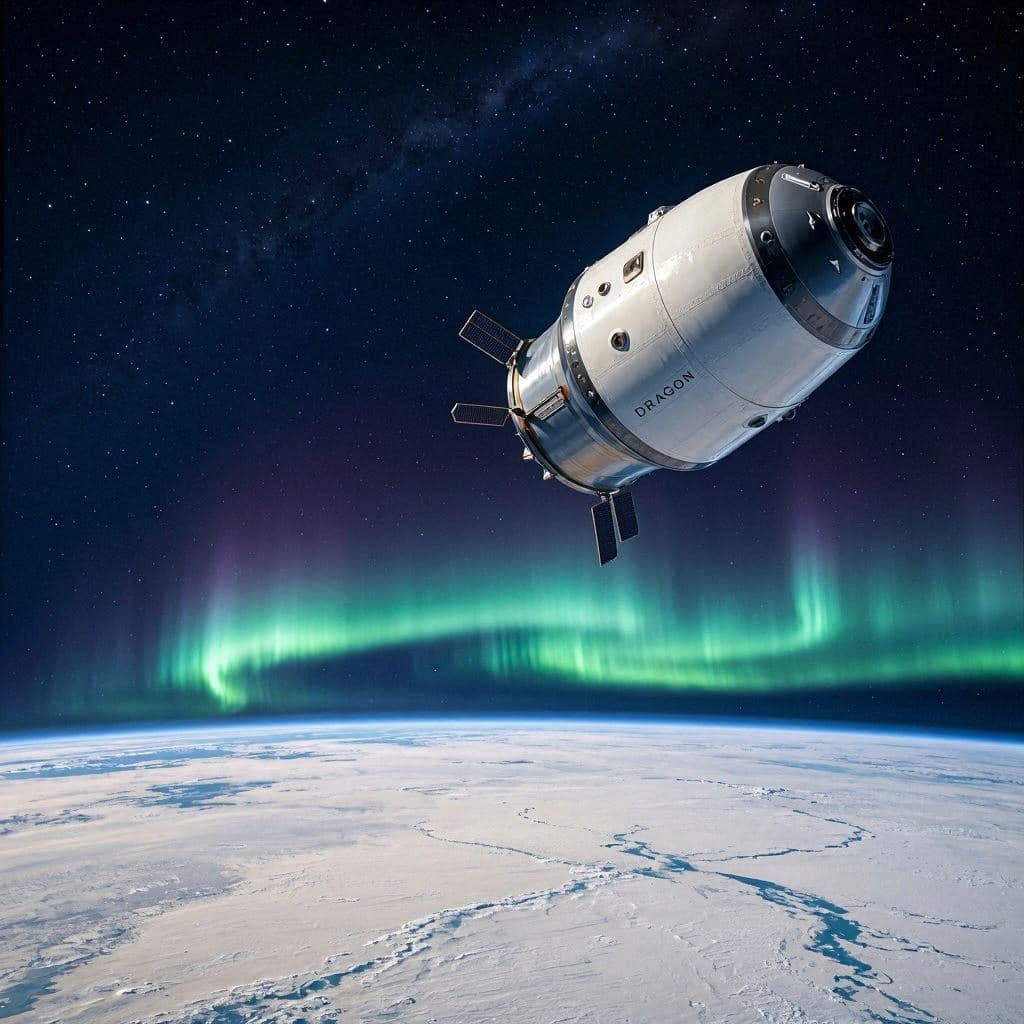
Some journeys redraw maps, while others quietly redefine the meaning of exploration itself. The path traced by the Fram2 mission did not cross continents or oceans in the familiar sense. Instead, it curved above Earth's northern and southern extremes, offering a perspective that few had imagined possible for a crewed spacecraft. In doing so, the mission added a new chapter to the continuing story of human spaceflight.
Launched in April 2025 aboard a SpaceX Crew Dragon spacecraft, Fram2 carried four private astronauts into a true polar orbit. Unlike the trajectories used by previous crewed missions, the spacecraft passed directly over both the North Pole and the South Pole, allowing the crew to observe regions rarely seen from a human-operated spacecraft. The mission marked the first time people had completed such an orbit.
The mission's name honored the historic Norwegian exploration ship Fram, which carried pioneering expeditions through the Arctic and Antarctic more than a century ago. Just as the original vessel ventured into Earth's most remote frontiers, the spacecraft sought to extend exploration into a different frontier, linking the spirit of polar discovery with modern spaceflight.
Although the mission was privately funded, its objectives extended beyond symbolism. During several days in orbit, the crew conducted scientific experiments, collected Earth observation data, and evaluated how people adapt to unique orbital conditions. Researchers expect some of the findings to contribute to future commercial and scientific missions.
Flying over the poles also offered an uncommon view of Earth's climate systems. From this vantage point, the crew observed expansive ice sheets, cloud formations, and auroral activity that are difficult to see from the lower-inclination orbits commonly used by crewed spacecraft. Such observations complement satellite data and highlight the value of different orbital paths.
The success of Fram2 reflects the changing landscape of space exploration. Commercial companies now work alongside government agencies, expanding opportunities for scientific research, technology demonstrations, and human spaceflight. Rather than replacing national programs, these efforts increasingly complement one another through shared expertise and innovation.
Experts note that missions like Fram2 demonstrate how commercial capabilities continue to evolve. As spacecraft become more versatile and mission planning grows increasingly ambitious, private crews are expected to participate in a wider range of scientific and exploratory activities, opening new possibilities for collaboration across the global space community.
Fram2's journey lasted only a few days, yet its significance may endure far longer. By completing the first crewed mission in a true polar orbit, the expedition showed that exploration continues to find new directions. Even after decades of human spaceflight, Earth still offers perspectives that remind us discovery is not only about traveling farther, but also about seeing familiar places in entirely new ways.
AI Image Disclaimer: The illustrations included with this article are AI-generated artistic visualizations created for editorial purposes and do not depict actual mission photography.
Sources Verified Space.com SpaceX Reuters Associated Press NASA
Published by Banx Network. This article is part of the Banx decentralized media programme, powered by the BXE token on the XRP Ledger.