The history of computing has often been defined by overcoming limitations once considered impossible. From room-sized machines to devices that fit in a pocket, each generation of technology has been shaped by breakthroughs that gradually transformed ambitious ideas into practical tools. Quantum computing now stands at a similar stage of development, where progress depends not only on increasing computational power but also on solving one of the field's greatest technical challenges—reducing errors that naturally arise during quantum operations.
An international team of researchers has announced a significant advance in quantum computing error correction, marking an important milestone toward the development of more reliable quantum computers. The breakthrough focuses on improving methods that detect and correct errors occurring in quantum bits, or qubits, which are highly sensitive to environmental disturbances. Scientists believe the new approach could enhance the stability of future quantum systems while supporting increasingly complex computational tasks.
Unlike conventional computer bits that exist as either zero or one, qubits can occupy combinations of both states through a property known as superposition. This unique capability allows quantum computers to perform certain calculations far more efficiently than classical machines. However, qubits are also exceptionally fragile, with heat, electromagnetic interference, and even minor environmental fluctuations capable of introducing computational errors.
The research team developed an improved error-correction framework that allows quantum information to remain stable for longer periods without significantly increasing computational overhead. By combining advanced coding techniques with more efficient measurement protocols, the researchers demonstrated greater resilience against common sources of quantum noise during laboratory testing. While the experiments were conducted under highly controlled conditions, the results represent encouraging progress toward scalable quantum computing.
Error correction has long been regarded as one of the fundamental requirements for practical quantum computers. Because qubits cannot simply be copied in the same manner as classical data, researchers must employ sophisticated mathematical techniques that distribute quantum information across multiple physical qubits. These systems continuously detect and correct errors while preserving the integrity of delicate quantum states.
Experts note that advances in quantum error correction may accelerate research across multiple scientific disciplines. Future quantum computers could eventually contribute to drug discovery, advanced materials research, climate modeling, financial optimization, and cryptography by solving problems that remain computationally demanding for today's most powerful supercomputers. Although widespread commercial applications are still under development, each improvement brings the technology closer to practical implementation.
Major universities, government laboratories, and technology companies continue investing heavily in quantum research. International collaboration has become increasingly important as scientists combine expertise in physics, computer science, engineering, and mathematics to address the complex challenges involved in building fault-tolerant quantum systems. Continued progress will likely depend on sustained innovation across both hardware and software development.
The latest achievement demonstrates that quantum computing continues advancing through steady scientific progress rather than dramatic overnight transformation. Each improvement in error correction strengthens the foundation for future generations of quantum technologies, bringing researchers closer to systems capable of performing reliable large-scale computations. As experimental capabilities continue to mature, the field remains one of the most dynamic frontiers in modern science and engineering.
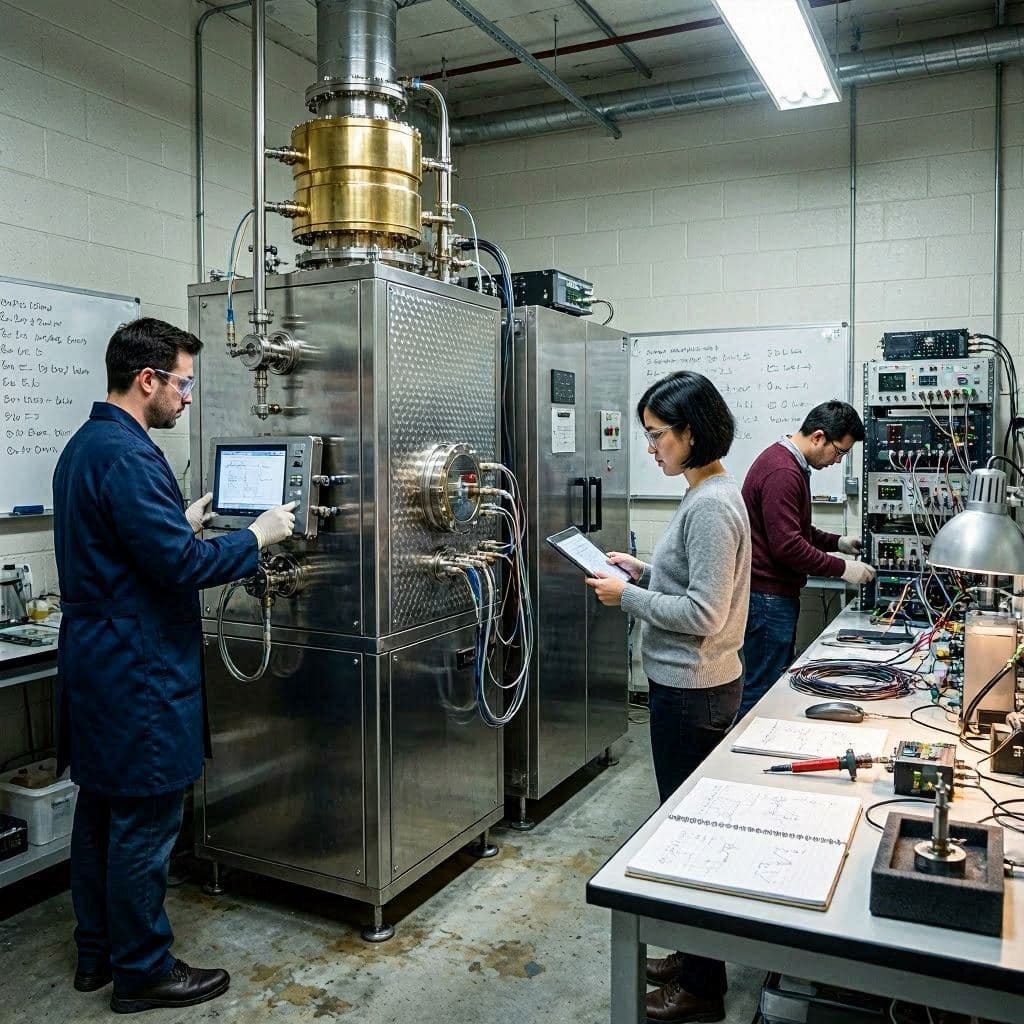
AI Image Disclaimer: This illustration was generated using artificial intelligence to visualize a quantum computing concept and does not represent an actual laboratory or experimental setup.
Sources (verification check): Nature, Science, Reuters, IBM Research, MIT Technology Review
Published by Banx Network. This article is part of the Banx decentralized media programme, powered by the BXE token on the XRP Ledger.