The universe often reveals its greatest mysteries in the briefest of moments. A flash lasting only a fraction of a second can carry clues about distant galaxies, extreme magnetic environments, and physical processes that remain beyond the reach of laboratories on Earth. Such is the fascination surrounding Fast Radio Bursts, or FRBs, which continue to challenge astronomers with every new discovery.
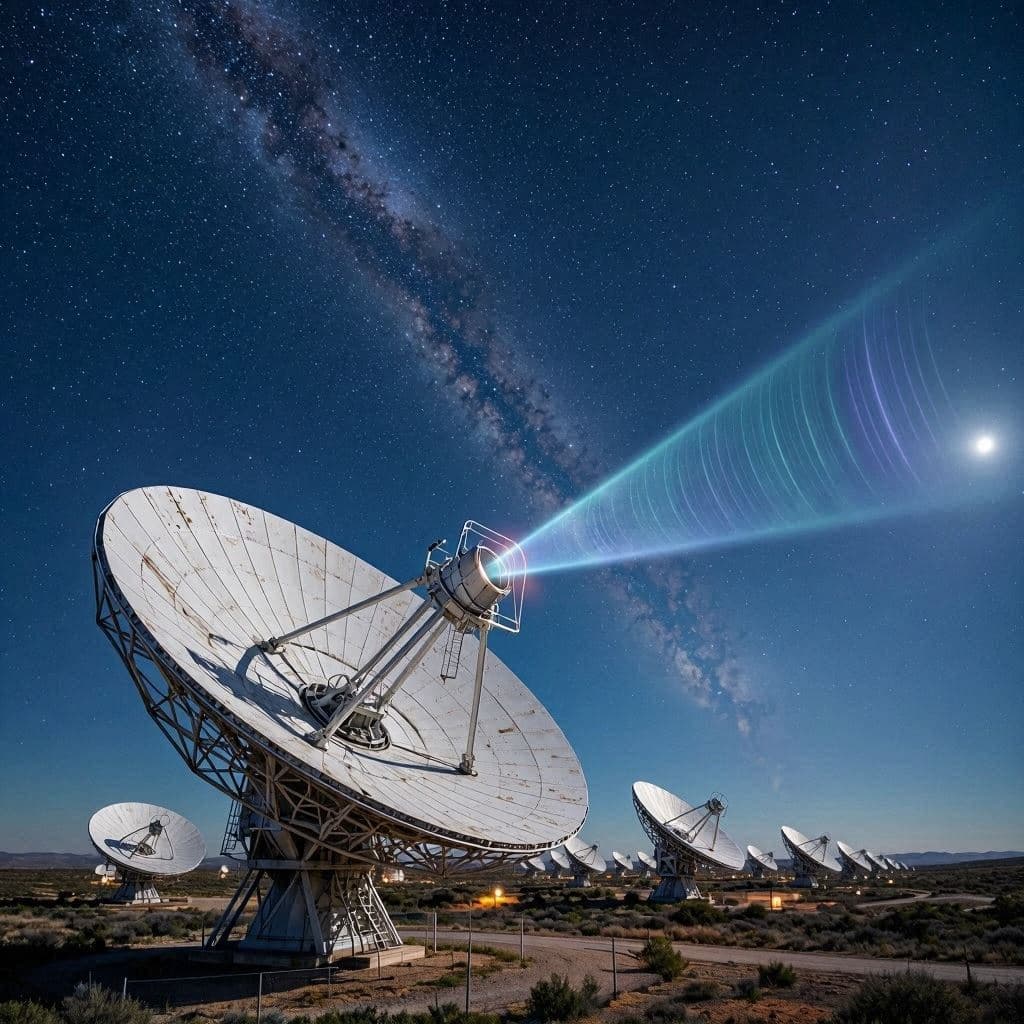
An international team led by Australian researchers has reported detailed observations of FRB20250613A, a repeating Fast Radio Burst first detected by the Australian Square Kilometre Array Pathfinder (ASKAP). The study found that the object displays several unusual characteristics, including rapid variations in signal scattering over timescales of minutes to hours and significant changes in its polarization properties. These observations suggest that the radio bursts travel through an exceptionally turbulent environment before reaching Earth.
Using data collected from ASKAP, the MeerKAT radio telescope in South Africa, and the Murriyang Parkes radio telescope in Australia, researchers analyzed multiple bursts emitted by the source. Their observations revealed measurable changes in rotation measure and depolarization over periods ranging from days to months, indicating the presence of highly magnetized plasma surrounding the source.
The research also identified a recurring separation of approximately 6.8 milliseconds between components of several radio bursts. Scientists suggest this timing pattern may originate from the emission mechanism itself rather than from material located between the source and Earth. If confirmed by future observations, the finding could provide valuable clues about how repeating Fast Radio Bursts are generated.
One of the study's most intriguing conclusions concerns the environment surrounding the burst source. The observations are consistent with the possibility that the FRB originates within the dense stellar wind of a Be-star binary system, where powerful magnetic fields and ionized gas interact with the emitted radio waves. While additional observations will be needed to confirm this scenario, it offers a plausible explanation for the unusually complex behavior recorded during the monitoring campaign.
Fast Radio Bursts have become one of astronomy's most active research fields over the past decade. Although hundreds have now been detected, only a relatively small number are known to repeat, making objects such as FRB20250613A particularly valuable for long-term scientific study. Repeating sources allow astronomers to revisit the same object multiple times and observe how its properties evolve.
Beyond understanding the bursts themselves, FRBs are increasingly used as tools to investigate the structure of the universe. As radio waves travel across billions of light-years, they interact with diffuse gas between galaxies. By measuring these interactions, astronomers can improve estimates of the distribution of ordinary matter throughout the cosmos and refine models describing the evolution of galaxies and the intergalactic medium.
The discovery highlights Australia's continuing role in radio astronomy through facilities such as ASKAP and Murriyang Parkes. As new radio observatories become operational and existing instruments continue monitoring repeating sources, researchers expect additional observations to further clarify the origins of Fast Radio Bursts and deepen our understanding of some of the universe's most energetic phenomena.
AI Image Disclaimer: The accompanying illustrations are AI-generated to visualize the scientific concepts discussed and are not actual telescope images or observational data.
Source Verification Check: arXiv (research preprint), CSIRO, ASKAP collaboration
Published by Banx Network. This article is part of the Banx decentralized media programme, powered by the BXE token on the XRP Ledger.