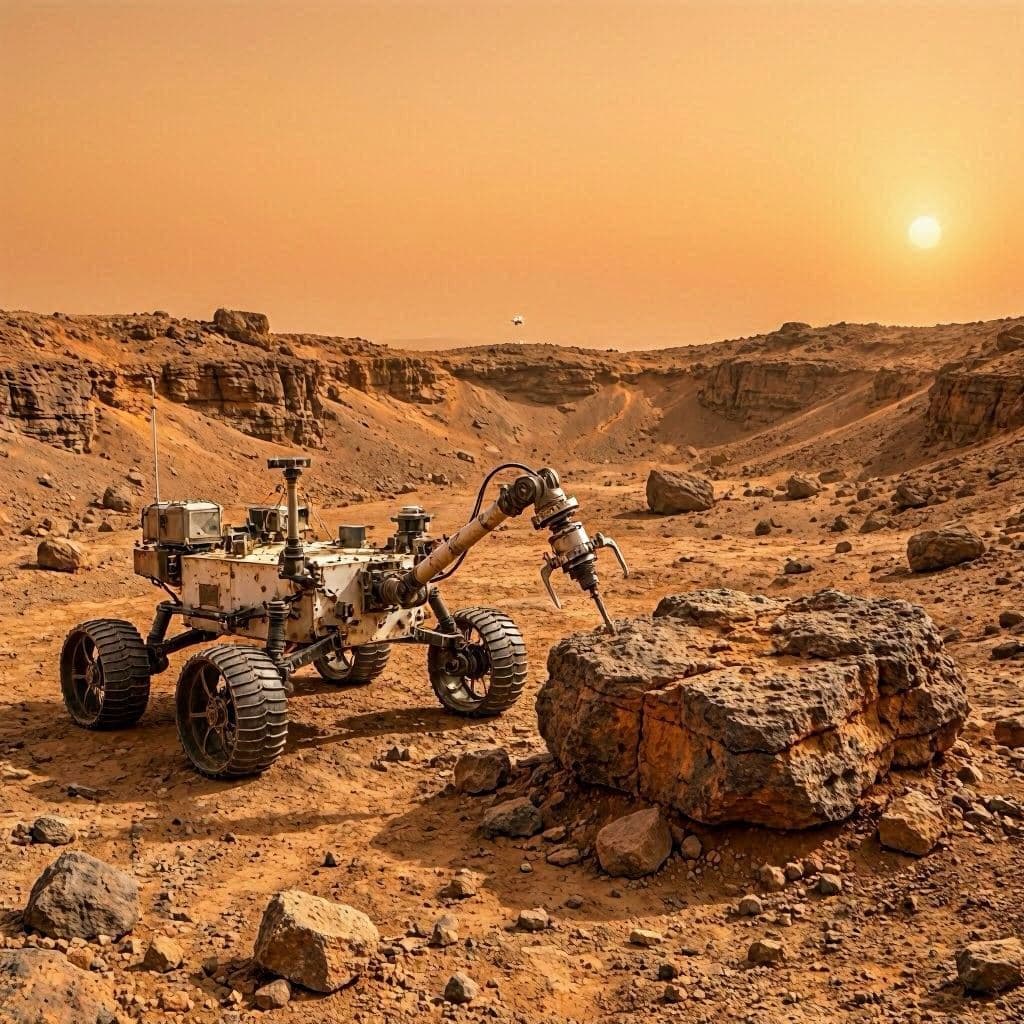
On the dusty surface of Mars, where winds move fine particles across ancient terrain, every rock carries the possibility of a story billions of years old. The Perseverance rover continues its journey through this silent landscape, gathering data that gradually reshapes humanity’s understanding of the red planet.
Body: NASA’s Perseverance mission is designed to study Mars’ geology and assess whether the planet ever had conditions suitable for microbial life. Its instruments are capable of analyzing rock composition, detecting chemical compounds, and collecting detailed environmental data.
Recent reports indicate that the rover has identified materials consistent with complex organic compounds. In scientific terms, “organic” refers to carbon-based molecules, which can form through both biological and non-biological processes.
This distinction is crucial. While organic molecules are considered essential building blocks for life as we know it, their presence alone does not confirm biological activity. Geological processes, radiation-driven reactions, and meteorite impacts can also produce such compounds.
The Jezero Crater, where Perseverance is operating, is of particular scientific interest because it once contained a lake billions of years ago. Sedimentary rocks in this region may have preserved chemical signatures from that ancient environment.
Scientists on Earth carefully analyze the rover’s transmitted data, comparing it with previous Mars missions and laboratory simulations. This step-by-step validation process ensures that interpretations remain grounded in reproducible evidence.
Although the findings are intriguing, researchers emphasize caution. Each new result contributes to a broader dataset rather than a standalone conclusion. Over time, these combined observations may help clarify Mars’ environmental history.
Closing: As Perseverance continues its exploration, scientists will refine their understanding of Mars’ chemical landscape. The discovery of organic materials adds another piece to a long-running investigation into the planet’s ancient conditions.
AI Image Disclaimer: This article includes AI-generated visuals intended solely for editorial illustration purposes.
Sources (source verification check): NASA, Jet Propulsion Laboratory (JPL), Nature Astronomy, Science Daily
Published by Banx Network. This article is part of the Banx decentralized media programme, powered by the BXE token on the XRP Ledger.