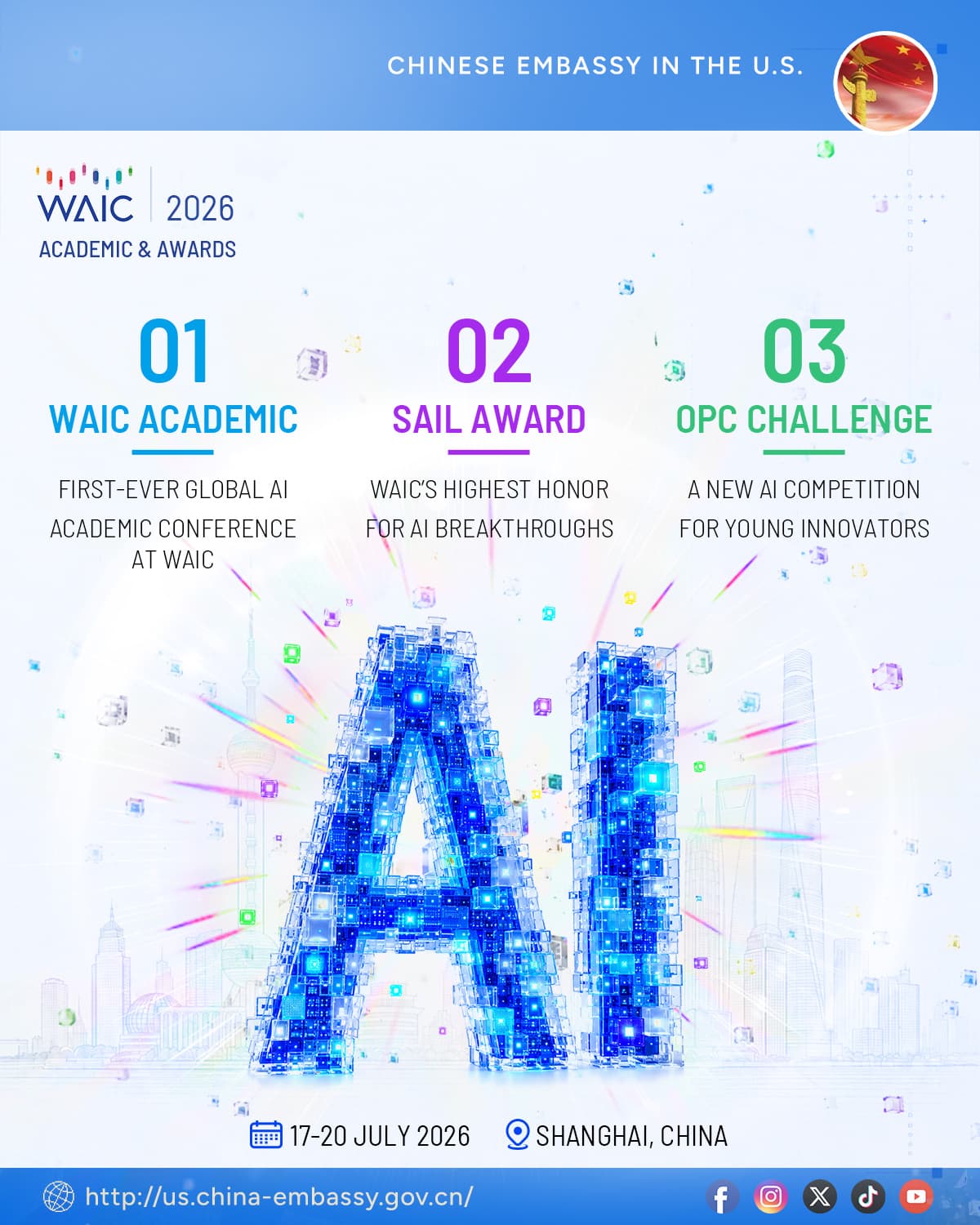
China is expanding its efforts to position itself as a global leader in artificial intelligence by promoting the 2026 World Artificial Intelligence Conference (WAIC), an event designed to bring together researchers, technology companies, universities and policymakers from around the world. The Chinese Embassy highlighted the conference's international focus, stating that WAIC 2026 will unite global experts, leading institutions and young innovators in Shanghai to accelerate AI research, technological development and international cooperation. The conference agenda features three flagship initiatives aimed at advancing artificial intelligence innovation. These include the inaugural WAIC Academic Conference, the prestigious SAIL Award recognizing significant AI breakthroughs, and the OPC Challenge, a competition encouraging emerging innovators to develop next-generation AI solutions. Chinese officials view the event as an opportunity to strengthen international collaboration despite growing geopolitical competition surrounding advanced technologies. Artificial intelligence has become one of the world's fastest-growing strategic industries, influencing sectors including healthcare, finance, manufacturing, transportation, cybersecurity and scientific research. The conference is expected to attract executives from major technology firms, university researchers, startup founders, venture capital investors and government representatives seeking partnerships and investment opportunities within the expanding AI ecosystem. China has invested heavily in AI infrastructure over recent years through semiconductor development, cloud computing expansion, robotics research and machine learning applications. Officials have repeatedly identified artificial intelligence as a priority industry capable of driving long-term economic growth and industrial modernization. WAIC has steadily grown into one of Asia's most influential technology conferences, showcasing advances in generative AI, autonomous systems, humanoid robotics, large language models and enterprise automation. The SAIL Award remains one of the event's highest honors, recognizing researchers and organizations whose innovations demonstrate meaningful technological progress with real-world applications. Previous recipients have included companies and academic institutions responsible for significant advances in artificial intelligence. Meanwhile, the OPC Challenge seeks to encourage young innovators by providing a global platform where students, startups and research teams can present breakthrough ideas while competing for recognition from industry experts. The event comes amid intensifying global competition in AI regulation, semiconductor development and digital infrastructure. Governments worldwide are increasing investments while simultaneously developing policies to address issues including AI safety, data governance, cybersecurity and responsible deployment. Industry analysts expect WAIC 2026 to generate announcements involving research partnerships, commercial product launches and international collaborations that could shape future AI development across multiple industries. While geopolitical tensions continue influencing technology policy worldwide, conferences like WAIC provide opportunities for dialogue between governments, businesses and researchers seeking common standards and shared innovation goals. As artificial intelligence continues transforming the global economy, events promoting international cooperation may play an increasingly important role in accelerating research while encouraging responsible development across borders.
Published by Banx Network. This article is part of the Banx decentralized media programme, powered by the BXE token on the XRP Ledger.