

Key Highlights
- Australia introduces a national framework for AI data centers to minimize water consumption.
- Prime Minister Anthony Albanese announces plans for an Office of AI to oversee national policy.
- New regulations aim to balance technological growth with environmental sustainability.
Australia is taking significant steps to ensure that the rapid expansion of artificial intelligence (AI) is accompanied by responsible resource management. The government has announced a new national framework that mandates large AI data centers to minimize their water consumption. This initiative, unveiled by Prime Minister Anthony Albanese, is part of a broader strategy to establish an Office of AI, which will coordinate national AI policy and regulation across various government sectors.
The proposed framework aims to strike a balance between investment in AI technologies and the need for environmental sustainability. Under the new rules, operators of major AI data centers will be required to adopt water-efficient practices. Additionally, they will need to take greater responsibility for their energy consumption. This includes underwriting or providing their own electricity supply, covering grid connection costs, and reducing the strain on Australia's power network during peak demand periods. These measures are designed to prevent the expansion of digital infrastructure from imposing additional costs on households or overburdening public resources.
The initiative reflects a growing awareness of the environmental impact associated with AI computing. Data centers, which are essential for running advanced AI systems, primarily use water for cooling high-performance servers. As the demand for AI technologies increases, so too does the need for efficient resource management. The Australian government hopes that by promoting more efficient cooling technologies and careful resource planning, it can support ongoing innovation while mitigating environmental impacts.
In addition to environmental requirements, the proposed framework introduces broader national standards for AI development. The government plans to enhance copyright protections, establish clearer approval processes for AI infrastructure, and create consistent regulations across Australia's states and territories. Officials assert that these reforms are intended to provide certainty for the industry while maintaining public confidence in the country's digital transformation.
Environmental organizations have generally welcomed the government's commitment to stronger oversight. However, they continue to advocate for a careful assessment of future data center projects. Some community groups argue that rapid infrastructure expansion should only proceed once comprehensive national standards are fully implemented, particularly in regions where water and energy resources are already under significant pressure.
Industry representatives have expressed support for the establishment of clearer national rules but emphasize that successful implementation will require coordination among governments, utilities, and technology companies. Many operators have already begun investing in renewable energy sources, advanced cooling systems, and more efficient facility designs to reduce both energy and water consumption as the demand for AI continues to grow.
Australia's proposed framework is part of a broader international movement to ensure that artificial intelligence develops in a responsible manner. By prioritizing environmental stewardship alongside technological innovation, the country aims to create an AI ecosystem that fosters economic growth while preserving the natural resources essential for future generations.
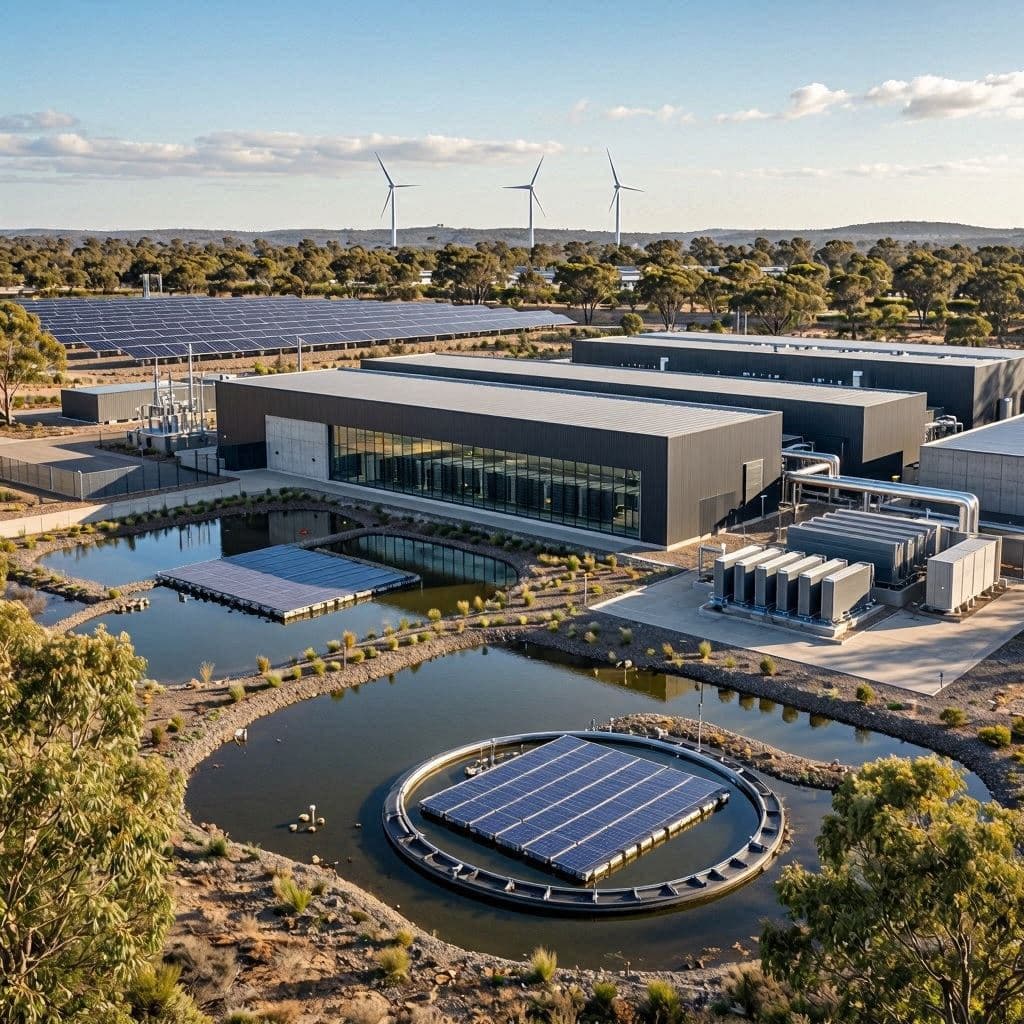
AI Image Disclaimer: The accompanying illustrations are AI-generated for editorial visualization and are intended to represent the topic rather than actual government meetings or data center facilities.
Published by Banx Network. This article is part of the Banx decentralized media programme, powered by the BXE token on the XRP Ledger.




