
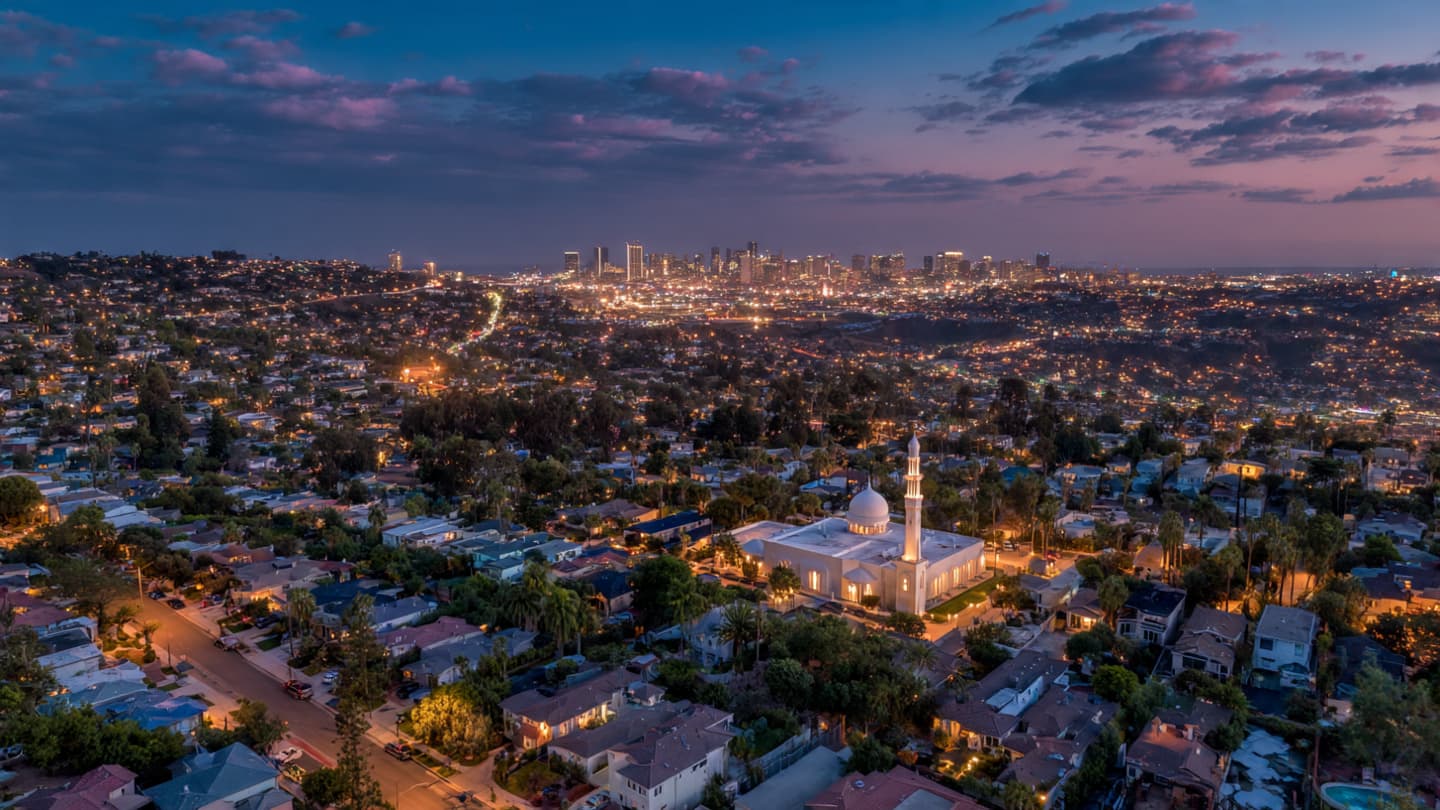
The evening air in San Diego often carries a softness shaped by ocean wind and fading sunlight. In neighborhoods scattered between hills and highways, daily life moves quietly toward nightfall — families returning home, traffic thinning along wide boulevards, places of worship filling briefly before their lights dim again. At mosques across the city, evening prayers usually unfold in calm repetition: shoes lined neatly near entrances, murmured greetings in hallways, familiar voices echoing gently beneath high ceilings.
This week, that rhythm was broken by violence.
Authorities in San Diego are continuing to investigate a deadly shooting at a mosque that left members of the local Muslim community grieving and searching for answers. Police responded rapidly after reports of gunfire near the place of worship, where worshippers and community members had gathered during evening hours. Officials confirmed fatalities and injuries, though investigators are still piecing together the precise sequence of events and the possible motive behind the attack.
In the immediate aftermath, the area surrounding the mosque shifted from sacred quiet to emergency response. Patrol vehicles blocked nearby streets beneath flashing red and blue lights. Ambulances moved in and out of the scene while families waited anxiously for information about relatives and friends. Witnesses described confusion, panic, and the sudden collapse of ordinary routine into fear.
Mosques, like churches, synagogues, and temples, often function as more than religious buildings. They become gathering places shaped by memory and familiarity — places where children study after school, elders share meals, and immigrant communities maintain connection through language, prayer, and tradition. Violence inside or near such spaces therefore carries a particularly deep emotional impact, extending beyond physical harm into the sense of safety communities attach to worship itself.
San Diego’s Muslim population is large and diverse, reflecting generations of immigration and cultural exchange tied to Southern California’s international character. Across the city and surrounding county, mosques serve communities with roots stretching from the Middle East and South Asia to East Africa and beyond. In moments of crisis, those networks often respond quickly, organizing vigils, support services, and spaces for collective mourning.
Officials have not yet released all details surrounding the shooting, though investigators continue examining evidence, interviewing witnesses, and determining whether the incident may have been motivated by religious hatred, personal grievance, or other factors. Law enforcement agencies, including federal authorities, are reportedly involved in aspects of the investigation as community leaders call for both transparency and calm.
The shooting arrives during a period when concerns about violence targeting religious communities remain deeply present across the United States. Over recent years, attacks involving churches, synagogues, mosques, and other public gathering spaces have left lingering anxiety in communities already navigating polarization, online extremism, and rising fears surrounding public safety.
Yet alongside grief, moments like this often reveal quieter forms of solidarity.
Messages of support emerged quickly from interfaith organizations, local leaders, and neighboring religious communities across California. Vigils were organized. Flowers and handwritten notes appeared near the mosque entrance. Public officials spoke about protecting freedom of worship and preserving the sense of openness that defines many American communities despite repeated episodes of violence.
There is something especially painful about violence entering spaces built around reflection and peace. The architecture of worship — prayer rugs, wooden pews, stained glass, calligraphy, candles — exists partly to create distance from the noise and unpredictability of the outside world. When that sanctuary is disrupted, even briefly, the emotional rupture extends far beyond a single building.
Meanwhile, investigators continue reconstructing timelines and examining digital evidence, surveillance footage, and witness testimony. Questions remain about the suspect, the circumstances leading to the attack, and whether warning signs existed beforehand. For families directly affected, however, the search for explanation unfolds alongside more immediate realities: hospital visits, funeral preparations, unanswered phone calls, and the slow shock that follows sudden tragedy.
As night settles once more across San Diego’s neighborhoods, the mosque stands under a different kind of silence now — one shaped not only by mourning, but by resilience. Community members continue gathering there, despite fear, carrying meals to grieving families, standing shoulder to shoulder during prayer, and trying to reclaim familiarity from violence.
Beyond the investigation and headlines, that quieter effort may become part of the story too: the attempt to preserve trust, dignity, and belonging after a place meant for reflection became the center of grief.
And beneath California’s calm coastal skies, a city continues searching for understanding in the aftermath of a night that altered the rhythm of an ordinary evening forever.
AI Image Disclaimer These visuals were generated using AI tools to illustrate the setting and atmosphere described in the article and are not authentic photographs.
Sources Associated Press Reuters CNN BBC News San Diego Union-Tribune
Note: This article was published on BanxChange.com and is powered by the BXE Token on the XRP Ledger. For the latest articles and news, please visit BanxChange.com