
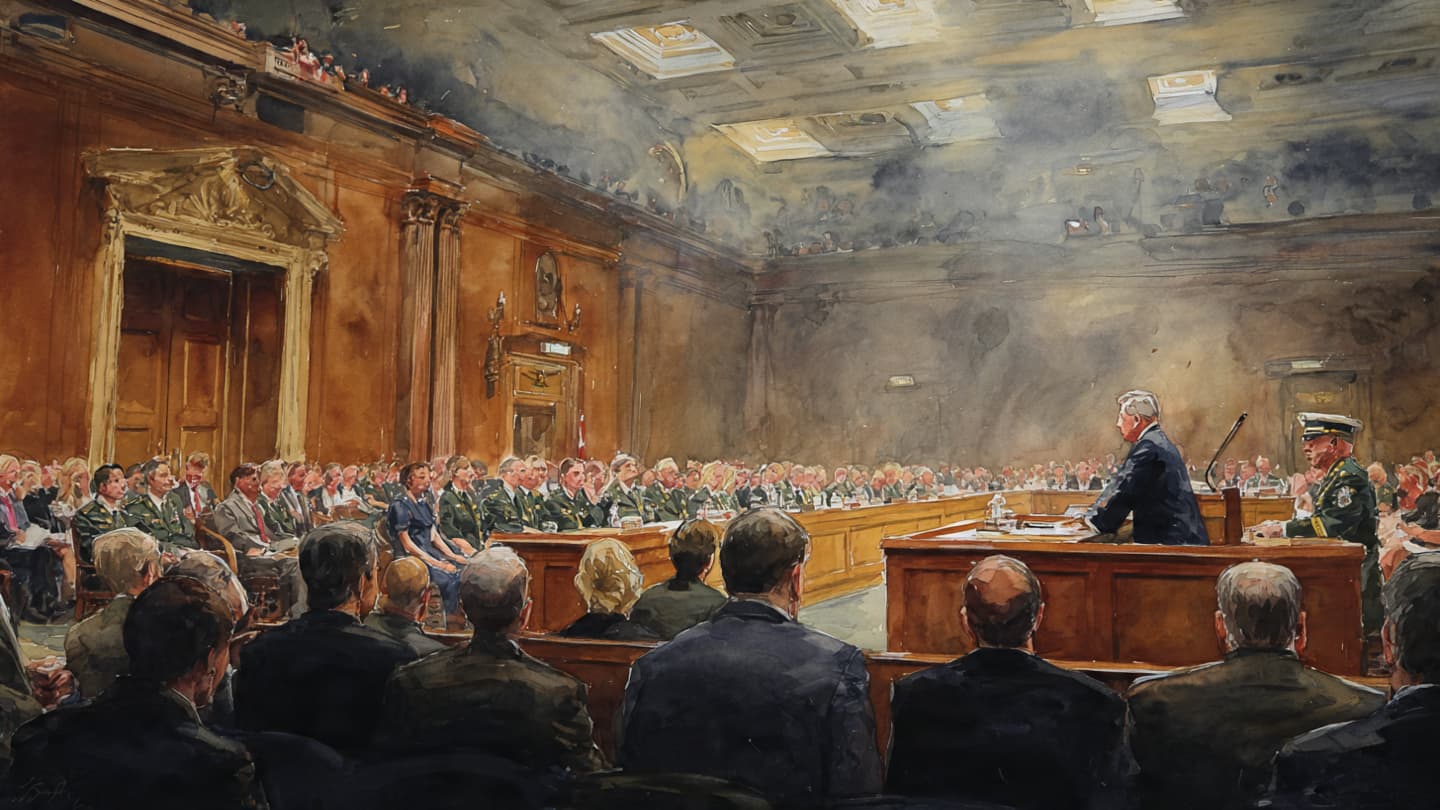
The language of global politics often moves like weather across an open sea—sometimes calm, sometimes restless, and occasionally filled with distant thunder before storms fully arrive. In Washington this week, that atmosphere unfolded inside congressional chambers as senior American military officials faced intense questioning over tensions involving Iran, while abroad, Russian President Vladimir Putin and Chinese President Xi Jinping continued voicing criticism toward former President Donald Trump’s foreign policy posture.
The congressional hearing reflected growing concern among U.S. lawmakers regarding the possibility of wider instability in the Middle East. Members of Congress reportedly questioned military leaders about contingency planning, regional deployments, and the risks associated with escalating confrontation between Washington and Tehran. The discussions came amid renewed diplomatic uncertainty surrounding nuclear negotiations and maritime security in the Gulf region.
Several lawmakers raised concerns about whether current military strategies could unintentionally deepen regional tensions rather than contain them. Questions reportedly focused on deterrence policies, the movement of naval assets, and the potential consequences of miscalculation in already fragile geopolitical conditions. Military officials responded by emphasizing preparedness while reiterating that diplomatic solutions remain preferable whenever possible.
At nearly the same moment, geopolitical pressure was also building on another front. During recent talks in Beijing, Putin and Xi criticized what they described as unilateral approaches in global affairs, comments widely interpreted as indirect criticism of Trump-era international policies and broader Western influence. The two leaders warned that global stability could weaken further if major powers prioritize confrontation over cooperation.
The parallel developments highlighted how interconnected global crises have become. A congressional debate in Washington now echoes across diplomatic halls in Beijing and Moscow, while decisions surrounding sanctions, military positioning, and trade relationships increasingly shape international alignments. In this environment, even carefully worded statements can carry significant geopolitical meaning.
Observers noted that the criticism from Russia and China also reflects deeper concerns about the future structure of international institutions. Both governments have repeatedly argued for a multipolar world order in which power is distributed more evenly among nations, rather than concentrated around a single dominant bloc. While disagreements remain substantial, the rhetoric illustrates a continuing shift in how global influence is being debated.
Meanwhile, concerns surrounding Iran remain central to broader regional stability. International analysts continue warning that unresolved disputes involving sanctions, uranium enrichment, and military presence in strategic waterways could increase the risk of unintended escalation. At the same time, several diplomatic channels reportedly remain open, offering some room for negotiation despite visible tensions.
For ordinary citizens far removed from these political arenas, such developments may appear distant, yet they influence global markets, energy prices, and international security calculations that shape daily life in subtle ways. The language of diplomacy often sounds abstract, but its consequences can ripple quietly across economies and societies worldwide.
As hearings continue in Washington and diplomatic exchanges unfold abroad, governments appear increasingly aware that managing rivalry may become just as important as pursuing victory itself. In a world defined by overlapping tensions, restraint and dialogue remain among the few tools capable of slowing deeper division.
Visual illustrations accompanying this article were generated with the assistance of artificial intelligence.
Sources Verified: Reuters, The Guardian, Associated Press, Axios
Note: This article was published on BanxChange.com and is powered by the BXE Token on the XRP Ledger. For the latest articles and news, please visit BanxChange.com