Most rainbows belong to the daytime, appearing briefly after storms as sunlight bends gently through suspended droplets. Yet on rare nights beneath a full moon, another kind of arc quietly forms in the darkness. Known as a moonbow, the phenomenon appears pale and elusive, often hidden from casual sight, like a whisper of color moving through the night sky.
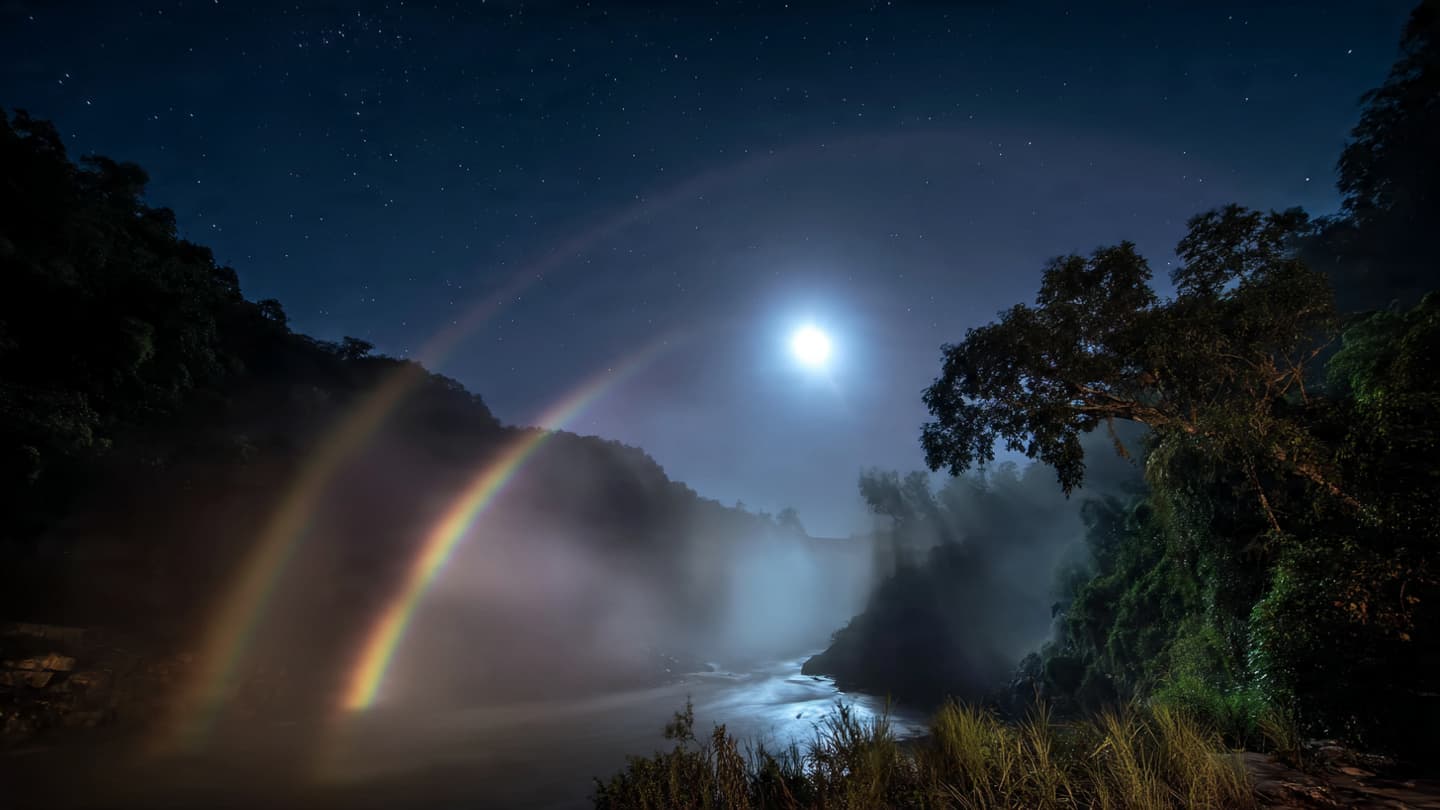
Unlike traditional rainbows created by direct sunlight, moonbows emerge when bright moonlight refracts through moisture in the air. The conditions required are unusually precise. A nearly full moon must sit low in a dark sky while rain, mist, or waterfall spray drifts opposite the light source. Even then, the spectacle may last only a short time before clouds or shifting weather erase it again.
Scientists describe moonbows as relatively uncommon because moonlight is far dimmer than sunlight. Human eyes often perceive them as white or silver arches rather than vividly colored bands. Cameras with longer exposure settings, however, can reveal the softer reds, blues, and greens hidden within the arc.
Certain regions around the world are known for more frequent moonbow appearances. Waterfalls with constant mist, such as those near Victoria Falls in southern Africa or Cumberland Falls in the United States, provide ideal environments. Tourists and photographers sometimes travel specifically during full moon periods hoping to witness the rare display.
Researchers say moonbows also offer a reminder of how familiar natural processes can still feel extraordinary under different conditions. The physics behind them is well understood, yet the visual experience continues to inspire fascination because of its rarity and quiet appearance against the darkness.
Astronomers note that the phenomenon has gained wider attention through improved nighttime photography and social media sharing. Images that once might have remained isolated among local observers can now circulate globally within hours, allowing more people to encounter events they may never see directly.
At the same time, scientists caution that increasing light pollution may reduce visibility in some areas. Artificial nighttime lighting can wash out dim celestial and atmospheric phenomena, making moonbows harder to observe from urban environments. Dark skies remain an important factor in preserving such natural experiences.
For many observers, moonbows carry a feeling different from daytime rainbows. Their faintness demands patience and stillness. Rather than arriving with dramatic brightness, they emerge softly, almost blending into the night itself. In that quietness, the spectacle often feels less like an announcement and more like a hidden detail briefly revealed.
As interest in astronomy and natural phenomena continues to grow, moonbows remain one of the sky’s more delicate reminders that even familiar elements—light, water, and darkness—can combine in unexpected ways under the right conditions.
AI-generated image disclaimer: Some visuals connected to this article were created using AI-generated artistic rendering.
Sources: NASA, National Geographic, Space.com, BBC Sky at Night Magazine
Published by Banx Network. This article is part of the Banx decentralized media programme, powered by the BXE token on the XRP Ledger.