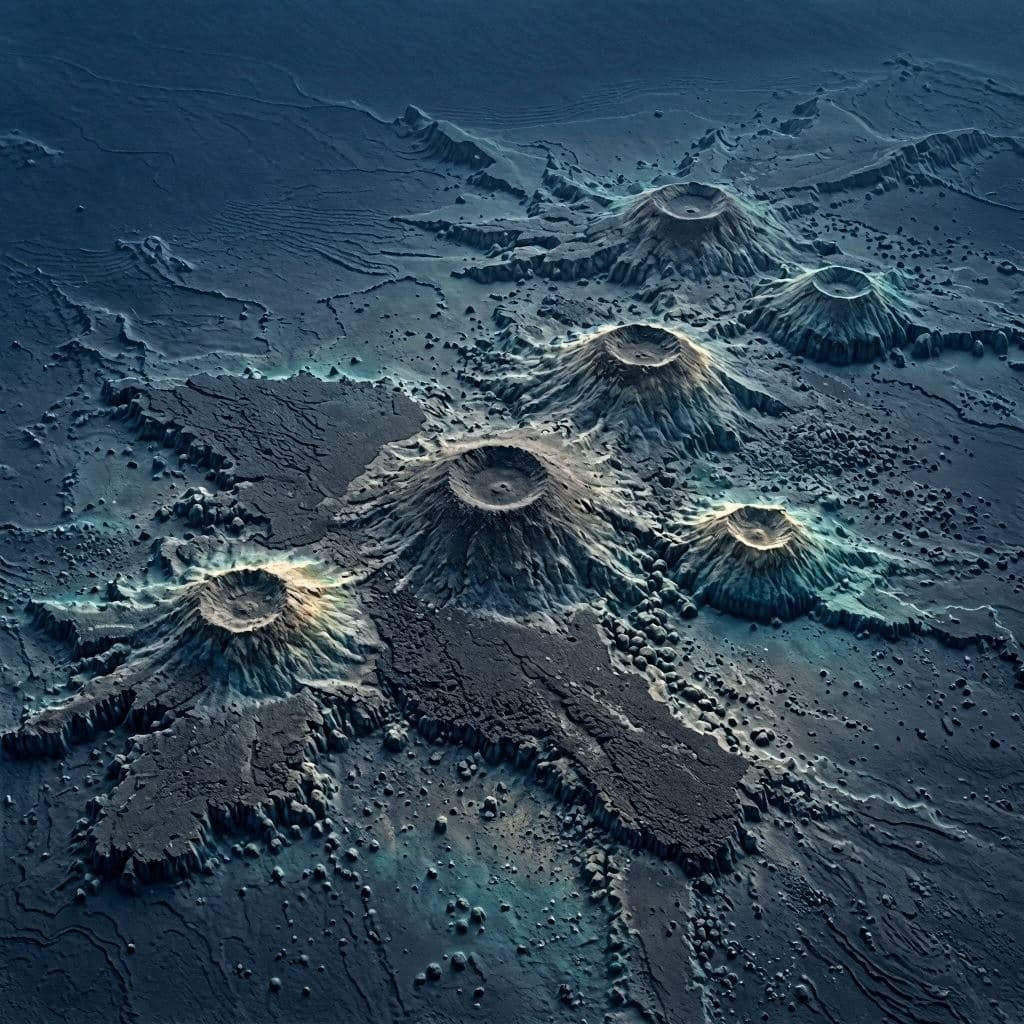
The sea often appears calm from the shore, its surface reflecting little of the stories unfolding beneath it. Yet below those familiar waters, Earth's geological history continues to reveal chapters that have remained concealed for thousands of years. Off the southwestern coast of Sicily, researchers have uncovered six previously undocumented underwater volcanoes, reminding scientists that even well-traveled marine regions can still hold remarkable surprises.
The discovery emerged during detailed geological surveys of the Sicilian Channel, an area shaped by the complex interaction between the African and Eurasian tectonic plates. Using high-resolution bathymetric mapping, magnetic measurements, and seismic imaging, researchers identified six volcanic edifices located between approximately 7 and 23 kilometers (4 to 14 miles) from Sicily's shoreline. The findings were published in the peer-reviewed journal Marine Geology.
Among the newly identified structures, the volcano named Actea attracted particular attention because it lies closest to the coast and displays evidence of a comparatively younger lava flow. Geological analysis suggests that while all six volcanoes formed during ancient volcanic activity, Actea experienced a later phase of magmatic reactivation after the Last Glacial Maximum, distinguishing it from the other submarine volcanoes in the group.
The volcanoes themselves are modest compared with famous mountains such as Mount Etna, rising roughly 16 to 107 meters (52 to 350 feet) above the surrounding seafloor. Nevertheless, their location within relatively shallow waters makes them scientifically significant. Their discovery improves researchers' understanding of how magma migrated through fault systems beneath the Sicilian Channel and how volcanic activity has evolved in the central Mediterranean over thousands of years.
Scientists determined the volcanic origin of these formations by combining multiple investigative techniques. Three-dimensional maps revealed crater-like shapes, while magnetic surveys detected signatures characteristic of volcanic rocks. Seismic profiles further exposed buried geological structures beneath the seabed, allowing researchers to distinguish volcanic features from ordinary underwater hills and sedimentary formations.
Although the newly documented volcanoes are not considered an immediate threat, researchers emphasize the importance of continued monitoring. The Mediterranean has a long history of submarine volcanism, including the brief appearance of Ferdinandea Island in 1831 after an underwater eruption. Understanding these hidden volcanic systems contributes to more accurate assessments of geological hazards affecting nearby coastal communities and maritime traffic.
The discovery also underscores how much remains unknown beneath Earth's oceans. While satellites have transformed the study of continents, large portions of the seafloor remain comparatively unexplored. Advances in marine geophysics now allow scientists to detect subtle geological structures that would have gone unnoticed only a generation ago, steadily expanding humanity's understanding of the planet's hidden landscapes.
Rather than rewriting the geological history of Sicily, the discovery enriches it with new evidence gathered through careful observation and modern technology. The six underwater volcanoes add another piece to the Mediterranean's complex tectonic puzzle and demonstrate that scientific exploration continues to reveal meaningful discoveries, even in regions that have been studied for centuries.
AI Image Disclaimer: The illustrations accompanying this article are AI-generated visual representations based on published scientific research and are intended to aid understanding rather than depict actual survey imagery.
Sources (Verified):
Marine Geology National Geographic Italian National Institute of Oceanography and Experimental Geophysics (OGS) Live Science
Published by Banx Network. This article is part of the Banx decentralized media programme, powered by the BXE token on the XRP Ledger.