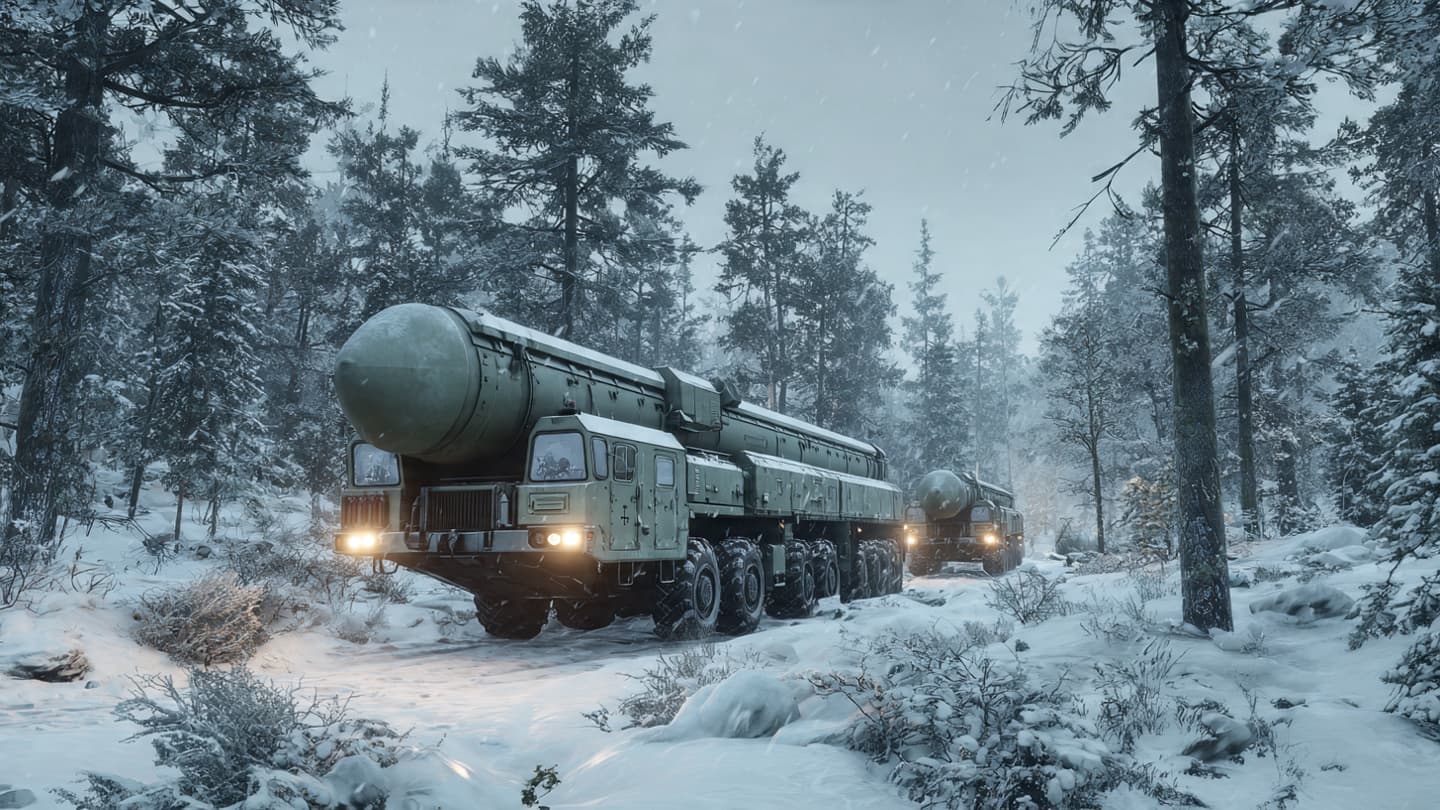
In the far northern reaches of Russia, where forests stretch endlessly beneath pale skies and railway lines disappear into frost-covered distance, movement has returned to military fields long shaped by the rituals of deterrence. Submarines cut silently through cold waters. Missile launch crews rehearse sequences practiced over generations. Radar stations glow against the darkness of approaching winter, their screens tracing invisible arcs across the atmosphere.
This week, Russia conducted large-scale drills involving its strategic nuclear forces, bringing together land-based missile systems, long-range bombers, and nuclear-capable submarines in what officials described as a routine exercise of readiness and command coordination. The maneuvers unfolded against the backdrop of continued tensions with NATO and the prolonged war in Ukraine, where the language of military signaling has increasingly become part of daily geopolitical life.
The exercises, announced by the Kremlin and overseen by President Vladimir Putin, reportedly included test launches of ballistic and cruise missiles from multiple regions across Russia. State media presented the drills as demonstrations of preparedness and strategic stability, emphasizing the functioning of command systems and the coordination between branches of the armed forces. Such exercises are not uncommon in Russia’s military calendar, yet each occurrence now resonates differently in a world already strained by prolonged confrontation and uncertainty.
Across Europe, the announcement arrived with familiar unease. For many countries bordering Russia or watching events from nearby capitals, military exercises involving nuclear forces carry a symbolic gravity beyond their technical details. They revive memories layered deep within the continent’s political consciousness — decades when missile silos, submarine routes, and air defense systems shaped the rhythm of global anxiety. The Cold War may belong to history books, yet its atmosphere lingers in gestures, doctrines, and carefully calibrated warnings.
In Moscow, officials framed the drills as defensive and procedural, part of maintaining strategic balance amid what they describe as increasing pressure from Western governments and NATO military expansion. Since the invasion of Ukraine, Russian authorities have repeatedly tied nuclear rhetoric to broader disputes over security architecture in Europe. Military exercises, troop deployments, and strategic messaging have become woven together into a larger narrative of endurance and confrontation.
Far from political chambers, however, the machinery of deterrence often unfolds in landscapes marked by silence. Along Arctic coastlines, submarines emerge briefly through icy waters before vanishing again beneath the sea. In remote missile fields, crews operate within rigid schedules beneath windswept towers and frozen terrain. The scale of nuclear infrastructure can feel strangely detached from ordinary life, existing in distant forests and underground complexes few civilians will ever see. Yet its presence shapes diplomacy, markets, alliances, and the quiet calculations of governments around the world.
The timing of the drills also reflects a broader atmosphere of military signaling that has intensified across multiple regions in recent years. NATO has expanded exercises along its eastern flank, while Russia continues reinforcing strategic messaging through visible demonstrations of military capability. Each movement becomes part of a larger conversation conducted not only through speeches and treaties, but through formations at sea, aircraft routes, missile trajectories, and televised command briefings.
Analysts observing the exercises noted that such drills serve multiple audiences at once. They reassure domestic constituencies, signal resolve to adversaries, and remind allies of existing strategic balances. Yet they also underscore the fragility of communication in periods of heightened mistrust. In an era shaped by rapid information flows and compressed political timelines, displays intended as deterrence can sometimes deepen uncertainty rather than reduce it.
Meanwhile, ordinary life across Russia and Europe continues beneath the shadow of these distant calculations. Trains still cross snowy borders. Cafés in Warsaw, Helsinki, and Moscow remain filled with evening conversation. Cargo ships move through Baltic waters under gray autumn skies. Much of modern geopolitics unfolds this way — immense strategic forces operating alongside the continuity of civilian routine, each world aware of the other but never entirely touching.
For now, the drills have concluded without incident, according to Russian officials, who described the exercises as successful demonstrations of operational readiness. Western governments continue monitoring strategic developments closely, while diplomatic relations between Moscow and NATO remain tense and limited. The exercises may pass from headlines within days, yet their deeper resonance lingers longer, carried through a continent still shaped by the memory of divided eras and unfinished rivalries.
And so, beneath the northern sky, the choreography of deterrence continues — quiet, methodical, immense — reminding the world how power is often measured not only by movement, but by the silence that follows it.
AI Image Disclaimer: Illustrations were generated with AI and are intended to visually represent the themes of the story.
Sources Reuters Associated Press BBC News The Moscow Times Al Jazeera
Published by Banx Network. This article is part of the Banx decentralized media programme, powered by the BXE token on the XRP Ledger.