
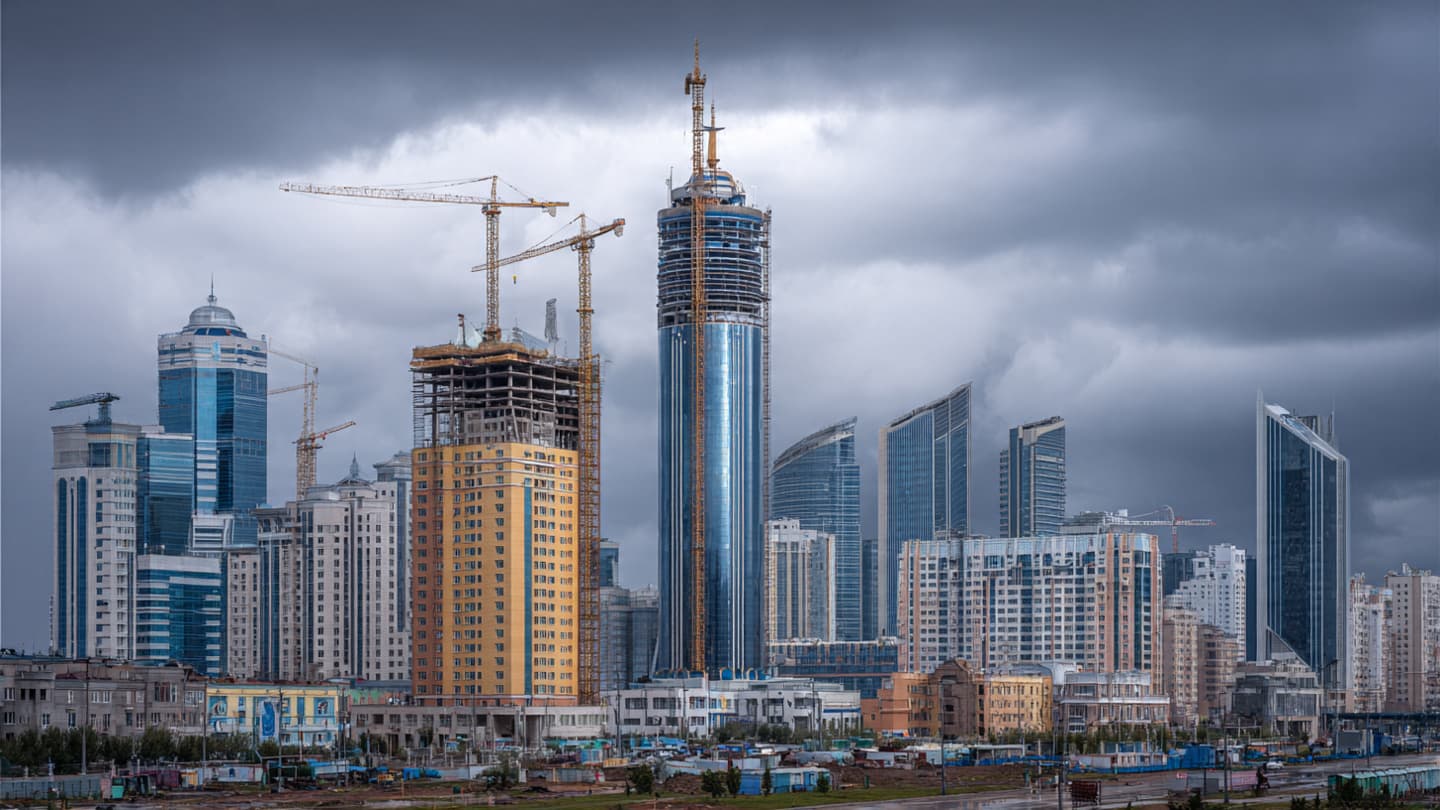
In Kazakhstan’s larger cities, construction cranes continue moving above widening roads and glass towers, even as conversations surrounding the global economy grow more restrained. Cafés remain crowded, freight trains continue crossing the steppes, and industrial centers carry on beneath pale skies that seem unchanged by international forecasts. Yet behind this outward continuity, economists have begun speaking in quieter, more measured tones about the years ahead.
Financial institutions and regional analysts expect Kazakhstan’s economy to remain resilient despite projections of slower growth during the coming period. While expansion is anticipated to continue, global market conditions, energy price fluctuations, and regional economic uncertainties are expected to moderate the pace compared to earlier forecasts.
Kazakhstan’s economy remains heavily influenced by energy exports, trade flows, infrastructure development, and industrial investment. The country’s strategic geographic position between Europe and Asia has also strengthened its role within regional transport and logistics networks, helping sustain economic activity even during periods of broader international volatility.
Development agencies note that Kazakhstan has maintained relative economic stability through diversification efforts involving manufacturing, transportation infrastructure, renewable energy projects, and digital modernization initiatives. These sectors are increasingly viewed as essential buffers against fluctuations in global commodity markets.
Still, slower growth projections reflect wider global realities rather than isolated domestic weakness. International trade patterns remain uneven, inflation pressures continue affecting multiple economies, and geopolitical uncertainty across several regions has complicated investment planning worldwide. Kazakhstan, deeply connected to international energy and transport systems, inevitably feels those shifts.
Across Central Asia, Kazakhstan continues holding one of the region’s most significant economic positions. Infrastructure corridors linking China, Russia, Europe, and neighboring states have increased the country’s logistical importance, particularly as governments and businesses seek alternative trade routes and regional partnerships.
Yet resilience itself is often difficult to measure in daily life. It appears less through dramatic announcements than through continuity — factories continuing production, households maintaining spending, and businesses adapting gradually rather than collapsing suddenly. Economic stability, especially during uncertain periods, often moves quietly.
Observers also point toward Kazakhstan’s long-term structural challenges, including environmental pressures, dependence on natural resources, and the need for sustained institutional reforms capable of supporting broader diversification. Slower growth forecasts do not erase these concerns, but they place greater emphasis on how carefully future policies are managed.
The Asian Development Bank and regional analysts expect Kazakhstan to continue experiencing economic growth throughout 2026, though at a more moderate pace shaped by evolving international market conditions and regional economic dynamics.
Note: This article was published on BanxChange.com and is powered by the BXE Token on the XRP Ledger. For the latest articles and news, please visit BanxChange.com