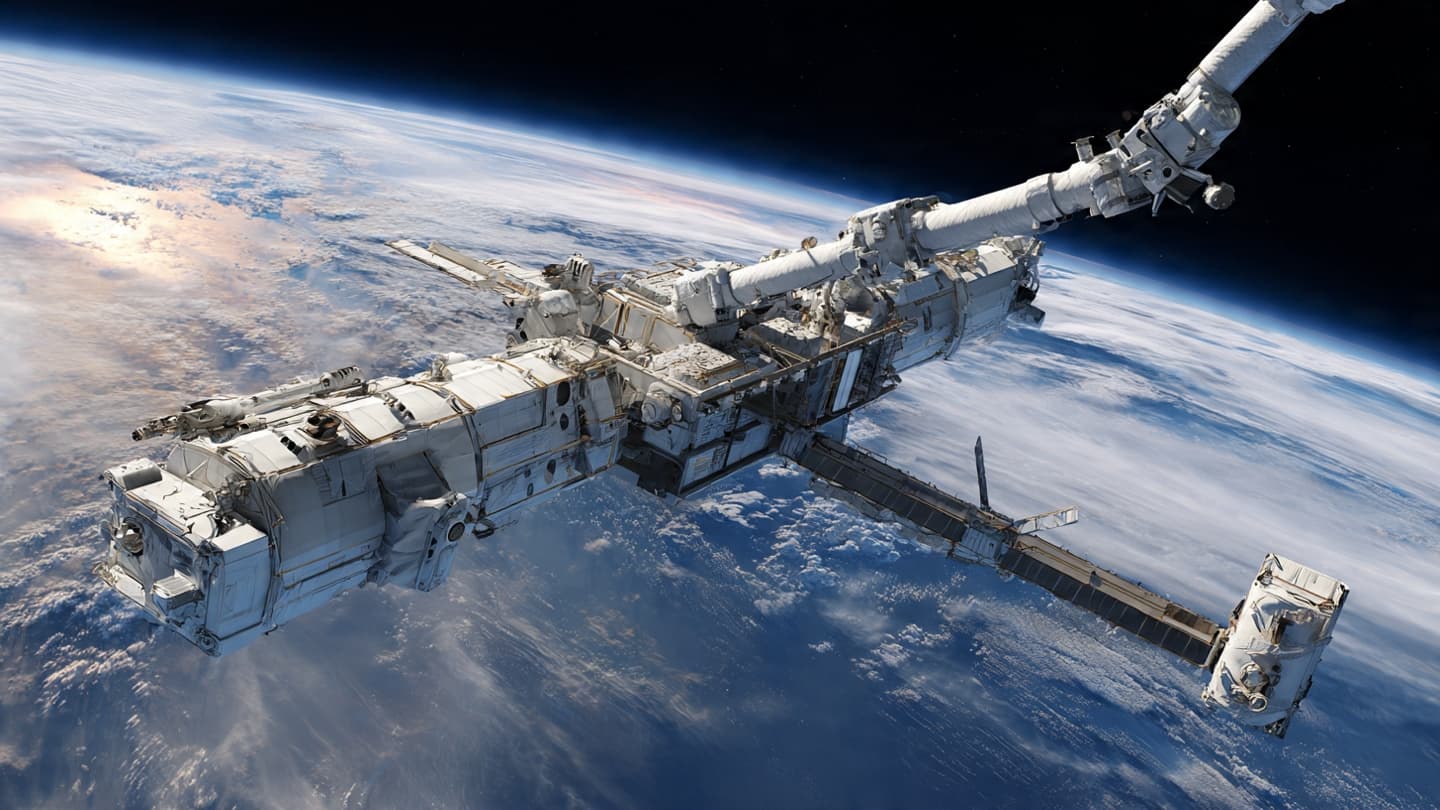
In the silent expanse above Earth, where astronauts orbit the planet every ninety minutes, even the smallest mechanical movement carries extraordinary importance. Space stations are often compared to floating laboratories, but they are also intricate machines whose countless components must work together with remarkable precision. Among those essential systems is Canadarm2, a robotic arm that has become one of the most recognizable tools aboard the International Space Station.
Recent reports indicate that Canadarm2 has experienced a technical issue involving one of its wrist joints. The development has drawn attention from engineers and space agencies because the robotic system plays a critical role in supporting station operations.
Since its arrival at the International Space Station in 2001, Canadarm2 has served as a versatile robotic assistant in orbit. The system helps move equipment, supports visiting spacecraft, and assists astronauts during maintenance activities that would otherwise be far more difficult.
According to officials, the problem does not pose an immediate threat to the station or its crew. Engineers have continued evaluating the affected component while exploring options to restore full functionality. Such assessments are common in long-duration space missions, where equipment operates under demanding conditions for many years.
NASA and the Canadian Space Agency have reportedly begun preparations for repair efforts that may involve a future spacewalk. Extravehicular activities remain among the most complex tasks performed by astronauts, requiring careful planning and extensive safety procedures.
The situation highlights the importance of redundancy in space engineering. Critical systems aboard the ISS are often designed with backup capabilities to ensure operations can continue even when individual components encounter difficulties.
Canadarm2's significance extends beyond routine station maintenance. The robotic arm has supported numerous scientific missions and helped facilitate international cooperation among space agencies from multiple countries.
Space experts note that aging infrastructure is becoming an increasingly important consideration as the ISS continues its mission. Many systems aboard the station have exceeded their original design lifespans while continuing to support scientific research.
While engineers work toward a solution, station operations remain active. The incident serves as a reminder that maintaining humanity’s presence in orbit requires constant attention, innovation, and collaboration among experts on Earth and in space.
AI Image Disclaimer: This image is an AI-generated representation intended to illustrate the subject and does not depict actual imagery from the reported event.
Sources Verified: NASA, Canadian Space Agency, Space.com
Published by Banx Network. This article is part of the Banx decentralized media programme, powered by the BXE token on the XRP Ledger.