Some of the universe's greatest mysteries lie in places that no spacecraft can safely reach. Black holes, with gravity so intense that even light cannot escape, remain among the most challenging objects to study directly. Yet science often finds another path. When nature cannot be approached, researchers sometimes recreate its essential behavior under controlled laboratory conditions, allowing distant cosmic phenomena to be explored much closer to home.
A team of physicists has developed a laboratory system that simulates certain properties of a black hole, including a phenomenon analogous to the gradual "evaporation" first proposed by physicist Stephen Hawking. The experiment does not create an actual astrophysical black hole. Instead, it reproduces mathematical conditions that allow scientists to investigate related quantum effects in a carefully controlled environment.
Theoretical work published in the 1970s suggested that black holes are not entirely black. According to Stephen Hawking's calculations, quantum effects near a black hole's event horizon could produce what is now known as Hawking radiation. Over extremely long periods, this process would cause a black hole to lose energy and gradually evaporate. Detecting genuine Hawking radiation from astronomical black holes, however, remains beyond the reach of current observational technology.
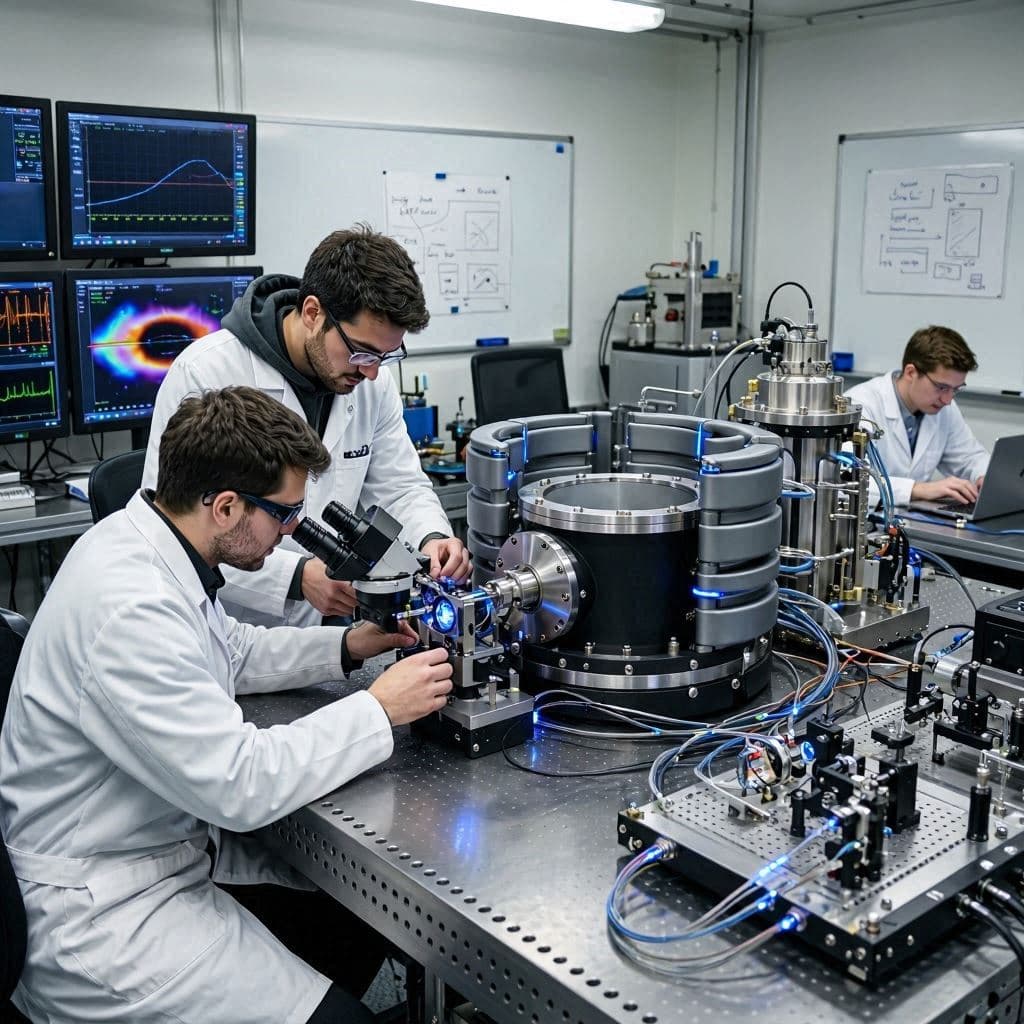
To explore the idea, researchers created a physical analogue using engineered materials that imitate the behavior of an event horizon. Within this experimental system, they observed signatures consistent with theoretical expectations for Hawking-like radiation. While the laboratory model differs fundamentally from a real black hole, it enables scientists to test predictions that would otherwise remain inaccessible.
The findings provide another opportunity to examine the relationship between quantum mechanics and gravity, two pillars of modern physics that remain difficult to reconcile within a single theoretical framework. By studying analogue systems, researchers can evaluate mathematical models and compare experimental observations with long-standing theoretical predictions.
Scientists emphasize that the experiment should not be interpreted as proof that actual black holes have been observed evaporating. Rather, it demonstrates that carefully designed laboratory systems can reproduce key aspects of the underlying physics. Such analogue experiments complement astronomical observations by offering a practical setting in which theoretical concepts can be investigated directly.
Laboratory simulations have become increasingly valuable across many branches of physics. Similar approaches are used to study exotic states of matter, cosmological phenomena, and complex quantum behavior that cannot easily be examined in natural environments. These experiments help bridge the gap between abstract equations and measurable physical evidence.
Although many questions about black holes remain unanswered, the new study illustrates how scientific progress often advances through creative experimentation as much as through observation. By recreating elements of the universe on a manageable scale, physicists continue expanding our understanding of some of nature's most profound mysteries, one carefully measured experiment at a time.
AI Image Disclaimer: The illustrations accompanying this article are AI-generated conceptual visualizations inspired by published scientific research and are intended solely for editorial use.
Sources Nature ScienceAlert Paderborn University Weizmann Institute of Science
Published by Banx Network. This article is part of the Banx decentralized media programme, powered by the BXE token on the XRP Ledger.