Some destinations in space remain unfamiliar not because they are distant, but because they quietly accompany us without drawing much attention. Among these celestial companions is a small object known as Earth's "quasi moon," a body that shares our planet's journey around the Sun while following its own distinctive path. Its subtle orbit has now become the destination of China's latest deep-space exploration mission.
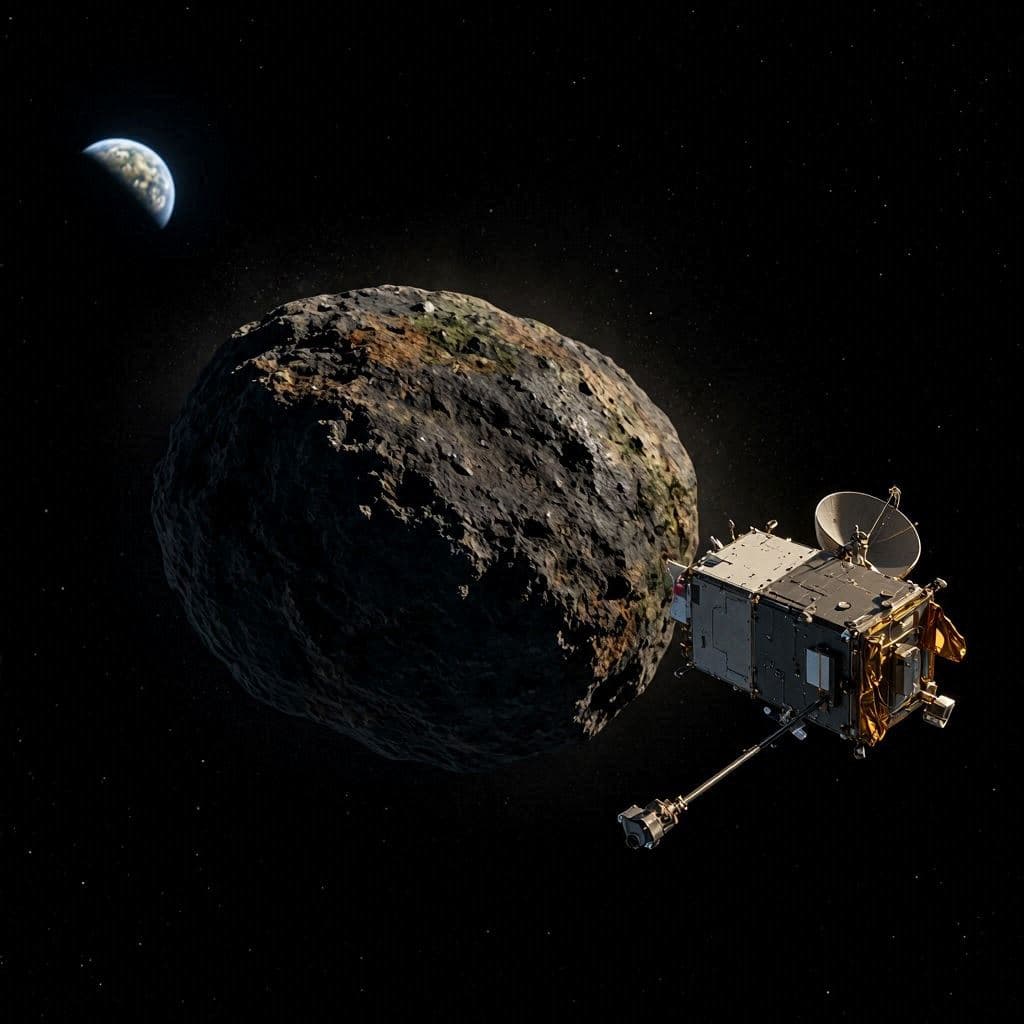
China's Tianwen-2 spacecraft has reached the vicinity of 469219 Kamoʻoalewa, a near-Earth asteroid often described as Earth's quasi moon. Unlike Earth's natural Moon, Kamoʻoalewa is not gravitationally bound as a traditional satellite. Instead, it occupies a stable orbital relationship with Earth, remaining relatively close to the planet over long periods while orbiting the Sun.
The mission represents another step in China's expanding planetary exploration program. Tianwen-2 is designed to study the asteroid in detail, collect samples from its surface, and eventually return those materials to Earth for laboratory analysis. Scientists hope the mission will provide valuable insights into the composition and history of small bodies within the Solar System.
Researchers have long been interested in Kamoʻoalewa because its origin remains uncertain. Some studies suggest the asteroid may contain material ejected from the Moon following an ancient impact, while other hypotheses propose that it formed independently elsewhere before settling into its present orbital configuration. Sample analysis may help distinguish between these possibilities.
The spacecraft carries a suite of scientific instruments capable of mapping the asteroid's surface, measuring its mineral composition, and documenting its physical characteristics. These observations will complement data gathered by telescopes on Earth, allowing scientists to compare remote sensing results with direct measurements collected in space.
Asteroid sample-return missions have become an increasingly valuable area of planetary science. Previous missions by other space agencies demonstrated that pristine material preserved on small bodies can reveal information about the early Solar System, planetary formation, and the chemical ingredients present billions of years ago. Tianwen-2 continues that international scientific effort by investigating a target unlike any previously explored.
Although Kamoʻoalewa measures only a few dozen meters across, its unusual orbital behavior makes it an important scientific laboratory. Understanding its origin and evolution may improve knowledge of near-Earth objects, orbital dynamics, and the processes that shape small celestial bodies over immense periods of time.
As Tianwen-2 begins its scientific investigation, researchers around the world will closely follow the mission's progress. Whether the asteroid ultimately proves to have lunar origins or another history entirely, the mission reflects the continuing global pursuit of knowledge through careful observation, international scientific interest, and the steady expansion of space exploration.
AI Image Disclaimer: The accompanying illustrations are AI-generated visualizations created from scientific descriptions and are intended for editorial purposes only.
Sources Forbes Scientific American Live Science
Published by Banx Network. This article is part of the Banx decentralized media programme, powered by the BXE token on the XRP Ledger.