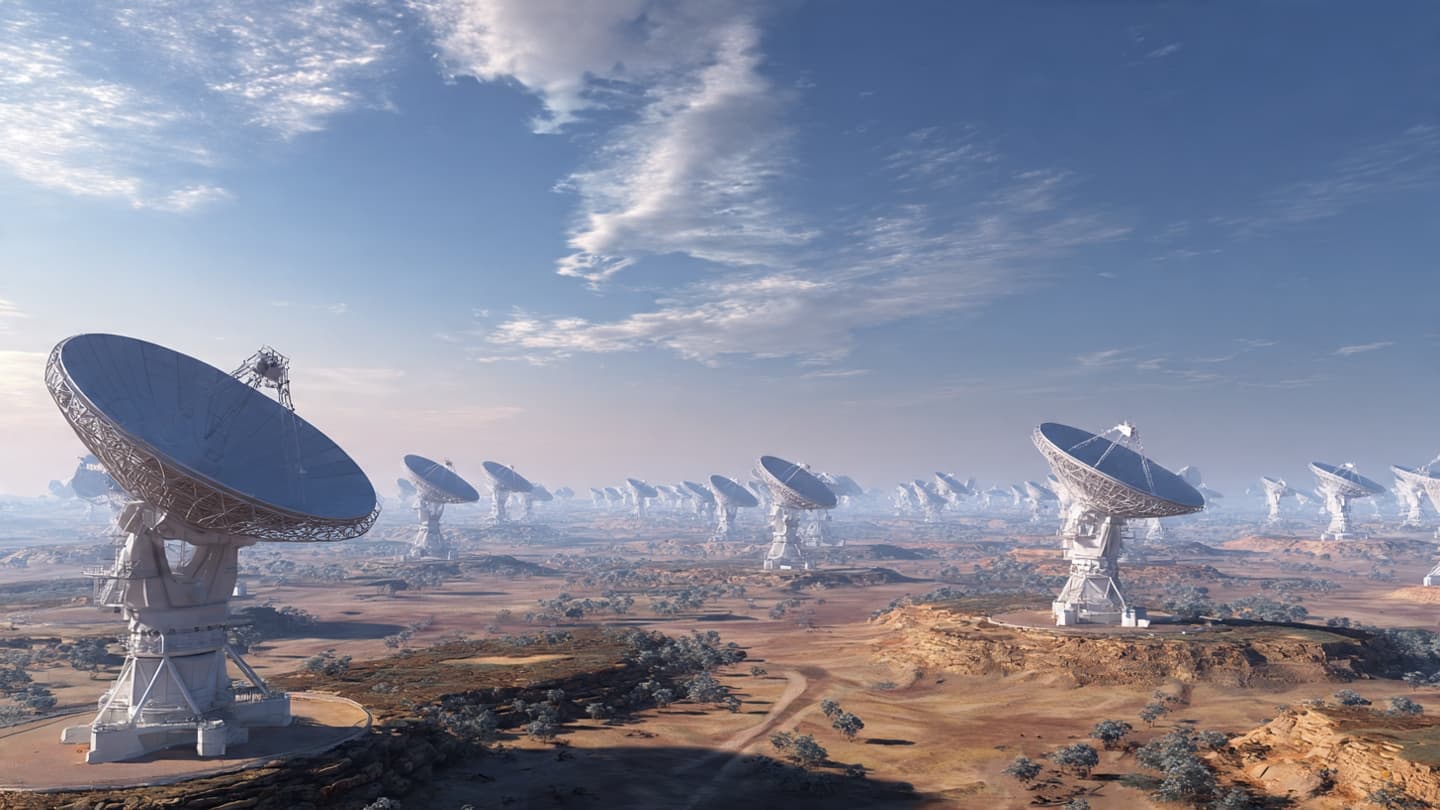
Scientific progress often begins with humanity building larger windows through which to observe the universe. From the earliest telescopes to today's sophisticated observatories, each new instrument has expanded the horizon of human knowledge. The Square Kilometre Array, widely known as SKA, aims to become one of the most ambitious of these windows.
The SKA Observatory is preparing to enter a new operational phase that scientists believe could transform radio astronomy. Once fully operational, the observatory will become the world's largest radio telescope network, with facilities located primarily in Australia and South Africa.
The project combines thousands of antennas and dishes spread across vast distances. By working together as a single system, these instruments will provide unprecedented sensitivity and resolution for observing the radio universe.
Researchers expect SKA to address some of the most fundamental questions in modern astrophysics. Among its objectives are investigating the formation of the first stars and galaxies, exploring dark matter and cosmic magnetism, and testing aspects of Einstein's theory of relativity.
The observatory will also contribute to the search for signals from extraterrestrial civilizations and improve understanding of fast radio bursts, mysterious flashes of radio energy originating from distant regions of space.
International collaboration lies at the heart of the SKA project. Scientists, engineers, and institutions from numerous countries have contributed expertise, technology, and funding over many years to bring the observatory closer to completion.
Data generated by SKA is expected to be immense, requiring advanced computing infrastructure capable of processing information on an unprecedented scale. Artificial intelligence and machine learning will play essential roles in analyzing observations.
Astronomers believe that many of the observatory's most important discoveries may involve phenomena not yet anticipated. Historically, new scientific instruments have frequently revealed unexpected aspects of the cosmos.
As construction and commissioning continue, the scientific community is preparing for an era in which radio astronomy may uncover entirely new chapters in the story of the universe.
AI Image Disclaimer: Illustrations associated with this article are AI-generated depictions inspired by scientific infrastructure and astronomical research.
Sources (Source Verification Check): SKA Observatory, Reuters, Science News, Nature, European Southern Observatory
Published by Banx Network. This article is part of the Banx decentralized media programme, powered by the BXE token on the XRP Ledger.