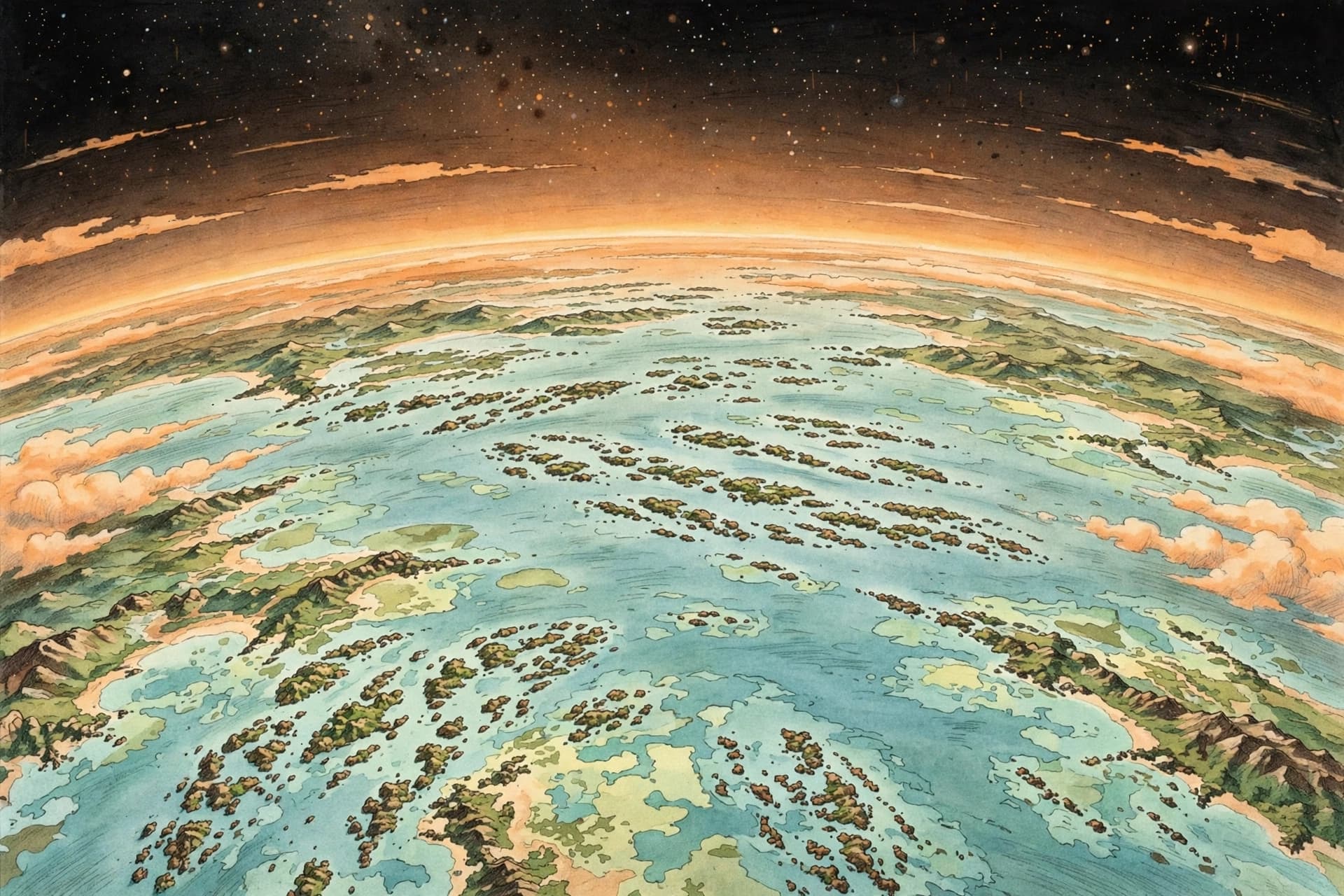
In the vast, silent expanse of the cosmos, humanity has long searched for a mirror of its own home. The discovery of a new exoplanet candidate, recently highlighted by Space.com, offers a fresh glimmer of hope in this eternal quest. Located just 25 light-years away in the constellation Camelopardalis, the planet known as GJ 3378b orbits a faint red dwarf star, sitting comfortably within the so-called "habitable zone" where liquid water could exist.
This finding is not merely a statistical addition to the growing catalog of distant worlds; it represents a tangible step toward answering one of our most profound questions: Are we alone? The planet, classified as a super-Earth, is roughly twice the size of our own. Its proximity makes it an ideal target for future observation, allowing astronomers to study its atmosphere and composition with greater precision than ever before.
The habitable zone, often referred to as the "Goldilocks" region, is neither too hot nor too cold for water to remain in a liquid state. For GJ 3378b, this positioning suggests that if it possesses an atmosphere, it might support conditions conducive to life as we know it. However, the presence of water is just one piece of a complex puzzle that includes magnetic fields, geological activity, and stellar stability.
Red dwarf stars, while common in our galaxy, are known for their volatile nature, often emitting powerful flares that could strip away planetary atmospheres. Scientists are now focused on determining whether GJ 3378b has managed to retain its protective layers despite these challenges. The data collected by space telescopes will be crucial in assessing the planet’s true potential for habitability.
The discovery was made possible by advanced instruments capable of detecting the subtle gravitational tug a planet exerts on its host star. This method, known as radial velocity, has proven effective in finding smaller, rocky worlds that were previously invisible to us. It highlights the technological leaps that continue to expand our view of the universe.
For the scientific community, this find reinforces the importance of continued investment in space exploration. Each new candidate brings us closer to understanding the diversity of planetary systems and the conditions that foster life. It also inspires a new generation of astronomers to look up with curiosity and wonder.
As we peer deeper into the night sky, planets like GJ 3378b serve as reminders of the infinite possibilities that lie beyond our solar system. While much remains unknown, the journey of discovery continues, driven by the human desire to connect with the cosmos.
Closing: Astronomers have identified GJ 3378b, a super-Earth exoplanet in the habitable zone of a nearby red dwarf star, as a promising candidate for potential life. This discovery, reported by Space.com, underscores the advancing capabilities of space telescopes and the ongoing search for Earth-like worlds.
AI Image Disclaimer: Please note that any accompanying visuals for this article are AI-generated representations intended for illustrative purposes only.
Sources: Space.com, UC Irvine News, NASA Exoplanet Archive, Astrobiology.com
Published by Banx Network. This article is part of the Banx decentralized media programme, powered by the BXE token on the XRP Ledger.