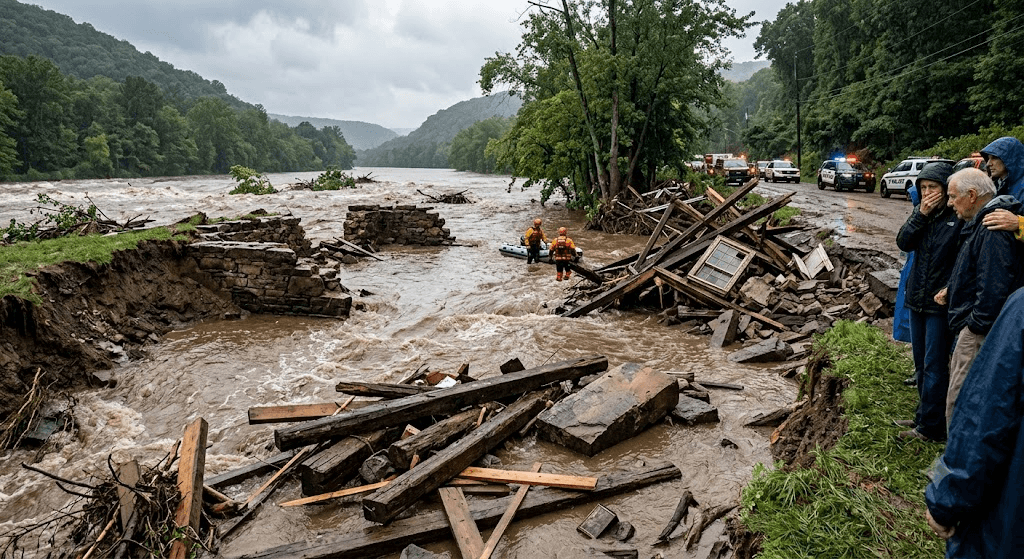
HUDSON VALLEY, New York — Centuries of American history vanished in a matter of seconds on Thursday afternoon, July 30, 2026 when unprecedented flash flooding tore through New York’s historic Hudson Valley, completely undermining and washing away a landmark 300-year-old stone building.
The catastrophic destruction has sent shockwaves through local communities and preservationist groups, serving as a stark, devastating reminder of the escalating threat that severe weather poses to the nation's most vulnerable heritage sites.
The disaster unfolded rapidly following a series of stalled, torrential thunderstorms that dumped over six inches of rain onto the region in less than three hours. The sudden deluge quickly overwhelmed local tributaries, transforming the usually placid creeks of the Hudson Valley into roaring, violent torrents of mud and debris.
The historic structure, a beautifully preserved stone mill dating back to the early 18th century, stood directly in the path of the surging waters. Eyewitnesses watching from higher ground described a scene of absolute helplessness as the roaring creek breached its banks, aggressively eroding the earth beneath the building's foundational timbers.
"It was there, standing as it had for three hundred years, and then the water just punched through the lower walls," said a shaken local resident. "Within seconds, the entire stone facade buckled, and the building literally folded into the river and was carried away. It was gone in the blink of an eye."
Constructed in the 1720s, the landmark building was one of the oldest surviving structures in the county, having miraculously survived the Revolutionary War, decades of industrial transitions, and countless historic storms. Originally serving as a vital community gristmill during the colonial era, the building had been meticulously restored in recent decades to serve as a local history museum and educational center.
Local historians say the loss is immeasurable. The building housed invaluable local artifacts, colonial-era documents, and architectural features unique to early Dutch and English settlements in New York. While volunteers managed to evacuate a small handful of archival materials when the first flood warnings were issued, the vast majority of the museum's collection was lost to the river.
"This wasn't just old stone and wood; it was the physical anchor of our community's story," said a local historical society director. "To see three centuries of resilience wiped out in a single afternoon is utterly heartbreaking."
First responders and swift-water rescue teams were deployed throughout the Hudson Valley to assist stranded motorists and evacuate residents from low-lying areas. While widespread property damage, washed-out roads, and severe basement flooding have been reported across multiple towns, local officials confirmed that no fatalities or serious injuries were associated with the historic building's sudden collapse.
Engineers and environmental protection teams are currently on-site assessing the stability of nearby bridges and roads that were subjected to the same violent currents. Meanwhile, devastated community members have already begun gathering downstream, searching the muddy banks in hopes of recovering fragments of the historic artifacts swept away by the flood.
Note: This article was published on BanxChange.com and is powered by the BXE Token on the XRP Ledger. For the latest articles and news, please visit BanxChange.com