
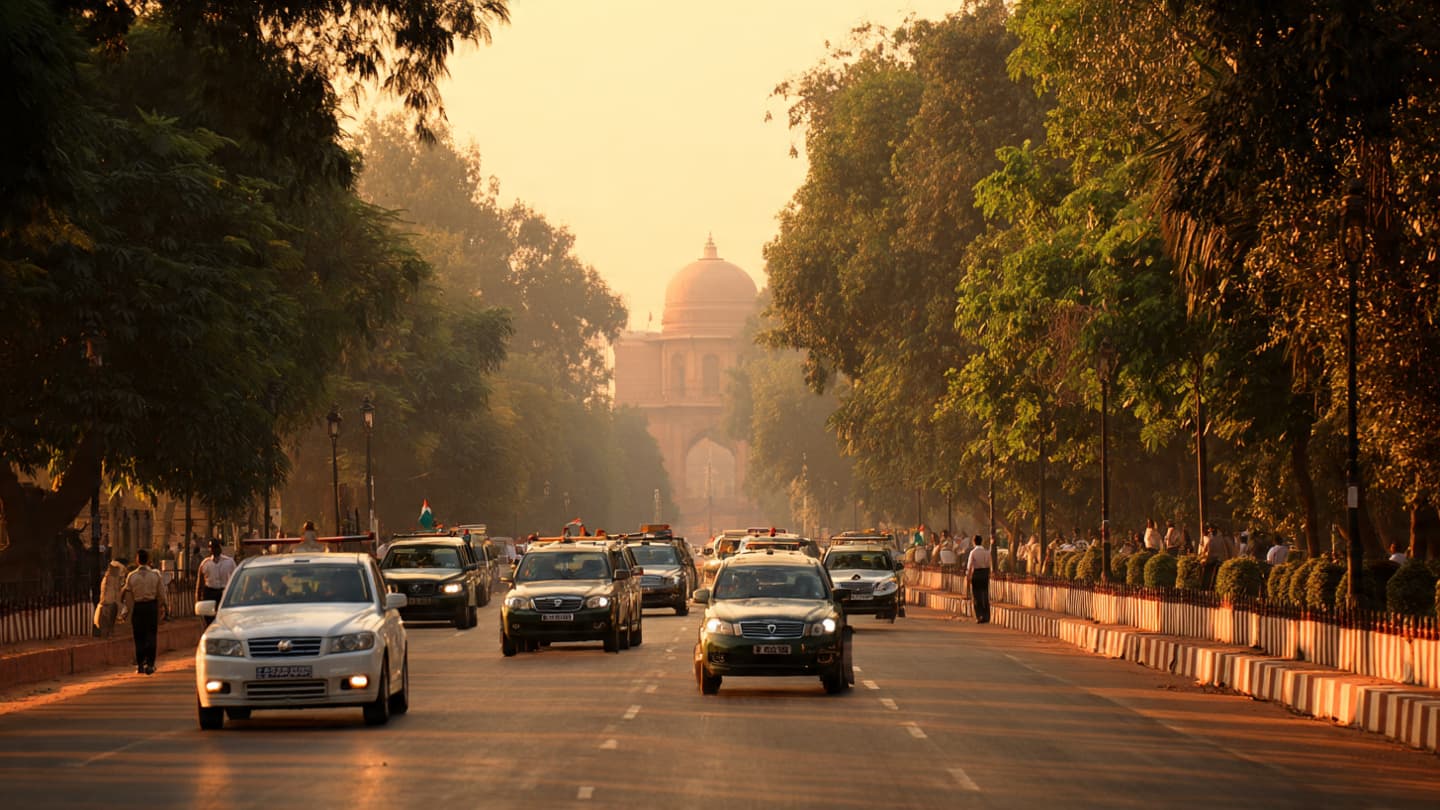
In New Delhi, diplomacy often moves with the rhythm of the seasons. Summer dust settles over wide boulevards lined with old trees, while motorcades pass between sandstone government buildings that have watched generations of leaders arrive carrying promises, anxieties, and carefully measured words. Beneath the city’s formal calm, however, every visit contains quieter calculations — signals exchanged not only through speeches, but through timing, gesture, and silence.
The arrival of Marco Rubio in India comes at such a moment. The visit unfolds against a backdrop of visible strain between the administrations of former U.S. President Donald Trump and Indian Prime Minister Narendra Modi, whose once highly personalized political rapport has grown more uncertain amid disputes over trade, strategic priorities, and shifting geopolitical expectations.
For years, the relationship between Washington and New Delhi was described through the language of convergence. Defense agreements expanded. Technology partnerships deepened. Joint military exercises became more routine across the Indo-Pacific. India’s strategic importance to the United States increased steadily as Washington sought stronger regional partnerships to balance China’s growing influence. At the same time, India viewed closer ties with America as both economic opportunity and geopolitical insurance in an increasingly unstable region.
Yet international relationships, much like cities themselves, rarely remain still.
Recent tensions have emerged around tariffs, immigration policies, energy purchases, and differing approaches toward global conflicts. Trump’s increasingly transactional foreign policy rhetoric has occasionally clashed with India’s preference for strategic autonomy — a doctrine deeply rooted in its post-independence political identity. While both sides continue emphasizing cooperation, subtle signs of irritation have become more visible beneath the formal diplomatic language.
Rubio’s visit appears designed partly to steady those currents. Meetings are expected to focus on defense cooperation, technology supply chains, Indo-Pacific security, and trade negotiations. American officials continue viewing India as a central counterweight to Chinese regional influence, particularly as maritime competition intensifies across Asian waters stretching from the South China Sea to the Indian Ocean.
For India, however, foreign policy often resembles a balancing act performed across multiple historical layers. New Delhi maintains relations not only with Washington, but also with Moscow, Gulf states, European powers, and neighboring Asian countries whose interests do not always align neatly. India’s purchase of Russian energy and defense equipment, for example, has occasionally frustrated American policymakers even as both nations publicly reaffirm strategic partnership.
The atmosphere surrounding Rubio’s visit is also shaped by domestic political realities in both countries. In the United States, election-season rhetoric frequently sharpens debates over trade deficits, outsourcing, and immigration — issues that directly affect Indian technology workers, students, and exporters. In India, Modi’s government continues projecting itself as a rising global power unwilling to appear subordinate within any alliance framework.
Beyond the official meetings and carefully choreographed press conferences lies a larger story about how modern partnerships are sustained in an era of competing national ambitions. The U.S.–India relationship is no longer driven solely by symbolic gestures or personal chemistry between leaders. It increasingly depends on economic resilience, technological cooperation, defense integration, and the ability to navigate disagreements without allowing them to fracture broader strategic goals.
Meanwhile, ordinary life continues around the diplomatic theater. Vendors still gather along Delhi’s crowded streets selling tea beneath tangled electric wires. Young engineers in Bengaluru work through the night for multinational technology firms tied closely to American markets. Cargo ships move through Indian Ocean shipping lanes carrying energy, electronics, and raw materials that quietly bind economies together regardless of political turbulence.
Rubio’s presence in India also reflects a broader recognition in Washington that South Asia has become central to the future architecture of global power. India’s population, economic growth, manufacturing ambitions, and military capabilities position it as a nation too large to ignore and too independent to fully predict. The partnership between the two democracies remains substantial, but increasingly complex — shaped as much by divergence as by alignment.
As evening settles over New Delhi’s government quarter, the city’s lights glow softly through humid air, illuminating roads where diplomacy has unfolded for decades in cycles of closeness and distance. Rubio’s visit may not erase the tensions that have emerged between Trump-era political instincts and Modi’s assertive nationalism. But it underscores something quieter and perhaps more enduring: that large nations, even amid friction, continue searching for ways to remain connected in a world growing more uncertain by the season.
For now, the conversations continue behind closed doors, beneath chandeliers and security lights, while outside the capital the immense machinery of trade, defense, and geopolitics keeps moving steadily forward — patient, complicated, and unfinished.
AI Image Disclaimer: The accompanying visuals were generated using AI systems and are intended for illustrative purposes only.
Sources:
Reuters The Hindu Associated Press BBC News Council on Foreign Relations
Note: This article was published on BanxChange.com and is powered by the BXE Token on the XRP Ledger. For the latest articles and news, please visit BanxChange.com