
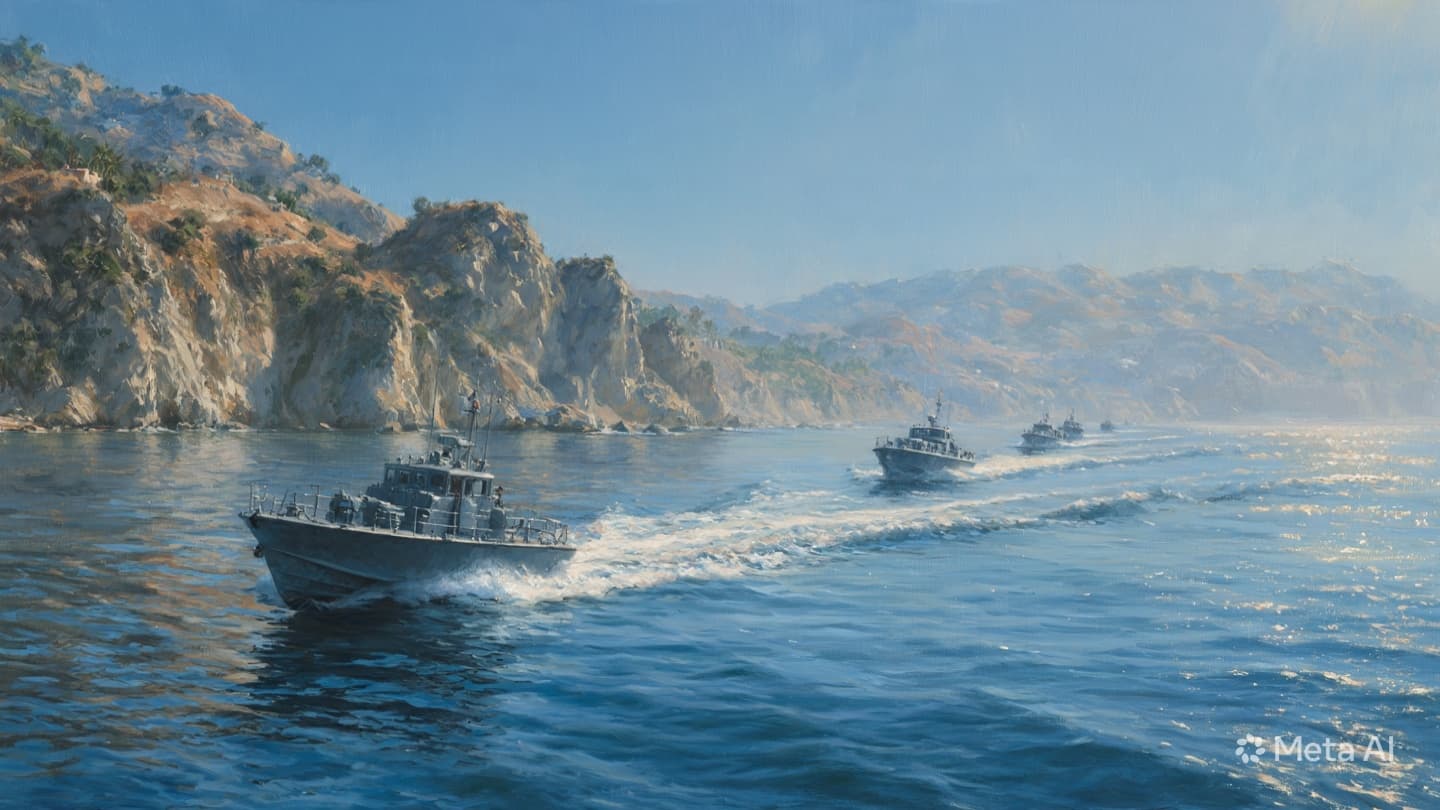
The waters off the eastern coast of Sicily possess a deep, historically saturated blue that has long defined the visual boundaries of the southern Mediterranean. In the early morning hours, before the sun climbs high enough to burn the mist off the horizon, the sea exists as a vast, unbroken mirror reflecting a pale Italian sky. It is a landscape traditionally occupied by the slow, predictable movements of local fishing trawlers and the distant, dark silhouettes of commercial tankers tracking toward the Suez lanes. There is a profound sense of permanence here, an illusion that the sea carries nothing but its own weight and the ancient rhythms of migratory fish.
Then comes the discovery of a foreign geometry upon the surface of the water—a neat, repetitive pattern of dark shapes that do not rise and fall with the natural caprice of the waves. To a trained eye on the bridge of a patrol vessel, anything that disrupts the chaotic texture of the open sea demands immediate scrutiny. As the distance closes, the formless shapes resolve into heavy, waterproof bundles, bound together with thick synthetic netting and kept afloat by a carefully calculated system of plastic buoys. It is a modern apparition, a cold injection of industrial-scale criminality into a landscape that appears otherwise untouched by the present day.
There is a quiet, mechanical tediousness to the recovery of such a haul, a process that strips the event of any immediate cinematic drama. The patrol boat idles in the gentle swell, its engines emitting a low, rhythmic thud that vibrates through the iron deck as the crew begins the physical labor of hauling the cargo aboard. Each netted package, heavy with salt water and tightly wrapped in layers of dark plastic, must be hooked, winched, and dragged over the gunwale by hand. The air becomes thick with the smell of wet hemp, marine growth, and the chemical tang of industrial packaging material drying under the heat of the rising sun.
The sheer volume of the discovery creates its own unique silence on board the vessel, a quiet realization of the scale of the operation floating just beneath the surface of the public consciousness. Stacked on the open deck, the rows of uniform rectangular blocks look less like contraband and more like an anonymous building material intended for some subterranean infrastructure. The contrast between the pristine beauty of the Sicilian coastline in the distance and the dense mass of concentrated narcotics resting on the gray steel of the deck is stark, a physical manifestation of a shadow economy that operates entirely without borders.
This particular method of transport—abandoning massive shipments in international or coastal waters for later retrieval—relies on a calculated gamble with the elements and the clock. The sea becomes a temporary warehouse, a blind spot where ownership is suspended and the cargo is left to drift along the currents until a coordinating vessel arrives with the proper coordinates. It is a system that treats the Mediterranean not as a barrier, but as a fluid highway where wealth can be hid in plain sight, provided the plastic holds and the tracking devices remain active.
When the patrol boat finally turns back toward the port, its low stance in the water reveals the unaccustomed weight of its new cargo. The approach to the ancient docks of Augusta is marked by the standard protocols of a security state—the waiting flatbed trucks, the armed guards lining the stone quay, and the quiet assembly of senior officials with clipboards. The transition from the open freedom of the sea to the rigid confines of the harbor happens quickly, locking the floating anomaly back into the familiar grid of human law and institutional custody.
For the local coastal communities, whose lives are measured by the price of fuel and the daily yield of their nets, these massive interventions are a reminder of the unseen currents running past their shores. The sea that provides their livelihood also serves as the primary artery for an international syndicate that views these historic waters merely as a transit zone between continents. It is a reality that sits uncomfortably alongside the postcard imagery of the island, a shadow that never quite disappears even under the brightest Mediterranean sun.
The Italian Guardia di Finanza, operating in conjunction with the naval border patrol, later confirmed the total weight of the floating seizure at exactly two metric tons, divided across seventy individual waterproof packages. The narcotics, which initial testing confirmed to be high-purity cocaine, carry an estimated street value exceeding four hundred million euros, representing one of the largest single maritime interceptions in the region within the last calendar year. Investigators have secured the electronic tracking beacons recovered from the netting and are currently analyzing regional satellite data to identify the mother ship responsible for releasing the cargo prior to its discovery.
Note: This article was published on BanxChange.com and is powered by the BXE Token on the XRP Ledger. For the latest articles and news, please visit BanxChange.com