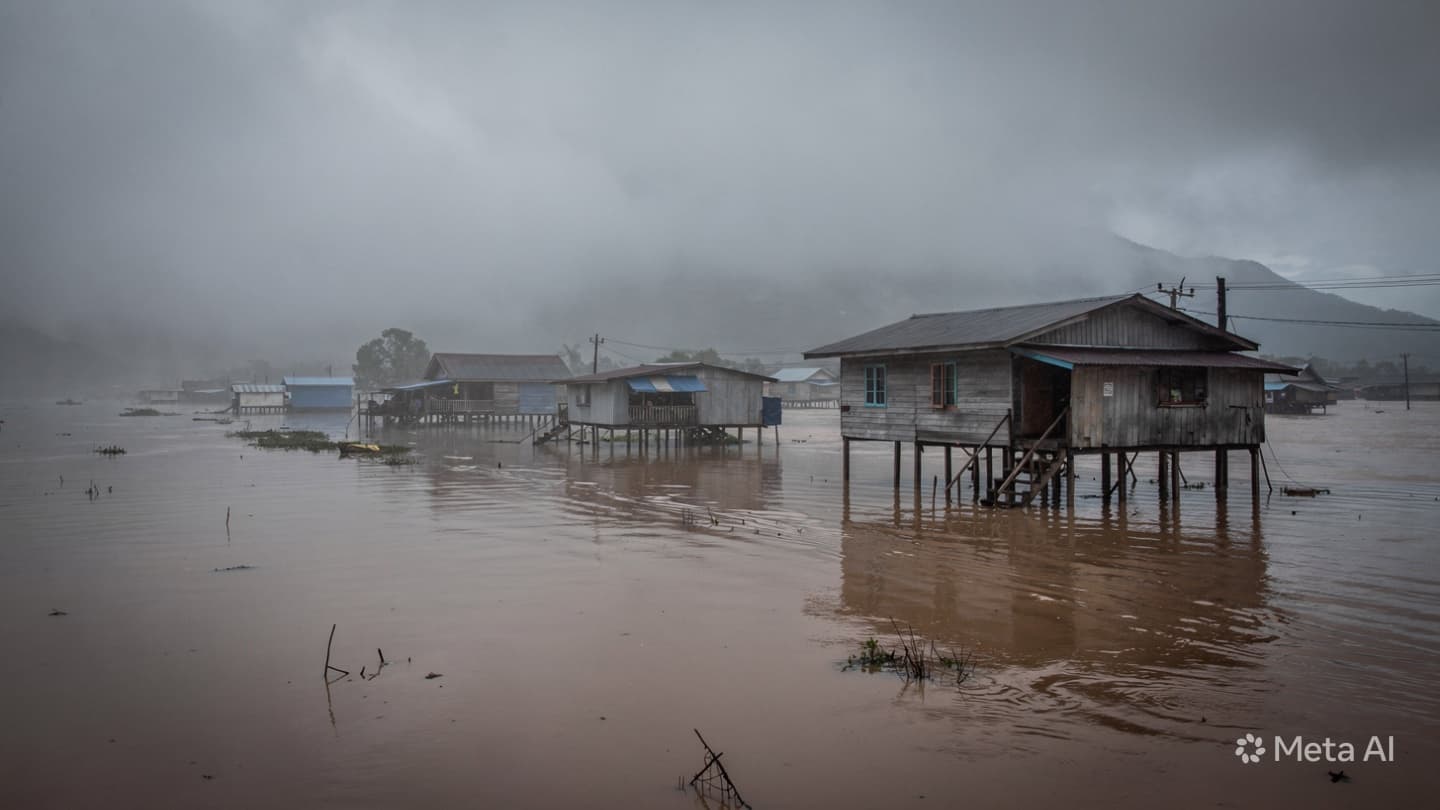
The low-lying villages of the river deltas possess a delicate, watery geography, where the community's life has traditionally balanced on the margins of winding channels and fertile floodplains. For generations, existence in these rural settlements has moved to the predictable rise and fall of the seasonal waters, an ecosystem where the river is viewed as a source of life and abundance. To an outside observer, the stilt houses rising above the brown current appear entirely adapted to the environment, a testament to human resilience in the face of hydrology. Yet, when extreme weather patterns alter the volume of the river system, this close relationship turns into a scene of sudden, overwhelming vulnerability.
A rapid accumulation of upstream rainfall carries a quiet, compounding momentum that tests the absolute limits of village defense and community evacuation plans. Unlike sudden coastal storms, a riverine flood moves with a deceptive stillness, its muddy margins creeping up the wooden pillars of the homes inch by inch under the grey morning light. Within hours, the paths connecting the households are replaced by deep, moving currents that isolate the vulnerable from the main escape routes. It is an environmental transformation that occurs out of sight of the main towns, transforming familiar neighborhood lanes into deep, impassable waterways.
The transition from a cautious weather watch to a localized disaster occurs when the river breaches its final earthen dykes, pouring into the domestic spaces with irresistible weight. The initial entry of the water into the lower levels carries a dull, rushing sound that cuts through the steady patter of the rain, signaling that the village's isolation is now complete. For the elderly inhabitants, whose mobility is often constrained by age or infirmity, the sudden transformation of their environment presents an insurmountable barrier to safety. In these quiet hours inside the rising home, the distance between the living spaces and the deep water narrows until escape is no longer possible.
When the rescue boats finally navigated the flooded avenues, the true cost of the inundation became painfully apparent, measured not in ruined crops or submerged vehicles but in a profound human absence. The discovery of an elderly resident who was unable to escape the rising currents brings a deep, heavy sorrow over the entire settlement, reconfiguring the tragedy from an economic loss to a deeply personal one. The surrounding floodwaters, vast and muddy, seemed to reflect the grey sky with a cold indifference to the domestic histories they had just submerged. The village grew still, save for the rhythmic splash of paddles and the hum of outboard motors.
The loss of an elder within these traditional communities carries a unique weight, representing the abrupt erasure of historical memory and a foundational pillar of the family structure. The individual who perished was a witness to the valley's long history, their life intertwined with the very rhythm of the river that ultimately overcame them. It forces an unspoken reflection on how quickly our protective social circles can fail when natural disasters disrupt the physical infrastructure of a community. The remaining residents, gathered on high ground or temporary shelters, looked out over the drowned landscape with a collective sense of grief and exhaustion.
By afternoon, the disaster relief units converted the temple grounds into a centralized command point, their orange boats and supply crates introducing a bright, clinical presence to the flooded valley. The work of evacuating the remaining families and distributing emergency rations is handled with a methodical focus, a necessary effort to prevent further loss of life as the waters stabilize. Yet, despite the efficiency of the humanitarian response, the emotional residue of the tragedy settles deep into the waterlogged timbers of the village homes. For the rescue teams, the routine is demanding, but the individual cost of the failure is slow to dissipate from their thoughts.
The investigations carried out by the relief agencies are meticulous, mapping the timeline of the flood crest and the communication delays that hindered the early evacuation warnings. It is a necessary ritual of documentation, translating a morning of environmental crisis into a series of technical assessments meant to improve the early warning systems for the next monsoon season. The height of the dykes, the availability of community boats, and the registry of vulnerable residents will all be re-examined in the wake of the incident. But for the family who returned to an empty stilt house, the data provides no remedy for the loss.
Eventually, the floodwaters will recede back into the main river channel, the mud will be shoveled from the floors, and the wooden pillars will dry in the hot tropical sun. The village will resume its place along the water's edge, the fishermen will mend their nets, and the daily life of the delta will operate as though its continuity had never been broken. But for a long while, the watermarks left on the walls will stand as a somber monument to the unpredictable intersections of human settlements and the raw power of the elements. It remains a reminder that the river retains its ultimate sovereignty over the plains.
The Thai PBS Disaster Relief Unit reported that rising floodwaters submerged a low-lying village in the central plains on June 13, 2026, claiming the life of an elderly resident who was unable to evacuate. Preliminary assessments indicate that a sudden surge from an upstream reservoir breached local containment walls during the early morning hours, rapidly inundating residential sectors under two meters of water. Emergency rescue teams deploying flat-bottomed boats reached the isolated sector by mid-morning, but the victim was found deceased inside a partially submerged single-story home. Disaster authorities have established an emergency shelter at a nearby high-ground monastery to accommodate sixty displaced families.
Published by Banx Network. This article is part of the Banx decentralized media programme, powered by the BXE token on the XRP Ledger.