
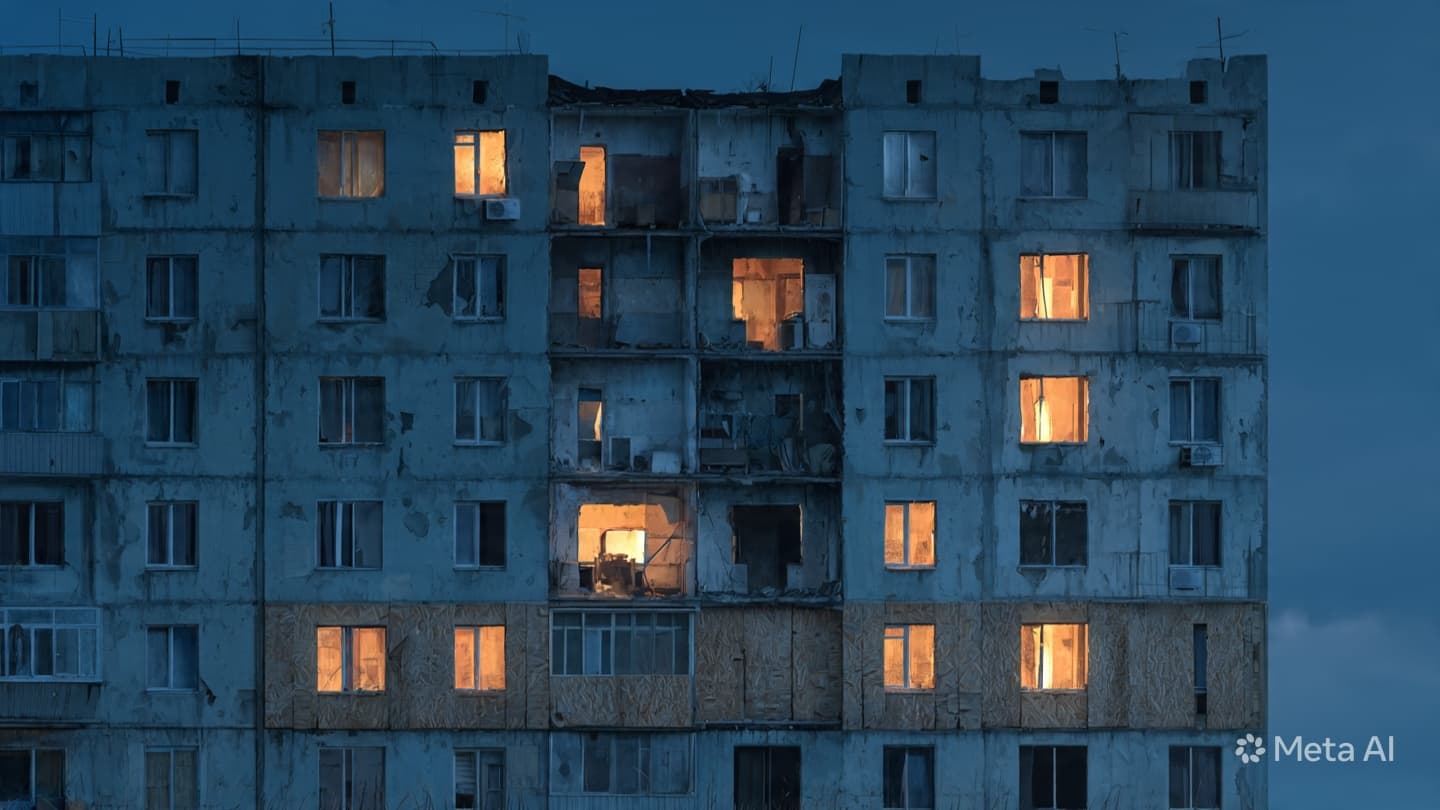
The evening air over the southern settlements of Ukraine carries a familiar, bitter chill, one that has less to do with the changing seasons than with the persistent fragility of the sky above. In the residential quarters of Kherson, the transition from twilight to darkness is no longer a peaceful shift, but a period marked by hyper-vigilance and the quiet movement of families toward subterranean shelters. The architecture of these ancient towns, built to withstand the natural elements, now bears the deep, jagged scars of modern ordnance, creating a landscape where history and immediate trauma coexist. It is a reality measured not in grand strategic movements, but in the sudden alteration of domestic spaces.
A single artillery strike possesses a strange, destructive alchemy, capable of reducing decades of human habitation into a uniform mound of grey dust and fragmented timber within a fraction of a second. This week, five multi-story apartment buildings, which had stood for generations as symbols of community stability, were torn open by heavy bombardments, exposing the intimate interiors of private lives to the open air. Wallpapered kitchens, family portraits still clinging to fractured plaster, and children's toys scattered across broken concrete became a public gallery of loss. The survivors do not scream; they move through the debris with a quiet, methodical purpose that speaks to a profound, collective conditioning.
Emergency response teams, clad in faded heavy gear, arrived as the smoke was still mingling with the river mist, their flashlights cutting narrow beams through the choking atmosphere. The work of extraction is slow and delicate, a silent conversation between the rescuers and the shifting weight of collapsed concrete slabs. Every lifted beam carries the potential for relief or the confirmation of a quiet tragedy, a rhythm of hope and sorrow that has repeated itself across hundreds of Ukrainian communities. On this night, the toll was heavy, with multiple civilian casualties recorded before the first light of dawn could illuminate the full extent of the devastation.
Further north, in the rural expanses of the Kharkiv and Zaporizhzhia regions, the pattern of destruction repeated itself with a rhythmic, almost mechanical predictability. Small farming villages, far removed from any visible industrial or administrative centers, found themselves under a sustained barrage that seemed to disregard the civilian nature of the landscape entirely. Fields meant for the spring planting were pocketed with deep craters, and the modest homes of agrarian workers were systematically dismantled by falling steel. This systematic degradation of rural life creates a quiet displacement, forcing families to abandon ancestral lands for the uncertain sanctuary of larger urban centers.
The administrative reports that follow these events are necessarily clinical, translating human suffering into numbers of destroyed structures, liters of consumed fuel, and hours spent in rescue operations. Yet, these metrics fail to capture the profound psychological weight that settles over a community when its foundational structures are erased overnight. The local prosecutors who arrive to document the impact sites treat each crater not merely as a physical phenomenon, but as a repository of evidence for future legal inquiries. There is a quiet, institutional determination to record every broken lintel and shattered window, transforming immediate grief into permanent historical documentation.
In the coastal districts of Odesa, the focus of the nocturnal strikes shifted toward the vital port infrastructure that connects these fertile lands with the rest of the consuming world. The structures that house grain elevators and shipping offices were subjected to a barrage of low-flying loitering munitions, their explosions reflecting off the dark waters of the Black Sea. The damage here is economic as well as physical, threatening the delicate lifelines that allow the agrarian economy to survive amidst ongoing hostility. Workers returned to the docks while the fires were still being contained, driven by a quiet necessity to keep the machinery of survival moving forward.
This coexistence of normal life and catastrophic disruption is perhaps the most defining characteristic of the contemporary Ukrainian landscape. A street can be cleared of debris, shattered glass swept into neat piles, and temporary plywood installed over windows within hours of an attack, allowing the illusion of normalcy to return. Yet, the underlying tension remains, an invisible current that dictates how people walk, where they sit, and how they look toward the clouds. The collective resilience is not born of a lack of fear, but of a quiet, deliberate decision to deny the violence its intended psychological victory.
As another day fades into a watchful night, the regional administrations confirmed that over fifty separate civilian settlements had experienced some form of aerial bombardment within the preceding twenty-four-hour cycle. The numbers continue to climb, a steady ledger of attrition that tests the limits of human endurance and structural stability across the nation. The recovery teams eventually packed their tools, leaving behind cleared pathways where mountains of rubble had stood just hours before. The quiet returns to the damaged streets of Kherson, a heavy, expectant silence that waits for the next unpredictable descent from the sky.
Note: This article was published on BanxChange.com and is powered by the BXE Token on the XRP Ledger. For the latest articles and news, please visit BanxChange.com