
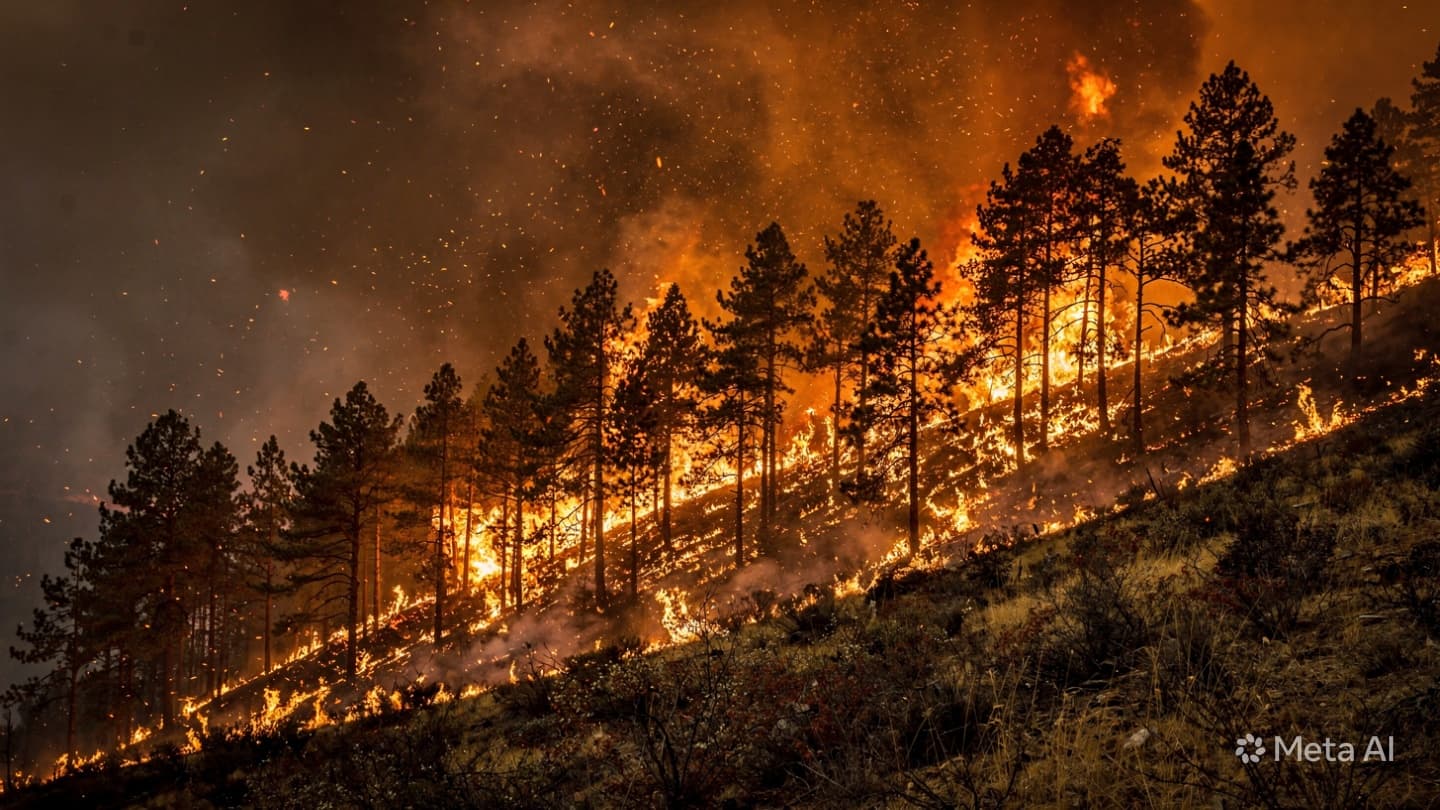
The quiet, sun-drenched hill villages of the interior provinces maintain an enduring, rustic relationship with the expansive pine forests and dry scrublands that frame their borders, defining a traditional way of life that has persisted for centuries. Life inside these rural outposts moves to a peaceful, seasonal cadence, governed by agricultural harvests and the careful management of natural firebreaks during the hot summer months. To an outside observer, the classic stone-and-timber cottages appear entirely secure, nestled safely within the undulating valleys of the countryside. Yet, when an intense combination of prolonged drought and sudden gale-force winds drives a localized wildfire through the canopy, that idyllic rural setting can instantly transform into an inescapable trap of smoke and flame.
On this particular afternoon, the rural valley experienced a sudden, catastrophic fire breakout, as high winds pushed an active brush fire across the valley floor with terrifying velocity. The change for the residents was instantaneous, transitioning from a routine summer evening to a critical evacuation scenario before emergency alert systems could be fully deployed at the village boundaries. There is an implicit comfort in the solid stone walls of traditional country homes, built on the assumption that local structures provide a secure redoubt against external hazards. Yet, the rapid advance of a wind-driven wildfire alters the parameters of rural survival completely, cutting off escape routes and trapping residents within a wall of intense radiant heat.
The transition from a standard emergency evacuation to a fatal structural entrapment happens in a matter of minutes, as flying embers ignite the dry vegetation surrounding isolated properties. Under the immense pressure of the advancing fire front, thick plumes of toxic smoke penetrate the interior spaces of homes, reducing visibility to zero and causing rapid respiratory distress before residents can access their vehicles. In the absolute isolation of a rural lane, the fire overruns the property with a fierce, unyielding momentum, engulfing the timber framework of roofs and blocking long driveways with burning debris. For anyone unable to evacuate ahead of the main fire line, the sudden loss of a clear path introduces an immediate hazard that limits all capacity to escape.
When the emergency firefighting crews and military rescue units finally contained the flank of the fire and breached the burned perimeter of the property, the true cost of the wildfire's speed was revealed. The discovery of a resident who had been unable to escape from inside the damaged home cast a profound, heavy sorrow over the entire rural commune, bringing a complete halt to the village's recovery efforts. The surrounding landscape, turned to a stark canvas of blackened earth and smoking tree stumps, stood as a silent witness to the sheer intensity of the fire's passage. The valley grew quiet, save for the constant thrum of water-dropping aircraft and the hushed voices of neighbors gathering at the local relief center.
The loss of life within a close-knit rural outpost carries a unique weight, representing a sudden, tragic rupture in the social fabric that sustains these shrinking inland communities. The home was a place of personal history and hard-earned comfort, built to endure the elements across generations rather than serving as a scene of sudden physical trauma. It forces an unspoken reflection on the increasing volatility of rural wildlands when modern drought conditions compress fire-behavior timelines beyond the reaction capacity of standard emergency services. The remaining villagers stood along the edge of the evacuation line, looking back at the smoking ridges with a quiet sense of shock and shared grief.
By midnight, provincial fire investigators and civil protection coordinators had established a secure command center near the main highway junction, their maps and weather charts introducing a clinical focus to the disaster. The technical task of mapping the fire's progression, documenting structural damage coefficients, and tracking active flare-ups along the perimeter was handled with a necessary focus. Yet, despite the organized efficiency of the emergency response, the emotional weight of the tragedy settles deep into the foundation stones of the district. For the containment teams, the incident is a matter of forward spread rates and wind vector shifts, but for the community, it is a deeply human loss.
The technical analyses completed by forestry experts and disaster response boards are meticulous, examining the moisture content of the fuel beds, the timing of the initial emergency alerts, and the deployment speed of rural fire tenders. It is a necessary ritual of modern emergency management, translating an evening of environmental crisis into a series of strategic recommendations meant to reinforce wildland-urban interface safety protocols. The expansion of mandatory clearance zones around rural properties, the implementation of automated satellite fire detection systems, and the modernization of rural evacuation sirens will all be thoroughly re-evaluated. But for the neighbors next door, the forestry metrics provide no immediate comfort for the empty space on the ridge.
Eventually, the final hot spots will be extinguished, the charred fields will see the return of winter rains, and the quiet rhythm of the inland village will slowly return to its familiar cadence. The stone walls will be rebuilt, new vegetation will sprout from the ash, and the memory of the sudden fire front will slowly blend into the long history of the valley's resilience. But for a long while, the blackened silhouette of the property against the summer sky will stand as a somber monument to the unpredictable intersections of human settlement and the raw power of a wildland fire. It remains a quiet warning that the elements retain an ultimate authority over the landscapes we choose to call home.
El País Spain Emergency Services confirmed that a fast-moving wildfire swept rapidly through a rural outpost on June 13, 2026, leaving one resident dead inside their home. Civil protection officials reported that extreme wind gusts combined with critically dry forest fuels allowed the fire to overrun several isolated properties before a full evacuation could be executed. Firefighters discovered the victim inside a partially collapsed timber-and-stone residence after containing the primary blaze along the northern ridge. The regional government has declared a state of environmental emergency for the municipality, deploying additional military emergency units to fortify containment lines around three adjacent villages.
Note: This article was published on BanxChange.com and is powered by the BXE Token on the XRP Ledger. For the latest articles and news, please visit BanxChange.com