High above the scattered islands of Oceania, where ocean winds rise unbroken across vast distances of blue, there are places where ice still clings to stone. Not in abundance, not in permanence, but in remnants—thin, retreating bodies of frozen time that endure on the highest ridges, as if uncertain whether to remain or dissolve.
These are the last glaciers of the southern island ranges, fragments of ancient accumulation that once stretched more confidently across mountain faces. Now, they exist in a state of quiet contraction, shaped by seasons that no longer hold the same balance between snowfall and melt. Their presence is less a landscape and more an echo—what remains when something larger has already begun to withdraw.
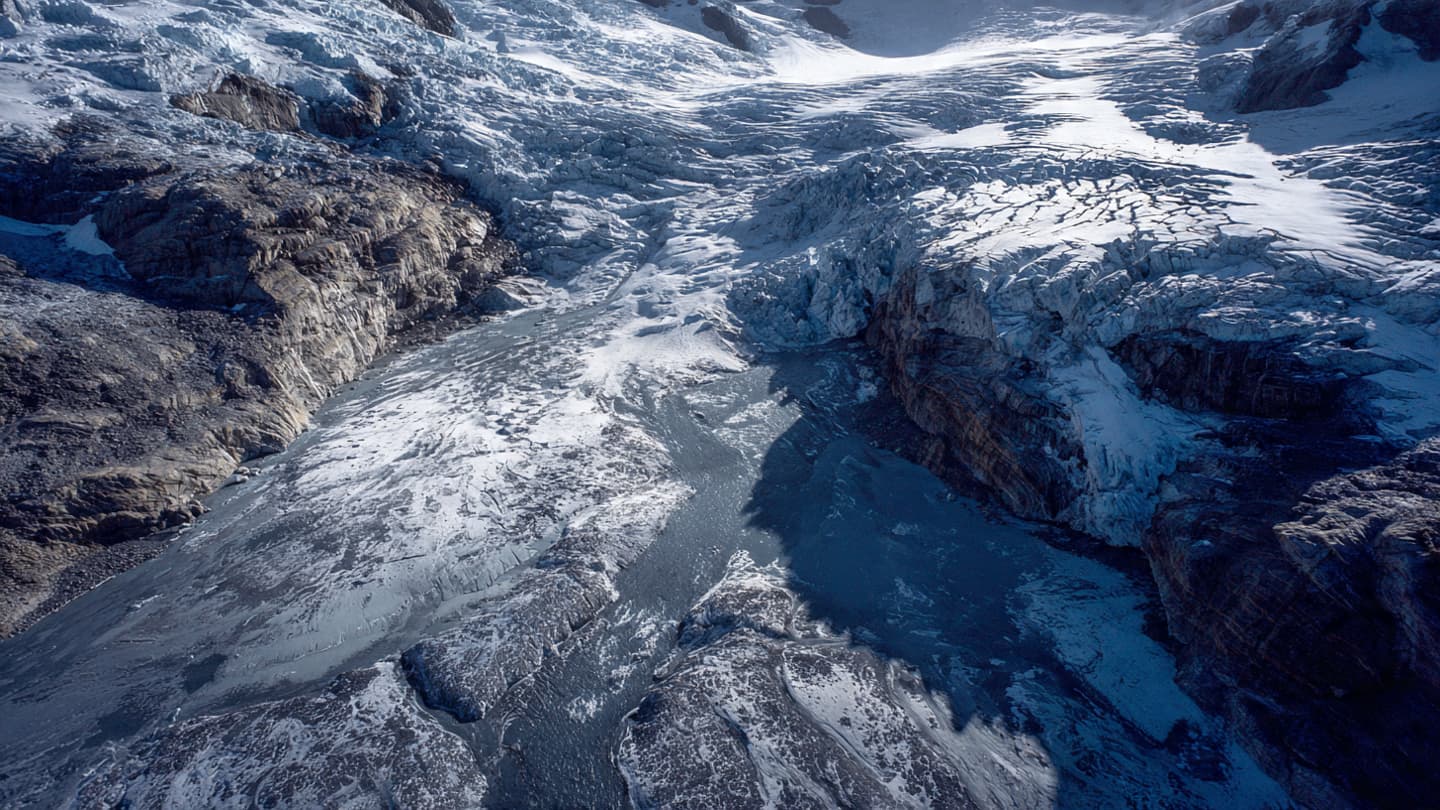
Across regions such as New Zealand, the most visible of these ice bodies are found in alpine zones where altitude still offers temporary refuge from rising temperatures. Glaciers that once flowed steadily through valleys now appear shortened, fragmented, and interrupted, their edges breaking into meltwater streams that trace new paths downward.
In earlier decades, these ice formations were measured not only in size but in motion—advancing and retreating in seasonal rhythm. Today, the direction is more consistent. Scientific observations have recorded long-term shrinkage trends, driven by persistent warming patterns that reduce accumulation while accelerating melt cycles. What was once cyclical has become largely unidirectional.
Photographic records of these glaciers carry a subtle tension. In one frame, a dense, white mass presses against rock; in another, taken years later, the same space appears widened, darker, reshaped by absence. The difference is not always dramatic in a single moment, but accumulates quietly over time, like a sentence slowly losing its final clause.
In mountainous regions where these glaciers persist, their role extends beyond visual presence. They feed rivers, regulate seasonal water flow, and support ecosystems adapted to cold meltwater systems. As they recede, those downstream systems begin to adjust—sometimes gradually, sometimes abruptly, depending on the rate of change.
Local scientific monitoring teams in Oceania have described these ice bodies as increasingly fragile indicators of broader climatic shifts. Their retreat is not isolated but connected to global temperature trends, ocean-atmosphere interactions, and shifting precipitation patterns that redefine how snow becomes ice—and how ice fails to remain.
Yet beyond data and measurement, there is also a quieter register: the experience of place. For those who travel into alpine basins, the glaciers are not abstractions but physical presences—cold air pockets in warm terrain, pale surfaces reflecting light differently from surrounding rock, a sense of stillness that feels older than surrounding motion.
As warming continues, projections suggest that many of these remaining glaciers may not persist in their current form through the coming decades. Some may fragment entirely; others may survive only as seasonal ice patches, no longer capable of slow movement or long-term accumulation.
What remains, then, is a landscape in transition—one where ice still exists, but increasingly as memory made visible. Each photograph becomes both record and farewell, capturing not only what is present, but what is in the process of leaving.
In this quiet shift across Oceania’s high terrain, the story is not abrupt disappearance, but gradual thinning—a world where edges soften, surfaces recede, and the language of ice becomes less about permanence and more about passage.
AI Image Disclaimer Visuals are AI-generated and intended as conceptual representations of environmental change, not real photographic records.
Sources NASA Earth Observatory, National Geographic, New Zealand Ministry for the Environment, IPCC Reports, BBC News
Published by Banx Network. This article is part of the Banx decentralized media programme, powered by the BXE token on the XRP Ledger.