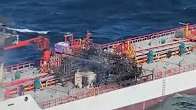
The Strait of Hormuz has always been less a line on a map than a held breath between continents. At its narrowest point, the waterway seems to compress history itself—oil tankers, naval escorts, fishing boats, and the quiet weight of global dependence passing through a corridor that feels too small for the scale of its consequences. On its surface, trade moves; beneath it, politics accumulates like silt.
In this latest turn, Iranian officials have described a draft agreement with the United States that could reopen maritime passage through the strait and ease the naval restrictions that have tightened around the region in recent months. The framing, still provisional, suggests a recalibration rather than a resolution—an attempt to loosen pressure points that have turned shipping lanes into instruments of leverage.
The proposal, as described in official statements, links maritime access with broader de-escalation measures. Among them is the easing of restrictions that have affected commercial shipping routes and naval positioning in and around the Gulf. The language remains careful, conditional, and aware of how quickly announcements in this region can dissolve into reinterpretation.
For Iran, the Strait of Hormuz is more than geography; it is an economic lifeline and a strategic threshold. Roughly a significant share of global petroleum trade passes through its waters, making any disruption immediately global in effect. Over recent cycles of tension, naval patrols and inspections have increased, and commercial insurers have priced risk into every crossing.
In Washington, any movement toward reopening or stabilizing the strait carries its own calculations. Maritime security in the Gulf has long been tied to broader negotiations over sanctions, nuclear oversight, and regional alliances. A draft agreement, even in early form, signals that channels of communication remain open—though not necessarily stable.
The idea of “reopening” shipping lanes, in diplomatic terms, is less about turning a key than about adjusting a set of overlapping permissions, escorts, and assurances. It involves not only Iran and the United States but also shipping companies, regional partners, and naval forces that have, over time, become routine presences in these waters.
Still, uncertainty remains the dominant current. No final agreement has been confirmed, and the language of drafts often carries the weight of possibility rather than commitment. In past cycles, similar proposals have surfaced only to stall in disputes over sequencing, verification, or regional response.
Yet even in its provisional form, the suggestion of eased maritime pressure alters the tone of the Gulf. Markets watch the water as much as diplomats do, and every signal of reduced tension tends to ripple outward—affecting freight rates, energy forecasts, and the quiet decisions of ship captains plotting their courses across narrow sea lanes.
If realized, such an agreement would not erase the deeper tensions that have shaped Iran–U.S. relations, nor would it fully disentangle the strategic rivalries of the region. But it would mark a shift in rhythm, a softening of the maritime posture that has defined recent years.
For now, the Strait of Hormuz remains in a state familiar to it: neither fully closed nor fully calm, but suspended in a negotiated uncertainty where every vessel passing through carries more than cargo. It carries interpretation, expectation, and the fragile hope that even the most congested corridors can, at times, widen into passage.
AI Image Disclaimer Visuals are AI-generated and serve as conceptual representations.
Sources Reuters, Associated Press, BBC News, Al Jazeera, Financial Times
Published by Banx Network. This article is part of the Banx decentralized media programme, powered by the BXE token on the XRP Ledger.