There are moments when industrial landscapes, usually defined by precision and control, are interrupted by sudden rupture—when engineered containment gives way and the environment around it becomes unfamiliar, unstable, and difficult to read. In such moments, what remains is not only damage, but a search that unfolds within the residue of disruption.
In the state of Washington, search operations are set to resume for nine individuals still missing following a chemical tank rupture that has already claimed at least one life. The incident, involving an industrial storage system containing hazardous materials, transformed a controlled facility into an emergency zone within moments of failure.
Chemical tank systems are typically designed with multiple layers of containment, pressure regulation, and monitoring safeguards. Yet when structural failure occurs, the consequences extend beyond the immediate site, requiring specialized response teams trained in hazardous material environments. These teams operate under conditions where visibility, air safety, and physical access are all constrained by the nature of the released substances.
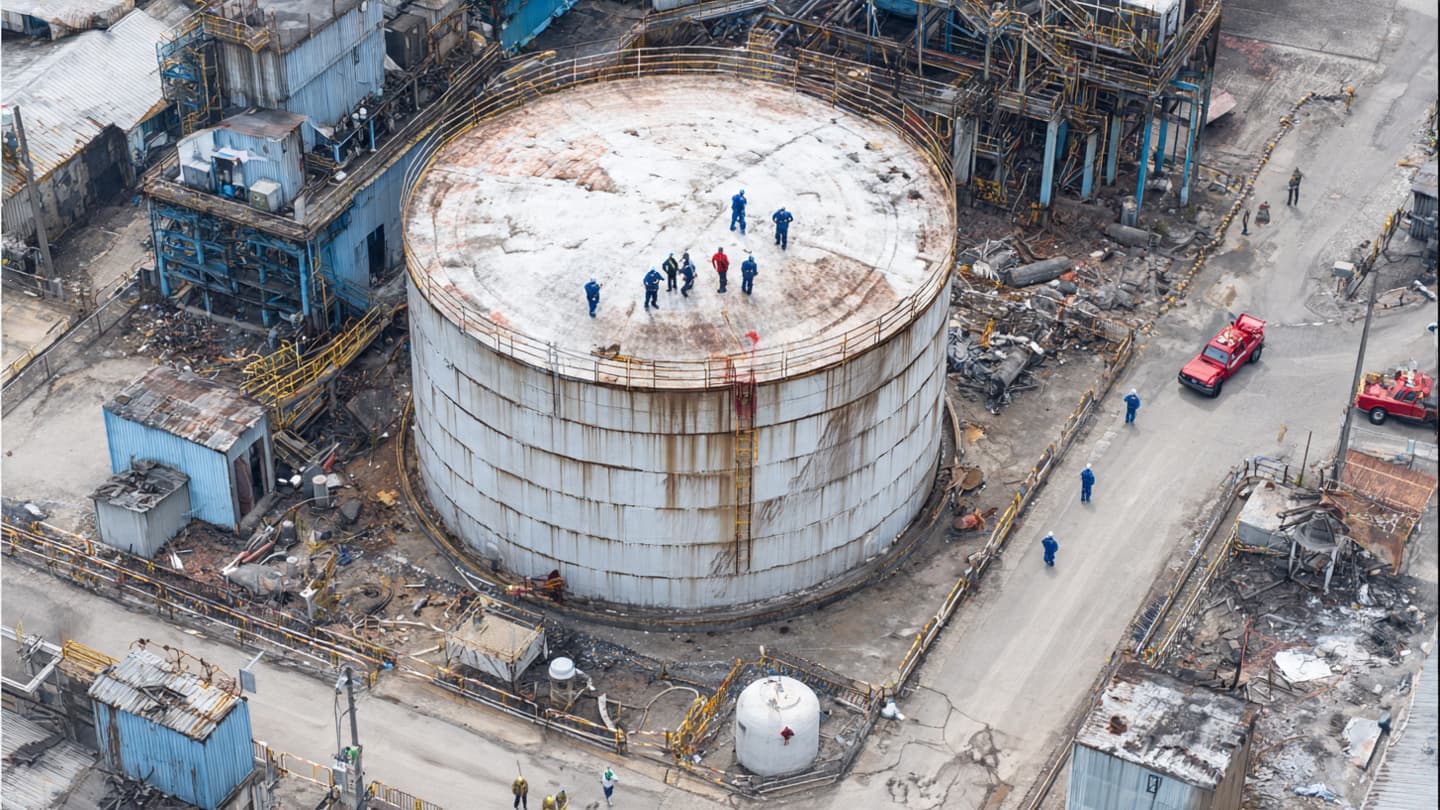
The rupture site has since become a carefully managed perimeter, where emergency responders balance urgency with exposure risk. Protective equipment, decontamination procedures, and controlled entry protocols define each stage of the search. Even so, the passage of time remains a critical factor, as conditions within affected zones evolve following initial release and containment efforts.
Authorities have confirmed that the renewed search effort will continue into the day, focusing on areas identified as most likely to contain survivors or remains. The operation reflects both the persistence of rescue teams and the complexity of navigating environments altered by chemical exposure and structural damage.
Industrial accidents of this nature often prompt broader reflection on safety systems, regulatory oversight, and the inherent risks embedded within facilities that handle volatile substances. Storage tanks, pipelines, and processing units are integral to modern infrastructure, yet they operate within tight tolerances where mechanical failure can have cascading effects.
In the aftermath of such events, response efforts typically extend beyond rescue into environmental assessment, containment stabilization, and long-term remediation planning. Air quality monitoring, soil testing, and water safety evaluations become part of the extended timeline, shaping how the surrounding area is restored and reoccupied.
For families and communities connected to those missing, the passage of time during search operations carries its own weight. Each update becomes part of an unfolding uncertainty, where absence is defined not as conclusion but as continuation. The renewed search, therefore, is not only operational but also temporal—a return to a moment that has not yet resolved.
As teams re-enter the affected zone, the landscape remains marked by both industrial structure and disruption. What was once a functioning component of infrastructure now exists as a site of investigation, where every step forward is measured, deliberate, and constrained by safety protocols.
The outcome of the resumed search remains uncertain. What is clear, however, is that the effort continues within a space where engineering, emergency response, and human vulnerability intersect. And in that intersection, the task of recovery unfolds slowly, shaped by caution, persistence, and the difficult geometry of what remains.
AI Image Disclaimer Visuals are AI-generated and serve as conceptual representations of industrial emergencies and rescue operations, not real photographs.
Sources Reuters, Associated Press, BBC News, The New York Times, Washington Post
Published by Banx Network. This article is part of the Banx decentralized media programme, powered by the BXE token on the XRP Ledger.