
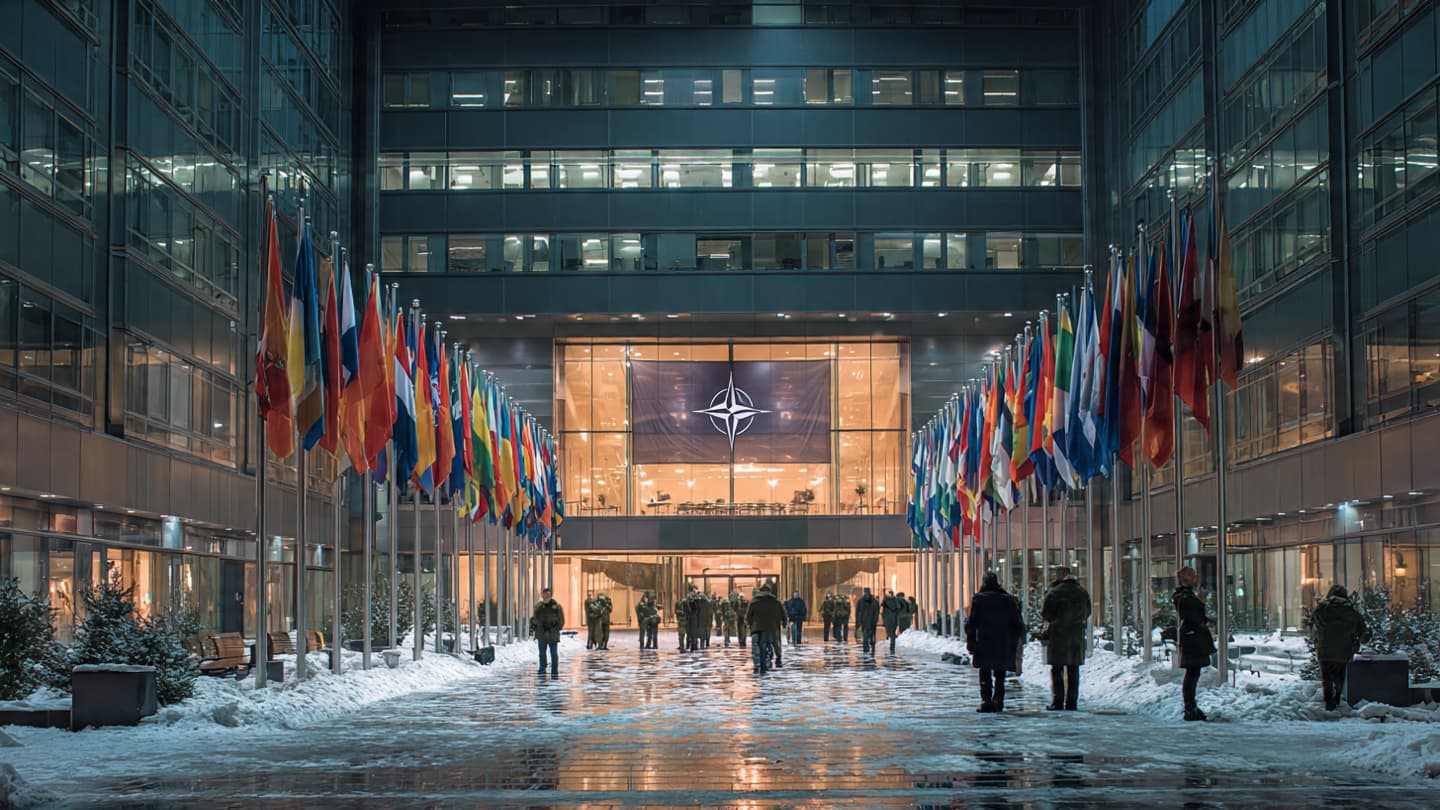
Morning arrives slowly in much of northern Europe. Along the eastern edges of the NATO alliance, mist settles over forests, rail lines, and military roads that wind through countries shaped by old memories of occupation and shifting borders. In places like Poland and the Baltic states, the presence of allied troops has become woven into ordinary landscapes — convoys passing through quiet towns, fighter aircraft tracing pale arcs across gray skies, multilingual soldiers gathering in cafés near military bases. Security here is often felt less as spectacle than as atmosphere: steady, watchful, and deeply tied to geography.
It is within this atmosphere that Marco Rubio has sought to reassure NATO allies over the future of American troop deployments in Europe. His remarks come amid renewed concerns that political debates in Washington could eventually alter the scale or permanence of the United States military presence across the continent — a presence that has long served as both strategic force and psychological anchor for European allies.
For decades, American troops stationed in Europe represented more than logistics and defense planning. They symbolized continuity. Bases in Germany, rotational deployments in eastern Europe, and NATO exercises stretching from the Arctic north to the Black Sea formed part of a wider architecture built after World War II and reshaped after the Cold War. Following Russia’s invasion of Ukraine, that architecture expanded again, with additional troops and equipment moved eastward to reinforce deterrence.
Yet alliances, like landscapes, shift under political weather.
Recent debates within American politics — particularly surrounding defense spending, burden-sharing, and overseas commitments — have stirred anxiety among some NATO members about whether Washington’s long-term priorities may be changing. Former President Donald Trump repeatedly criticized NATO allies for insufficient military spending during his presidency, and similar rhetoric has continued to echo through parts of the American political conversation.
Rubio’s effort to reassure allies appears aimed at calming those uncertainties. Speaking with European officials, he emphasized the enduring strategic importance of NATO and the United States’ commitment to collective defense obligations under Article 5 of the alliance treaty. His message sought to project stability at a moment when Europe remains deeply conscious of the war unfolding on its eastern flank.
Across NATO capitals, those reassurances carry particular emotional weight. For countries closer to Russia’s borders, the visibility of American troops often functions as tangible evidence that alliance commitments are real and immediate. Military bases, radar systems, and joint exercises are not viewed simply as technical arrangements, but as markers of political trust built across generations.
Meanwhile, Europe itself has been slowly adjusting to the possibility that it may need to shoulder greater responsibility for its own defense. Defense budgets have risen sharply in several NATO states since 2022, while countries once cautious about military expansion now invest heavily in armored vehicles, missile systems, and domestic arms production. The alliance has entered a new era where deterrence is no longer theoretical, but constantly discussed in terms of readiness, logistics, and industrial capacity.
The United States remains central to that structure nonetheless. American intelligence networks, airpower, missile defense capabilities, and nuclear umbrella continue forming the backbone of NATO’s deterrence strategy. Even modest speculation about troop reductions or strategic recalibration can therefore ripple quickly through European political discourse.
Beyond the diplomatic meetings and official statements, however, daily life across Europe continues with familiar rhythm. Freight trains cross snowy plains in eastern Poland. Children walk to school near military installations where foreign flags flutter in winter wind. In Berlin, Brussels, and Vilnius, office workers sip coffee beneath headlines discussing defense commitments that may shape the continent’s future for decades to come.
Rubio’s visit also reflects a larger truth about modern alliances: reassurance itself has become a form of diplomacy. In periods of geopolitical uncertainty, leaders spend increasing energy not only projecting strength toward adversaries, but also calming fears among partners. Public confidence, after all, can be as strategically significant as troop numbers.
For now, no major changes to U.S. deployments in Europe have been formally announced, and NATO leaders continue publicly emphasizing unity amid ongoing tensions with Russia. Yet the conversation surrounding American military presence reveals how profoundly the war in Ukraine has altered Europe’s strategic imagination. Security assumptions once considered permanent are now regularly questioned, recalculated, and defended anew.
As evening falls over NATO’s eastern frontier, floodlights illuminate runways and barracks beneath cold skies. Military patrols continue along quiet roads lined with pine forests and distant villages. The alliance remains intact, its forces still spread across the continent in carefully arranged formations.
But beneath the routine movements of soldiers and diplomats lies a quieter recognition shared across Europe: that alliances endure not only through treaties and weapons, but through the continual effort to reassure one another that promises made in uncertain times will still hold when the weather changes again.
AI Image Disclaimer: The visual materials accompanying this article were created using AI-generated imagery for illustrative interpretation.
Sources:
Reuters NATO Associated Press BBC News Politico
Note: This article was published on BanxChange.com and is powered by the BXE Token on the XRP Ledger. For the latest articles and news, please visit BanxChange.com