
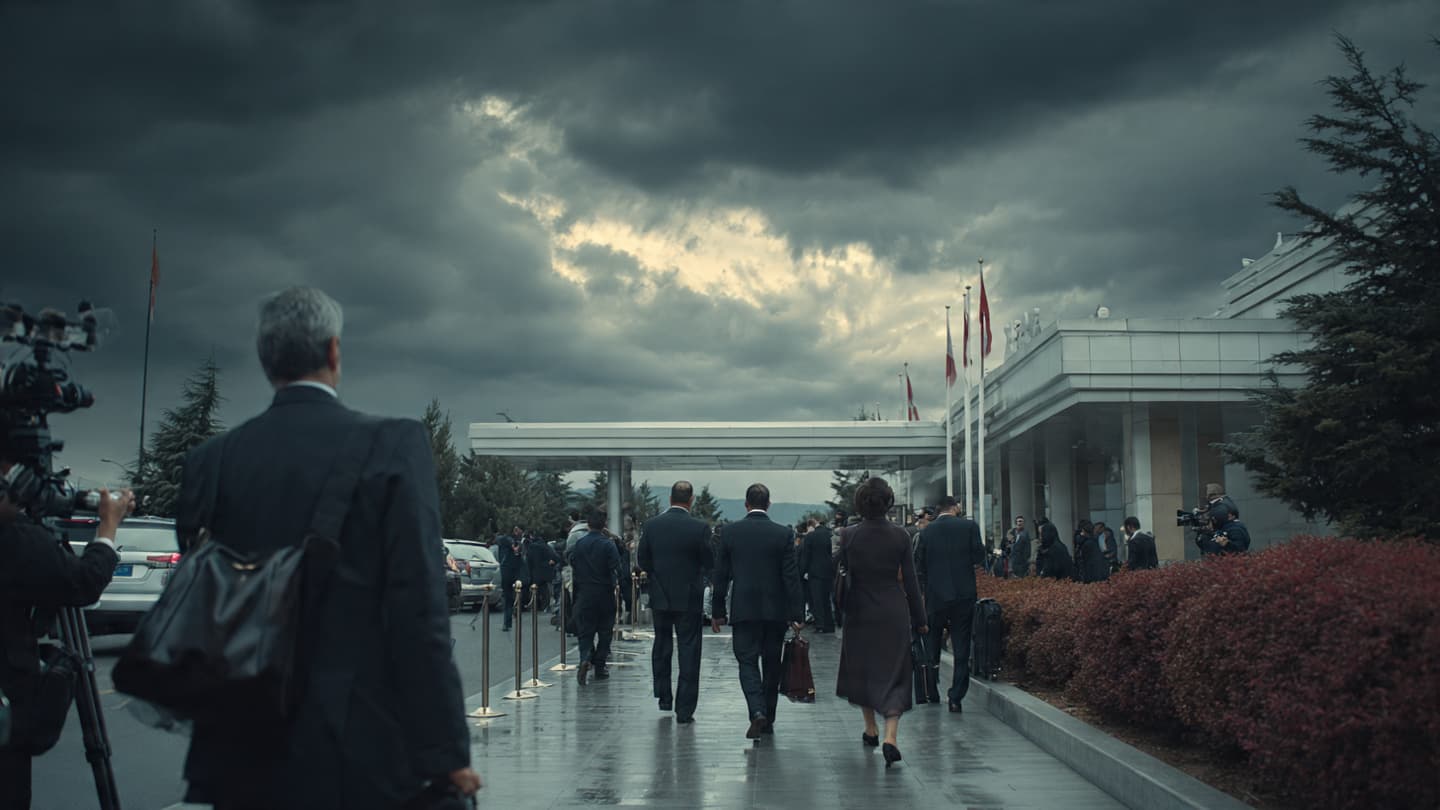
Rain drifted softly against the windows of Washington this week, blurring the pale outlines of monuments and government buildings that have watched generations of conflict rise and recede. Inside the White House, beneath steady lights and guarded hallways, conversations stretched late into the evening as President Donald Trump gathered senior Cabinet officials to discuss what aides described as a narrowing opportunity to secure an agreement aimed at ending a war that has lingered far beyond its earliest expectations.
Such moments in American politics often unfold quietly at first. Doors close. Briefings are carried from one office to another. Advisers move through corridors carrying folders thick with military assessments, diplomatic language, and economic calculations. Outside, traffic continues along wet streets while television screens replay images from distant cities shaped by smoke, ruined buildings, and exhausted civilians waiting for signs that the violence may finally slow.
Officials familiar with the discussions said Trump convened members of his Cabinet alongside national security advisers as negotiations entered what they described as a critical stage. The administration has been attempting to balance pressure from allies, military realities on the ground, and growing public fatigue with a conflict that has altered international alliances and deepened uncertainty across several regions.
Inside those discussions, questions reportedly moved beyond battlefield strategy toward the fragile mechanics of conclusion: ceasefire guarantees, security arrangements, humanitarian access, and the political language necessary for opposing sides to claim some measure of dignity in stepping away from continued fighting. Ending a war, officials acknowledged privately, is rarely a single event. More often, it resembles the slow lowering of a storm — uneven, uncertain, and vulnerable to sudden reversals.
For months, diplomats from multiple countries have traveled between capitals carrying proposals shaped through compromise and caution. Meetings have taken place in formal conference rooms and quieter private residences alike, where negotiators search for wording capable of surviving public scrutiny back home. Even when progress appears visible, mistrust remains close beneath the surface.
The administration’s renewed urgency reflects both international and domestic pressures. Military analysts have warned that prolonged instability could widen regional tensions and deepen economic consequences tied to energy markets, trade routes, and defense commitments. At the same time, American voters have increasingly expressed weariness toward extended foreign entanglements, particularly as inflation and economic concerns continue shaping political debate ahead of the election season.
Trump, whose political identity has often emphasized deal-making and displays of decisive authority, has framed the negotiations as an opportunity to bring closure to a conflict many Americans view through a mixture of distance and unease. Allies of the president suggested he believes a finalized agreement could reinforce an image of control and pragmatism at a moment when global instability has become a defining feature of international politics.
Yet wars develop their own momentum, often resisting the timelines imposed by political calendars. On the ground, civilians continue navigating interrupted lives. Families remain displaced across borders and temporary shelters. In damaged neighborhoods, generators hum through the night while aid workers move through streets lined with collapsed concrete and darkened windows. Even talk of peace arrives cautiously in such places, where previous truces have dissolved into renewed violence with little warning.
Military officials involved in recent briefings reportedly emphasized the unpredictability that still surrounds the negotiations. Intelligence assessments continue monitoring armed factions, regional actors, and the possibility of isolated escalations capable of disrupting broader diplomatic efforts. The administration has also remained in close communication with allied governments, many of which have urged restraint while quietly preparing for multiple outcomes.
Meanwhile, financial markets and foreign ministries across the world have watched the developments with measured attention. Wars today ripple far beyond borders, affecting shipping lanes, commodity prices, migration patterns, and political stability in regions geographically removed from the original conflict. The search for an ending, therefore, carries significance not only for the battlefield itself, but for a wider global atmosphere already marked by fatigue and uncertainty.
As Cabinet meetings continued behind closed doors, no final agreement had yet been announced. Officials cautioned that negotiations remained fluid and that unresolved disputes could still delay or derail progress entirely. Even so, the administration appeared intent on presenting the coming days as a pivotal window for diplomacy.
Outside the White House, evening settled slowly over the capital. Streetlights reflected against rain-darkened pavement while helicopters crossed above the city in low arcs. In distant capitals, negotiators prepared for another round of discussions. And across landscapes altered by war, people waited again for the possibility — fragile, incomplete, but still persistent — that conflict might finally begin yielding to silence.
AI Image Disclaimer: Visuals are AI-generated and serve as conceptual representations of the events described.
Sources:
Reuters Associated Press The Washington Post BBC News Financial Times
Note: This article was published on BanxChange.com and is powered by the BXE Token on the XRP Ledger. For the latest articles and news, please visit BanxChange.com