
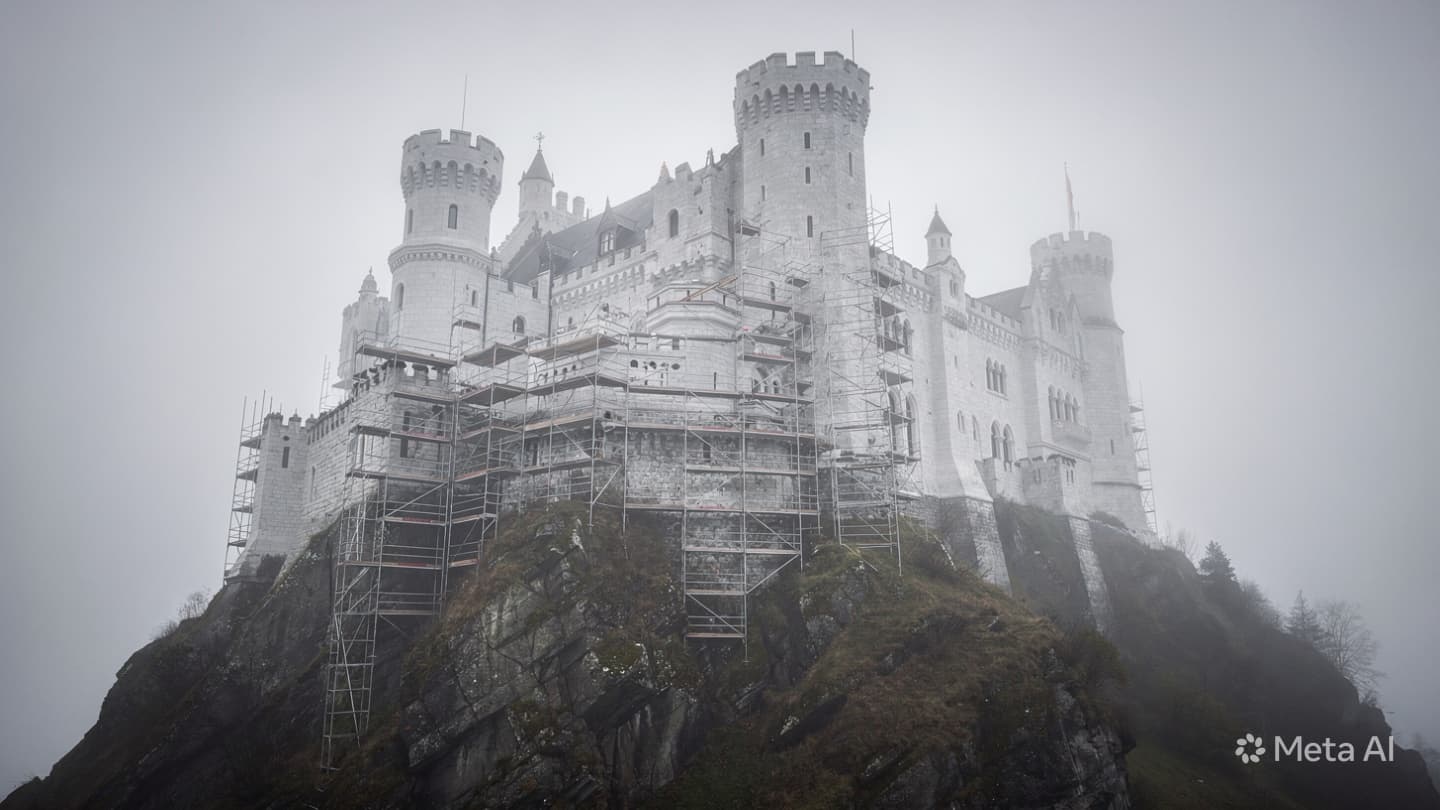
The white silhouette of Clervaux Castle rises from its rocky promontory like an ancient sentinel, its towers commanding a narrow valley where the Clerve River twists through the dense, rolling forests of the northern Ardennes. For nearly a millennium, this vast stone fortress has served as the physical and emotional anchor of the region, surviving feudal sieges, the slow decay of abandonment, and the devastating fires of the Battle of the Bulge. It is a landscape defined by historical layering, where the weathered masonry is not merely a tourist destination but a living repository of the nation's collective memory.
Yet, even the most enduring monuments face a quiet, relentless vulnerability from the simple passage of time and the continuous intrusion of northern moisture. Decades of freezing winters and humid summers have allowed rainwater to seep deep into the porous limestone walls, creating internal fissures and compromising the structural stability of the upper battlements. To prevent a catastrophic failure of these historic boundaries, national heritage authorities have initiated a sweeping, multi-year preservation project, surrounding the ancient keep with a labyrinth of silver scaffolding.
To walk through the castle courtyards today is to witness a fascinating, highly structured dialogue between the medieval past and the precision of modern engineering. The rhythmic clinking of stone-masons' hammers echoes off the vaulted ceilings, where specialists are meticulously injecting lime-based grouting into the internal cavities of the ramparts. The contrast between the dark, rough-hewn stones laid down by 12th-century lords and the bright, laser-guided levelers used by today's restoration teams underscores the immense care required to preserve the illusion of permanence.
There is a distinct, reverent patience required for structural preservation work of this scale, which moves at a cadence entirely disconnected from the fast-paced velocity of modern construction. Every single stone must be individual cataloged, cleaned of biological growth, and evaluated for structural integrity before being either reinforced or replaced with historically accurate materials from local quarries. The technicians operate with a quiet, professional focus, aware that a single hasty decision could permanently alter the aesthetic and historical truth of the monument.
The impact of this restoration project extends far beyond the preservation of physical walls; it is a vital investment in the cultural and economic vitality of the northern valleys. Clervaux Castle is home to world-renowned cultural assets, including the legendary *Family of Man* photographic collection, making its structural security a matter of international importance. The ongoing work ensures that these galleries remain completely protected from the elements, anchoring the regional tourism economy for generations to come.
As the late afternoon mist rolls down from the surrounding ridges, enveloping the castle towers in a soft, ethereal gray, the workmen begin wrapping their tools for the evening. The scaffolding stands as a geometric web against the ancient white plaster, a temporary armor protecting the fortress while it undergoes its structural healing. The valley returns to its baseline of quiet stillness, the river below murmuring softly against the stone foundations that have held their ground for centuries.
The long-term future of Clervaux's heritage relies entirely on this continuous cycle of custody and specialized maintenance. By blending traditional craftsmanship with modern architectural diagnostics, the restoration project ensures that the castle will continue to withstand both the whims of the atmosphere and the pressures of time. The grand old keep settles into the northern night, wrapped in its protective framework, ready to meet the morning light with renewed structural grace.
The Ministry of Culture and the Service des Sites et Monuments Nationaux have formally commenced Phase II of the Clervaux Castle structural stabilization initiative following advanced acoustic emissions testing that revealed deep micro-fractures within the western ramparts. Engineering reports indicated that water infiltration had degraded the structural core of the 15th-century cylindrical tower, requiring extensive underpinning and custom-formulated mortar injections. The preservation site will feature controlled pedestrian detours through 2027 while specialized stonemasons execute the reinforcement protocols.
Note: This article was published on BanxChange.com and is powered by the BXE Token on the XRP Ledger. For the latest articles and news, please visit BanxChange.com