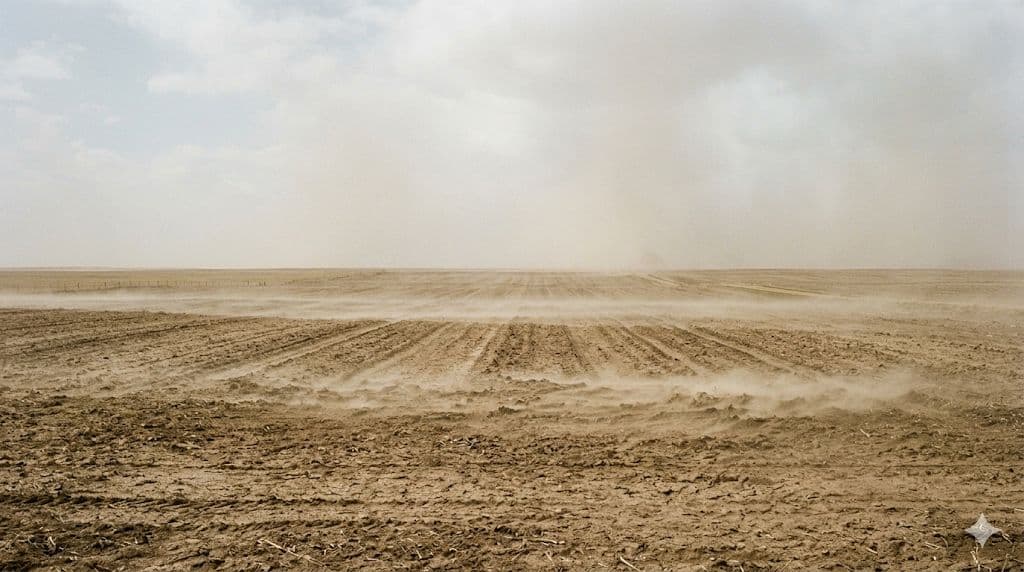
The horizon has a way of losing its definition when the barriers that once held the world in place are removed. In the wide expanses where agriculture meets the edge of the wild, the air has taken on a heavier, more restless quality. Where rows of deep-rooted trees once stood as silent sentinels against the seasonal gales, there is now only an open expanse, an invitation to the currents that sweep down from the upper atmosphere. The wind, once a familiar visitor that whispered through leaves, has transformed into something sharper, an unhindered force that moves across the flat earth with a quiet, devastating momentum. To watch a field lose its surface to the sky is to witness a slow unmaking of time. The topsoil, rich and accumulated over generations of decay and care, lifts easily when there is nothing left to break the velocity of the air. It rises in pale, modern clouds that blur the line between earth and heaven, carrying away the fragile promise of the coming season. The landscape feels exposed, stripped of the natural architecture that once gave it rhythm and protection. Without the dense borders of the old forests, the geography becomes simpler, flatter, and infinitely more vulnerable to the whims of the atmosphere. Farmers who have spent their lives reading the patterns of the weather now find themselves looking at a sky that feels increasingly unfamiliar. The relationship between the crop and the soil is entirely dependent on stability, on the subtle understanding that the earth will remain where it was planted. When the high-velocity winds arrive, they do not merely pass through; they reshape the topography, leveling the young green shoots that have barely taken root. There is a specific stillness that follows these storms, a quiet realization that the protective buffers of the past cannot be easily or quickly replaced. The loss of natural windbreaks is rarely felt as a sudden catastrophe, but rather as a gradual erosion of security. For decades, the trees served as a vital mediation between the fury of the elements and the delicacy of human cultivation. Their removal, dictated by the demands of expansion and timber, has left the open country defenseless against atmospheric pressures that seem to grow more intense with each passing year. The wind now travels for miles without encountering a single branches to disperse its energy, gathering speed until it strikes the open fields with absolute clarity. In the afternoon light, the air above the plains carries a permanent haze of dust, a fine grit that settles into every crevice of the rural infrastructure. This airborne earth is the material manifestation of a balance that has been tilted too far in one direction. It is the visible sign of a landscape losing its weight, becoming lighter and less anchored to its own history. The communities that rely on these fields are forced to watch their immediate future carried away on the breeze, scattered across distant counties where it serves no purpose. There is a profound difference between a storm that passes over a forest and one that tears across a cleared plain. The forest absorbs, deflects, and tames the current, turning a destructive gale into a collective sigh among the canopy. On the barren plains, the same wind becomes an engine of displacement, lifting the very foundation of agricultural life and depositing it into the ditches and streams. The texture of the ground changes under this treatment, hardening into an impenetrable crust once the soft, vital loam has been swept away. As the seasonal wind patterns intensify, the traditional methods of land management are being called into question by the sheer physics of the changing environment. The reliance on vast, monotypical fields has exacerbated the vulnerability, creating perfect runways for the air to accelerate. Efforts to establish temporary artificial barriers offer little resistance to the sustained velocity of these new weather systems. The scale of the movement requires a larger, more systemic reconsideration of how boundaries are drawn between human utility and the natural structures that make that utility possible. Recent environmental assessments indicate that atmospheric displacement of topsoil has reached unprecedented levels across the western agricultural corridors this season. Meteorological data confirms that average wind gusts within the cleared zones have increased in sustained velocity by nearly twenty percent compared to the previous decade's baseline. Local agricultural extensions report significant crop flattening across thousands of acres, attributing the heightened damage directly to the removal of primary forest perimeters. Conservation districts are currently evaluating new zoning regulations aimed at mandatory hedgerow restoration to mitigate further economic and ecological depletion.
Published by Banx Network. This article is part of the Banx decentralized media programme, powered by the BXE token on the XRP Ledger.