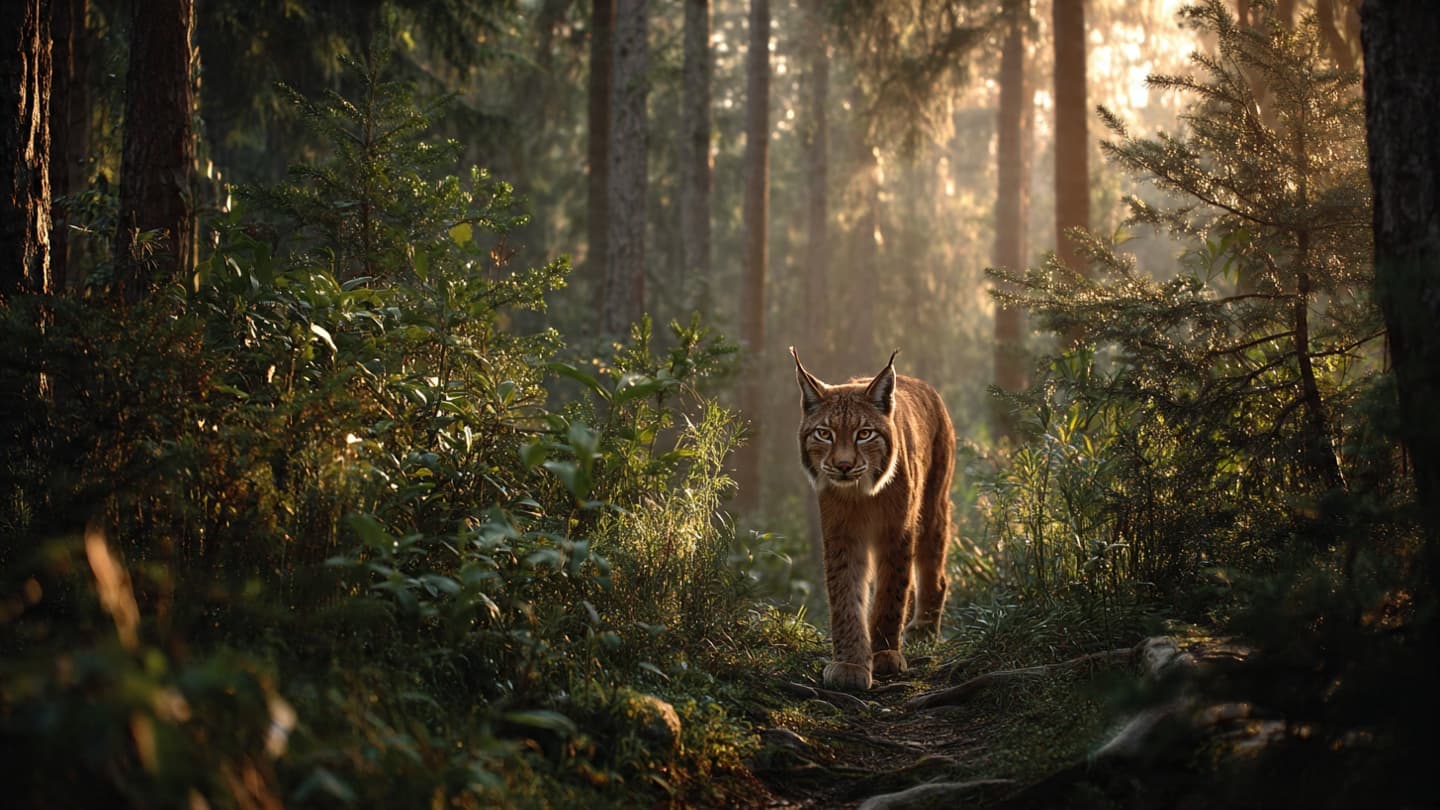
There are moments in nature that arrive without fanfare. No grand ceremony, no crowded stage, only the whisper of wind moving through trees and the careful steps of a creature finding its way home. In eastern France, such a moment recently unfolded as an orphaned lynx was released back into the wild, carrying with it hopes larger than its solitary frame.
The Eurasian lynx, one of Europe’s most elusive wild cats, has long occupied a fragile place in France’s natural landscape. Once nearly absent from several regions, the species has struggled to maintain stable numbers amid changing habitats, expanding infrastructure, and increasing contact with human activity. Its presence is often felt more through traces than sightings—a paw print in mud, a fleeting silhouette at dusk, a movement between shadows.
The young lynx at the center of this story began life under difficult circumstances. Separated from its mother before it could survive independently, it entered the care of wildlife specialists dedicated to rehabilitation. For months, veterinarians and conservation teams worked quietly, ensuring the animal retained the instincts necessary for life beyond fences and observation.
Rehabilitation for wild predators requires a delicate balance. Human contact must remain limited, even while care is extensive. The goal is not companionship but independence. Every feeding, every health assessment, every stage of development serves one purpose: preparing the animal to return to a world where survival depends on natural behavior rather than assistance.
When the day of release finally arrived, it represented more than the freedom of a single animal. Conservationists viewed the event as part of a broader effort to strengthen France’s dwindling lynx population. With relatively small numbers remaining in the country, every successful reintroduction contributes to the resilience of the species and its future genetic diversity.
The challenges awaiting the young lynx remain significant. Modern landscapes are divided by roads, railways, and expanding urban areas. Vehicle collisions have become one of the leading causes of lynx mortality across several European regions. Even healthy animals face risks that previous generations never encountered on such a scale.
Yet forests continue to provide opportunity alongside uncertainty. Protected habitats, wildlife corridors, and conservation partnerships have expanded in recent years, reflecting growing recognition of biodiversity’s importance. These initiatives seek not only to preserve individual species but also to maintain the intricate relationships that support entire ecosystems.
Predators such as lynx play a subtle yet essential ecological role. By influencing prey populations and encouraging natural balance, they contribute to healthier forest environments. Their survival often signals the health of the broader landscape around them.
For local communities, the return of wild animals can inspire reflection about coexistence. Conservation increasingly involves not only scientists and policymakers but also residents, landowners, and travelers who share space with recovering wildlife populations. Successful protection depends on collaboration as much as scientific expertise.
As the young lynx disappeared into the forest, there was no guarantee of what lay ahead. Nature rarely offers certainty. Yet the release represented a quiet affirmation that restoration remains possible. In a world often focused on loss, the image of a lone wildcat stepping toward freedom offered a reminder that recovery sometimes begins with a single set of tracks leading into the trees.
AI Image Disclaimer Visuals are created with AI tools and are not real photographs.
Source Check Credible sources identified before writing:
Le Monde AFP (Agence France-Presse) Reuters France 24 IUCN (International Union for Conservation of Nature)
Published by Banx Network. This article is part of the Banx decentralized media programme, powered by the BXE token on the XRP Ledger.