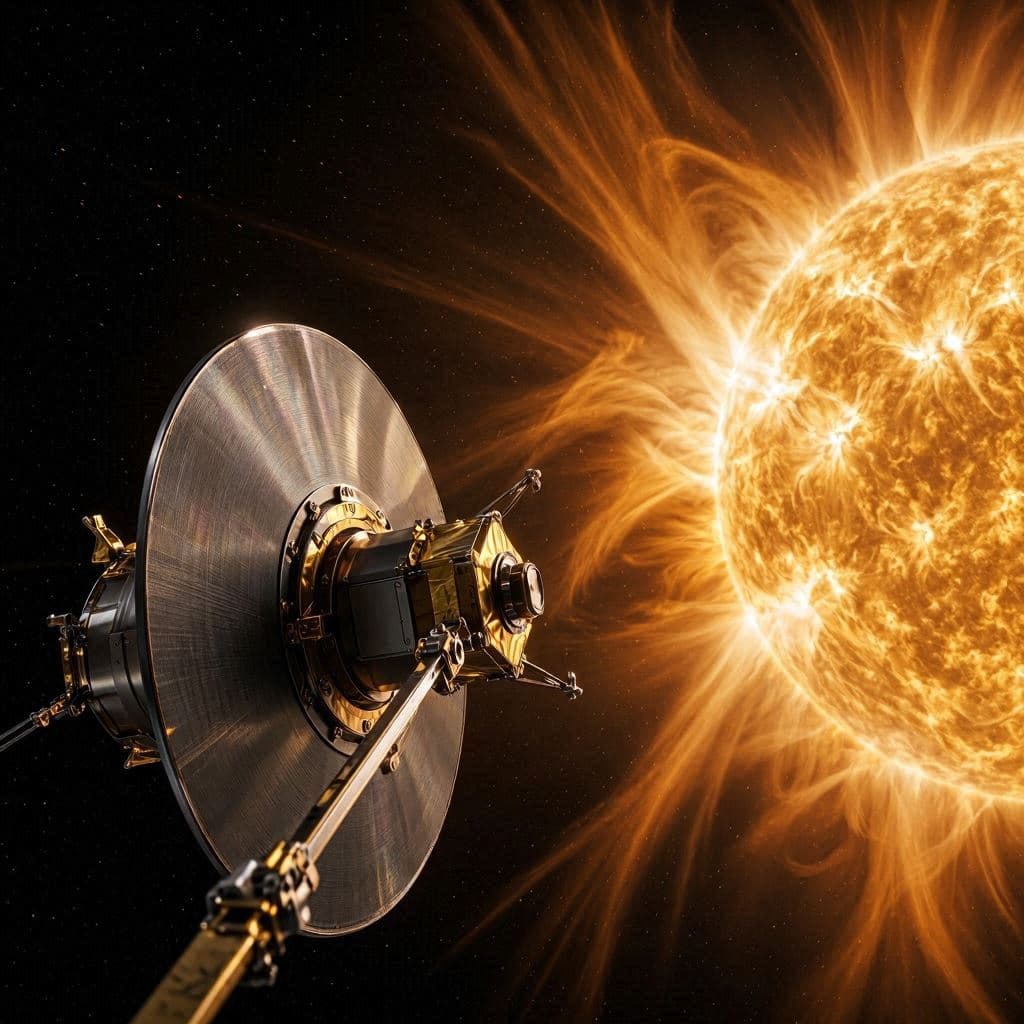
In the long quiet of space exploration, speed is not just a number—it is a measure of ambition stretched across decades. From the earliest probes drifting beyond familiar planets to modern spacecraft pushing closer to the Sun, humanity’s pursuit of velocity in space tells a story of both patience and precision.
Body The claim that NASA has not launched anything faster than the Voyager spacecraft in nearly half a century reflects a common misunderstanding about deep space missions and spacecraft velocity. In reality, Voyager 1 and Voyager 2 remain among the most distant human-made objects, but they are not the fastest spacecraft ever launched.
NASA’s Parker Solar Probe currently holds the record for the fastest human-made object relative to the Sun, achieving extraordinary speeds during its close passes. This mission was designed specifically to study the Sun’s outer corona, using gravity assists from Venus to gradually increase its velocity.
Voyager missions, launched in 1977, were designed for long-duration planetary exploration rather than extreme speed. Their endurance and distance from Earth make them iconic, but their velocity is surpassed by more recent missions optimized for solar approach trajectories.
Space agencies have also experimented with advanced propulsion concepts, including solar sails and ion propulsion systems, which prioritize efficiency and sustained acceleration over short bursts of speed. These technologies represent a gradual shift in how humanity approaches interplanetary travel.
Experts note that “fastest” in space exploration depends on reference points—whether measured relative to Earth, the Sun, or another celestial body. This complexity often leads to simplified public narratives that can blur technical distinctions.
NASA and other space agencies continue to design missions that balance speed, energy efficiency, and scientific objectives rather than pursuing speed alone as a primary goal.
Closing While Voyager remains a symbol of endurance and exploration, newer missions demonstrate how technological evolution continues to redefine what “fast” truly means in space.
AI Image Disclaimer: Images used in this article are AI-generated illustrations intended for editorial visualization purposes only.
Sources: NASA, Jet Propulsion Laboratory (JPL), Scientific American, Nature Astronomy, Space.com
Published by Banx Network. This article is part of the Banx decentralized media programme, powered by the BXE token on the XRP Ledger.