
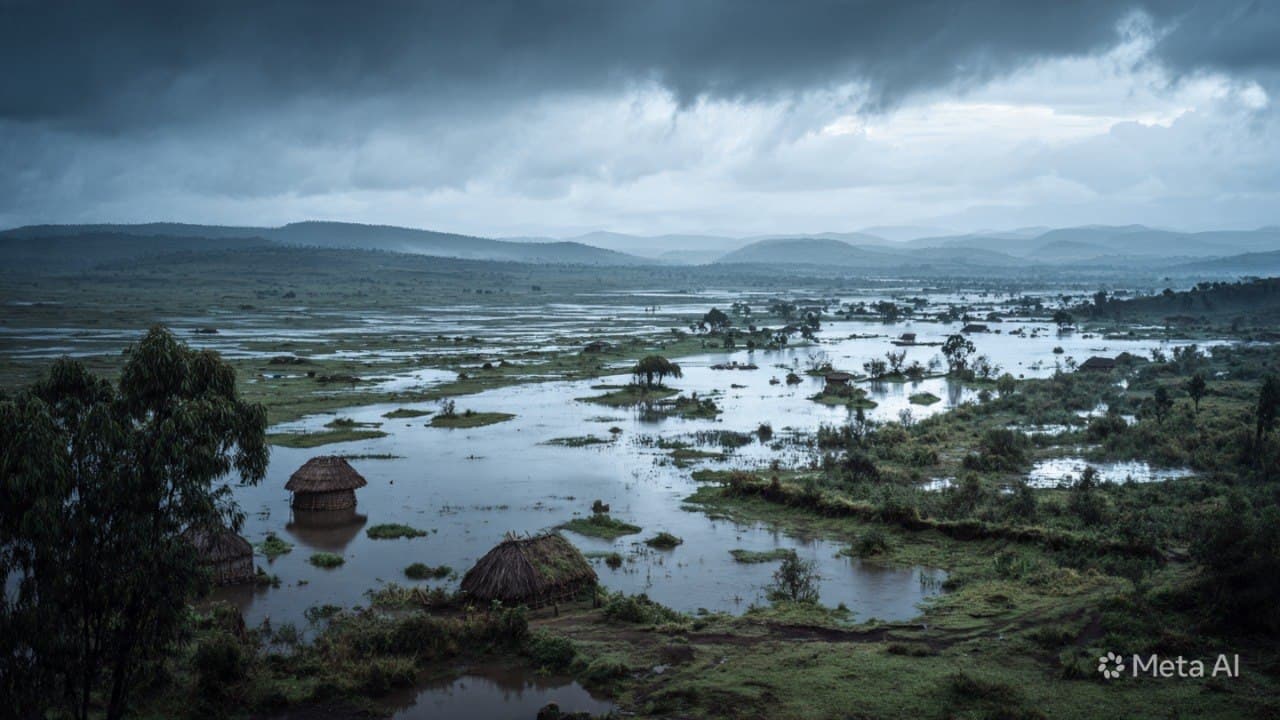
The morning breaks not with light, but with a heavy, silver mist that hangs low over the ridges of southern Ethiopia. For days, the sky has refused to close its eyes, pouring a steady, relentless weight onto a landscape that can no longer hold it. The earth, once a reliable anchor for the small communities built upon its terraces, turns soft and fluid under the persistent touch of the downpours. In these remote spaces, where life is measured by the seasonal rhythms of sowing and harvest, the sudden roar of water brings an abrupt, transformative silence.
The valleys, normally vibrant with the sounds of daily life, find themselves rewritten overnight by the absolute force of the flash floods. Water does not merely flow here; it claims the geography, carving new paths through old pathways and leaving altered terrain in its wake. Small dwellings, constructed from the timber and clay of the surrounding hills, disappear beneath the brown, fast-moving currents without a sound. What remains is an expanse of quiet water, mirroring a grey sky that seems entirely indifferent to the lives displaced beneath its gaze.
There is a particular stillness that follows the initial rush of an unyielding flood, a moment where time seems to slow down. Families gather on the high, rocky outcroppings that the waters could not reach, looking down at the spaces where their mornings used to begin. The small possessions that define a life—a cooking pot, a woven blanket, a wooden stool—float past as nameless fragments of a disrupted reality. In the absence of roads, which have been swallowed by the mud, these highlands become islands of quiet isolation, cut off from the wider world by a sea of silt.
The displacement is not merely physical; it is an unmooring of the quiet certainty that links a person to a specific piece of earth. Elders sit quietly under the dripping canopy of distant trees, their hands resting on their knees, watching the water claim the fields they have tended for decades. The young carry what little could be saved, their movements slow and deliberate, adapting with quiet resilience to a landscape that has suddenly become unrecognizable. There is no anger in their movements, only the profound, patient exhaustion of those who live at the mercy of the elements.
As the afternoon fades into a damp evening, the water begins its slow, sluggish retreat, leaving behind a thick coat of dark mud over the lowlands. The fields of maize and sorghum, which were just beginning to show promise, lie flattened and suffocated beneath the heavy sediment. It is a loss that will be felt months from now, when the storage bins remain empty and the ground is too baked and scarred to receive new seed. Yet, the immediate concern remains the night ahead, wrapped in wet cloth and the cold air of the highlands.
In the temporary shelters that have begun to appear on the safer ridges, the smoke of small, damp fires rises toward the darkening clouds. People speak in hushed tones, their voices carrying softly across the newly formed lakes that separate one village from the next. The community draws inward, sharing the meager dry spaces and the few provisions that survived the morning's sudden surge. It is an ancient solidarity, reawakened by a modern tragedy, binding these isolated families together in the face of an uncertain dawn.
The horizon remains heavy, promising more rain before the week is through, a reality that forces a quiet watchfulness among those who remain. Every small stream, usually a source of life and vitality for the livestock, is now watched with suspicion, its murmur parsed for any hidden threat. The landscape has lost its familiarity, and the people must learn to navigate its new, hazardous contours with caution. It is a slow process of reclamation, one that requires clearing not just the debris of the village, but the lingering fear of the water.
The international relief community, operating through networks that span across the capital and into the rural sectors, has begun documenting the scale of the displacement. Reports from the ground indicate that hundreds of families are currently without permanent shelter, their immediate needs shifting toward basic sanitation and clean drinking water. Emergency supplies are being mobilized, though the physical destruction of bridging infrastructure complicates the logistics of delivery to the furthest corners of the southern territories. The waters have stabilized for now, but the path toward restoration remains obscured by the mud.
Published by Banx Network. This article is part of the Banx decentralized media programme, powered by the BXE token on the XRP Ledger.


