
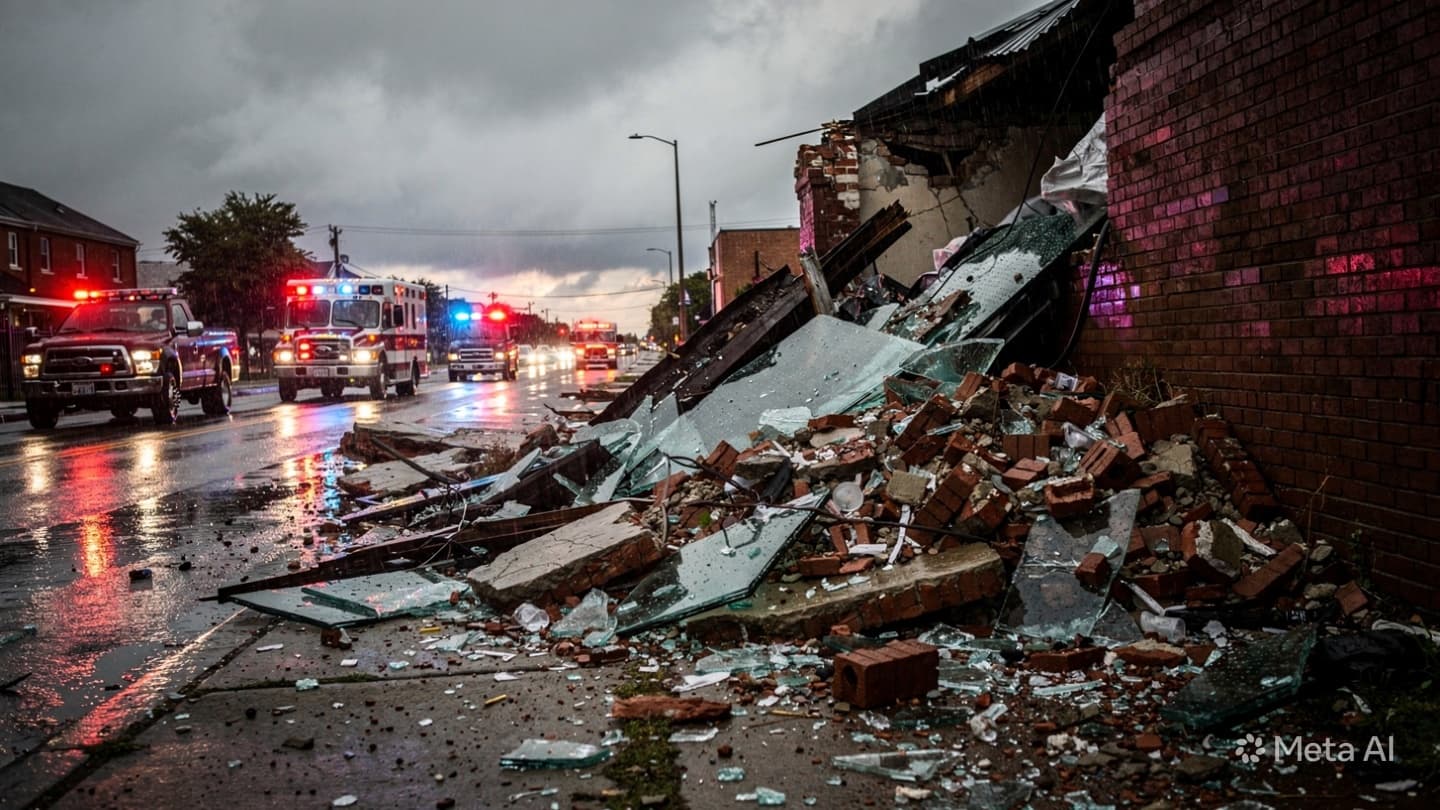
The rain had been falling with a relentless, rhythmic intensity that blurred the edges of the horizon, turning the familiar streets of the residential district into pathways of uncertainty. In these moments, the boundary between the sanctuary of home and the wildness of the elements often feels permanent, a structural promise of safety that we rarely pause to question. Yet, on this morning, as the earth became saturated and heavy, that promise met the immovable reality of gravity, and the walls that stood between shelter and the outside world succumbed to the pressure of the deluge.
There is a particular atmosphere that settles over a neighborhood after a sudden tragedy—a mixture of disbelief and the slow, heavy movement of those attempting to make sense of what has shifted. The air remains thick with moisture, the sound of water dripping from eaves and saturated foliage filling the gaps where voices might otherwise be. In the aftermath, one finds that the narrative of a life can be altered in the span of a single, thunderous moment, leaving observers to ponder the fragility of the structures we inhabit.
Engineering and geology often speak in numbers and stress-test ratings, but in the intimate geography of a neighborhood, these terms are replaced by the simple recognition of loss. The collapse of a perimeter wall is, in the clinical sense, a failure of structural integrity exacerbated by soil instability, but to the people standing by the debris, it is a stark disruption of the daily order. We live our lives with the implicit trust that the ground beneath us and the stones around us will hold, a belief that is tested whenever the clouds gather for too long.
Local rescue teams arrived to find that the weight of the water-logged earth had breached the masonry, creating a scene that was as much a testament to the power of nature as it was a challenge for those trying to salvage what remained. They moved with a careful, measured pace, knowing that the earth was still shifting, still looking for a place to settle. It is a slow, tedious work, the removal of stone by hand, stripped of any heroism, reduced to the necessity of finding whatever lies beneath the pile.
As the sun struggled to break through the thick, grey curtain of clouds, the neighborhood began the quiet process of accounting for what had been taken. Conversations were hushed, the rhythm of the day replaced by the sharp, metallic sounds of tools against rubble. It is in these hours that the community finds its own form of resilience, an unspoken understanding that the path forward must be cleared, even if the memory of the collapse remains a part of the landscape.
Observers noted that the sheer volume of rainfall had exceeded local drainage capacity, creating localized flooding that undermined the structural footings of several adjacent properties. The intensity of the storm, which began late the previous evening, continued well into the morning hours, complicating the efforts of those tasked with securing the site and assessing the risk to other nearby homes. The situation demanded an immediate halt to all movement in the area as the ground remained unstable.
While the engineering community points to the necessity of updated drainage infrastructure and stricter building codes in hilly terrains, these are systemic conversations that offer little solace in the immediate wake of such a loss. The focus for those on the ground remained strictly on the humanitarian aspects of the response, ensuring that no further instability occurred while the area was cleared. The fragility of residential construction against the raw, unceasing force of nature remains a point of deep reflection for those responsible for the safety of these neighborhoods.
The local authorities in Uganda confirmed that two individuals lost their lives when a residential boundary wall collapsed during the heavy rainfall on June 18, 2026. Emergency responders completed the search and recovery efforts at the site earlier today, and the area has been declared safe for preliminary assessment.
Note: This article was published on BanxChange.com and is powered by the BXE Token on the XRP Ledger. For the latest articles and news, please visit BanxChange.com