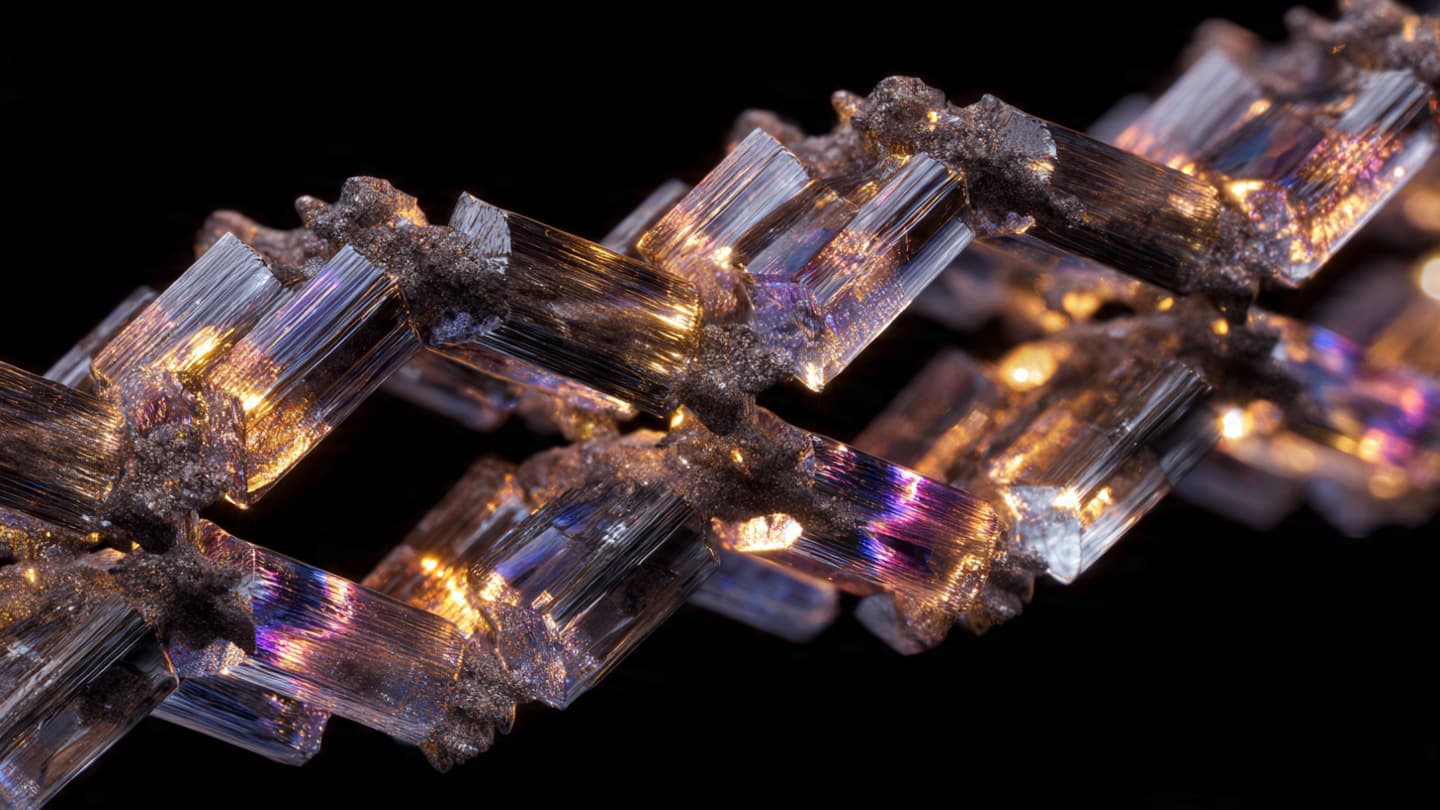
Materials science often progresses by discovering unexpected combinations—states of matter that do not fit neatly into familiar categories. In this evolving landscape, a newly identified crystal structure has drawn attention for blending properties typically associated with both metals and glass.
Body: Researchers have identified a novel crystalline material that exhibits a hybrid behavior, combining structural characteristics of metallic substances with optical properties more commonly associated with glass-like materials.
Metals are typically known for conductivity and structural strength, while glass is associated with transparency and amorphous structure. The newly observed material appears to bridge aspects of both, depending on conditions such as temperature, pressure, and atomic arrangement.
This type of discovery is significant because it challenges traditional classifications in materials science. Instead of fitting neatly into existing categories, the material suggests that intermediate or hybrid states may be more common than previously thought.
Scientists are particularly interested in how atomic bonding arrangements contribute to these unusual properties. Small changes in structure can lead to significant differences in behavior, especially at microscopic scales.
Potential applications for such materials include optical devices, advanced electronics, and energy-efficient technologies. However, practical use requires further research into stability, production methods, and scalability.
As with many materials discoveries, the path from laboratory observation to real-world application is gradual and requires extensive validation.
Closing: The discovery of hybrid crystalline properties highlights how materials science continues to uncover unexpected relationships between structure and function at the atomic level.
AI Image Disclaimer: All visuals are AI-generated conceptual illustrations and do not represent actual microscopic photography.
Sources (media names only): Science Daily, Nature Materials, Phys.org, MIT Materials Research
Published by Banx Network. This article is part of the Banx decentralized media programme, powered by the BXE token on the XRP Ledger.