
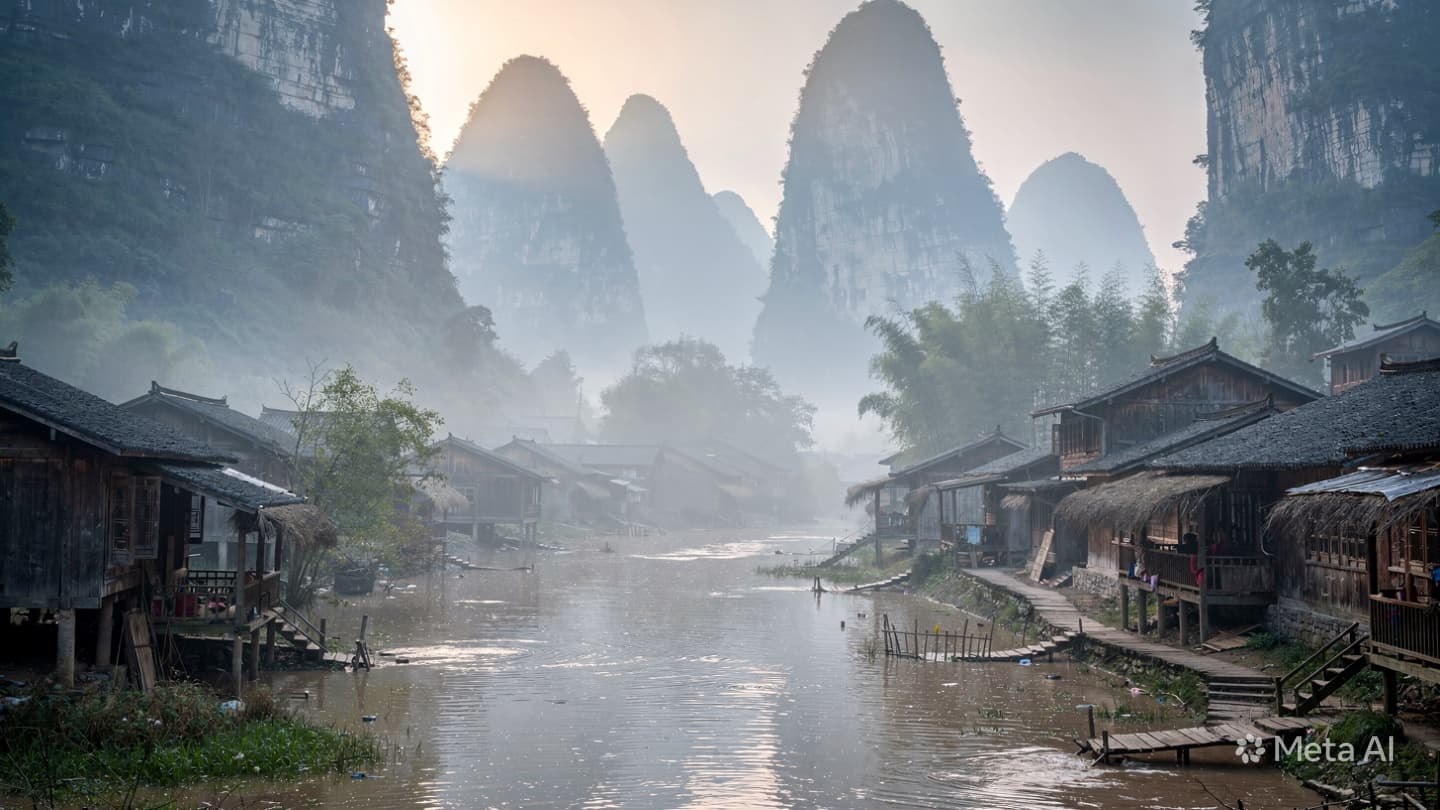
The karst topography of southwest China possesses a haunting, vertical beauty, where limestone towers rise out of the mist like ancient guardians of the soil. Here, life is lived in the narrow spaces between the cliffs, where generations of farmers have carved stepped terraces into the steep hillsides to catch the rain. The relationship with water is usually one of careful containment, a delicate balance of channels and stone walls designed to guide the element gently down to the valley floors. But when the atmosphere shifts completely, the very landscape that provides life can become a funnel for its destruction.
In the deep hours of the evening, the rain ceased to be a nourishing presence and transformed into an absolute weight pressing down on Guizhou Province. The cloudbursts were dense, localized, and relentless, filling the natural stone bowls of the upper peaks faster than the subterranean caves could drain them. When these high reservoirs overflow, the water finds the path of least resistance, roaring down the vertical limestone chimneys with a momentum that carries boulders and uprooted pines along with it. The valleys below, asleep and unsuspecting, suddenly found themselves at the bottom of a rising inland sea.
The sound of a mountain torrent in the dark is an immersive, terrifying phenomenon, less like water and more like the low, rhythmic grind of a massive engine moving through the rock. For the villages clustered along the stream beds, the night became a blur of rising dark currents and shifting foundations. The traditional brick and stone dwellings, built to endure the damp winters of the south, were suddenly insulated by a cold, moving pressure that filled kitchens and courtyards within minutes. The darkness amplified the isolation, cutting off the small communities from the wider world beyond the ridges.
By dawn, the violence of the cresting water had subsided, leaving behind a scene of quiet, sodden stillness under a pale, white sky. The terraced fields, which had been vibrant green just twenty-four hours prior, lay submerged beneath a thick, brown soup of mountain runoff. The small footpaths that connected neighboring hamlets had vanished entirely, replaced by temporary streams that continued to trickle down from the high cliffs. The survivors emerged into a world where the familiar boundaries of their geography had been washed away, leaving only the raw skeleton of the hills.
The human cost of the storm is felt not in loud declarations, but in the sudden, heavy absences that hover over the village squares. To lose three neighbors to the night is to lose a piece of the village's collective memory, an irreplaceable thread in the small fabric of rural life. There is a deep, quiet reverence in the way the remaining community members gather on the high ground, looking down at the places where the current was strongest. The mountain has reclaimed its territory, and the cost of that reclamation is borne entirely by those who till its slopes.
Emergency personnel, arriving along roads that had been partially cleared of rockfalls, moved through the mud with a quiet efficiency born of long experience in these rugged provinces. The tools of modern rescue feel small and fragile against the massive backdrop of the limestone cliffs, yet they are all that stand between the community and total isolation. Tarpaulins are raised, communication lines are re-established, and the slow process of accounting for every household begins under the watchful eyes of the local elders. It is a scene repeated across the changing seasons of the southern hills.
The atmospheric conditions that triggered the disaster are part of a larger, shifting pattern that local observers have watched with growing concern over recent seasons. The monsoon currents, drawn by temperatures far from the norm, carry a moisture load that the traditional infrastructure of the valleys was never designed to hold. Each year, the margin for error grows narrower for those who live beneath the peaks, turning every heavy summer forecast into a source of quiet anxiety. The rain is no longer just a season; it is an unpredictable variable.
The China Meteorological Administration released a statement confirming that three villagers lost their lives following a severe flash flood event in Guizhou Province on June 13, 2026. The disaster was caused by an extraordinary concentration of torrential rainfall over a six-hour period, which overwhelmed local mountain drainage systems and triggered multiple debris flows. Regional emergency services have completed initial search operations and are currently focusing on clearing blocked transport routes and restoring power to isolated settlements. Weather authorities maintain a high-level warning for neighboring counties as the rain system moves eastward.
Note: This article was published on BanxChange.com and is powered by the BXE Token on the XRP Ledger. For the latest articles and news, please visit BanxChange.com