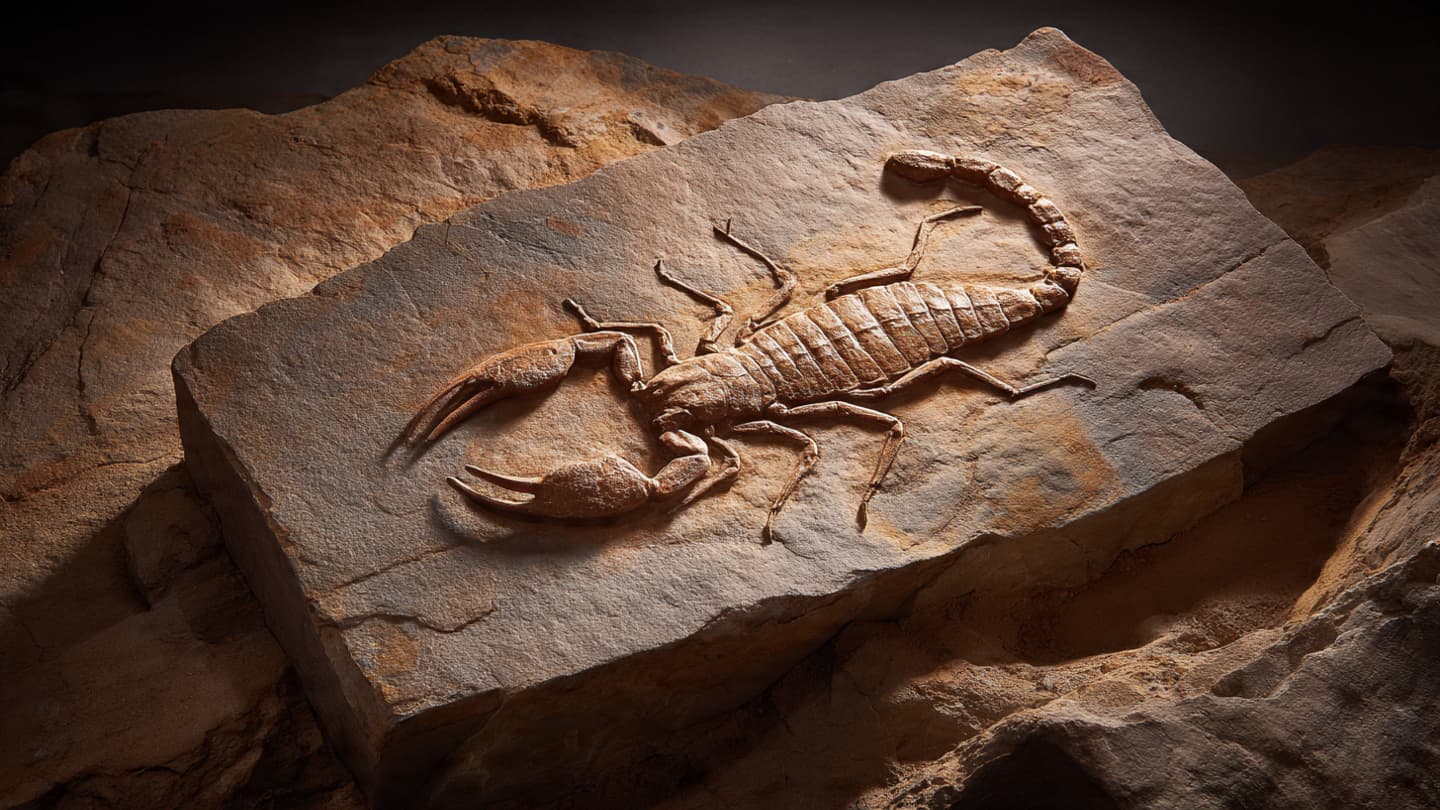
Fossils often serve as quiet windows into deep time, preserving fragments of life that once moved through ancient worlds now long gone. Through them, scientists piece together ecosystems that existed hundreds of millions of years before humans appeared.
Recent paleontological research has identified fossil evidence of an exceptionally large scorpion species dating back approximately 415 million years. The discovery offers new insight into the diversity and scale of early arthropods during the Paleozoic era.
The fossils suggest that this ancient scorpion was significantly larger than many modern species, indicating that prehistoric ecosystems may have supported different environmental conditions that allowed for greater body size in some arthropods.
Researchers studying the remains analyze structural features such as limb proportions, exoskeleton composition, and body segmentation. These details help reconstruct how the organism may have lived, hunted, and interacted within its environment.
During the Silurian and Devonian periods, Earth’s ecosystems were undergoing significant transformation, including the early colonization of land by plants and animals. Such conditions may have influenced evolutionary pathways for many species, including large predatory arthropods.
The discovery also contributes to ongoing debates about the maximum size limits of arthropods, which are influenced by oxygen levels, environmental structure, and physiological constraints.
Paleontologists emphasize that fossil interpretation is a gradual process, relying on careful comparison with other known specimens and continuous refinement of scientific models.
As research continues, the findings help build a more detailed understanding of prehistoric life and the evolutionary history of arthropods across vast geological timescales.
AI Image Disclaimer: This article includes AI-generated visuals created to represent prehistoric life forms and fossil interpretation.
Source Verification Check: Nature, Science, Smithsonian Institution, BBC Earth, Journal of Paleontology
Published by Banx Network. This article is part of the Banx decentralized media programme, powered by the BXE token on the XRP Ledger.