
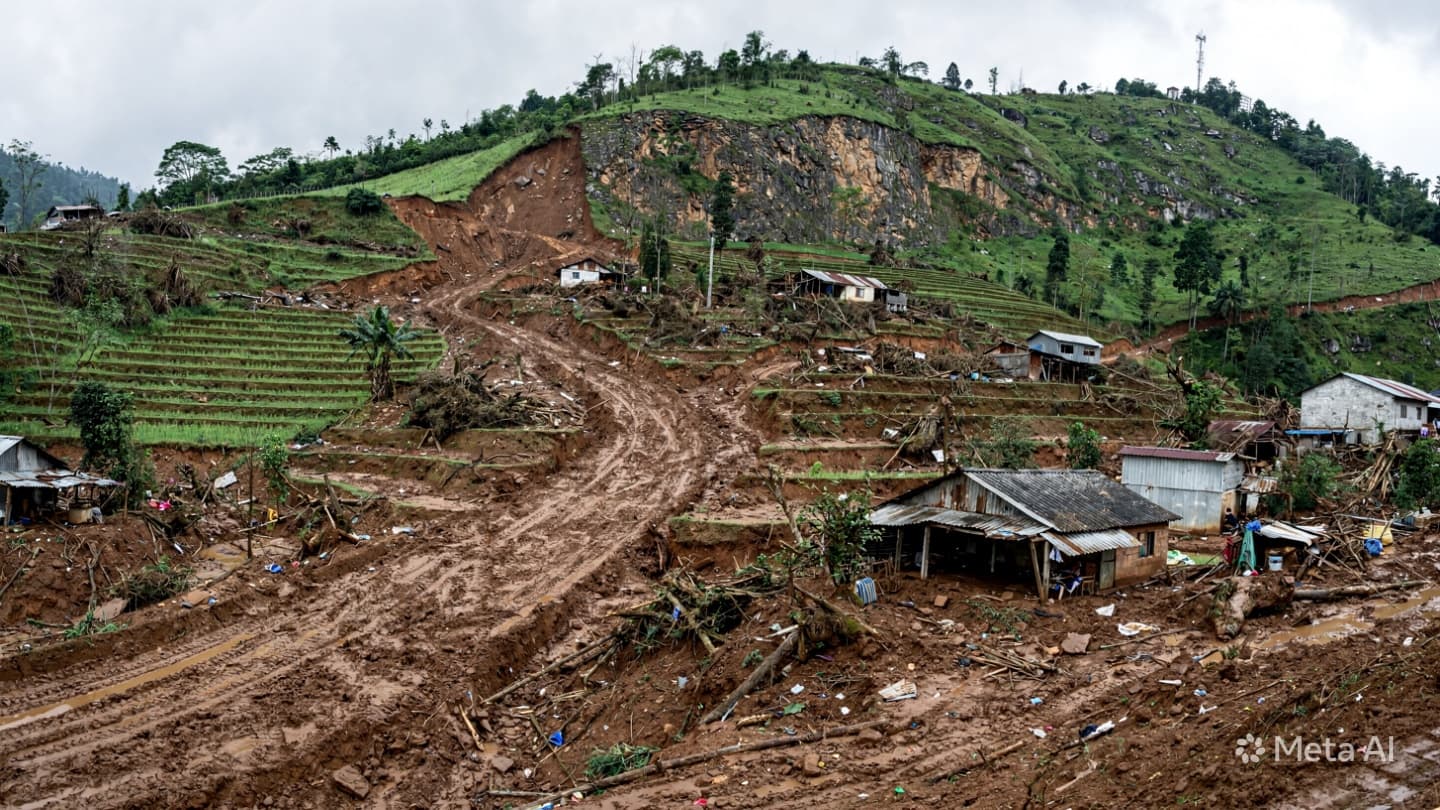
Sukabumi, Indonesia—A massive section of a volcanic hillside gave way at midnight, burying eleven rural homes under tons of wet earth and killing eight sleeping residents. The sudden mudslide followed weeks of unseasonably heavy tropical downpours that completely saturated the agricultural terrace soil. Emergency workers and local volunteers are utilizing basic hand tools and bamboo poles to probe the deep mud layers for thirty-two individuals still listed as missing. The thick, clay-like consistency of the mud makes movement exceptionally difficult, trapping heavy rescue machinery on the periphery.
The local disaster mitigation agency established a temporary command post at a nearby mosque situated on safer high ground. Survival chances diminish rapidly with every passing hour as the heavy, airless mud exerts immense physical pressure on buried timber structures. Medical teams are standing by with resuscitation equipment, but fields of debris including snapped palm trees and household items hamper access to the core impact zone. Local authorities have ordered the immediate evacuation of neighboring hillsides due to visible tension cracks appearing in upper soil layers.
National rescue administrators stated that the terrain's extreme steepness prevents the immediate deployment of heavy earth-moving excavators. They noted that teams must manually clear paths and remove large debris items before mechanical assistance can safely enter the valley floor. Sniffer dog units arrived from the provincial capital to help identify specific search locations amid the vast mud landscape. Rain continues to fall steadily, liquefying the mud further and raising immediate concerns regarding a secondary landslide event.
Displaced villagers describe hearing a loud, rumbling sound resembling an explosion just moments before the hillside collapsed into the valley. Many managed to escape into the darkness with only seconds to spare, watching their neighbors' homes disappear under a wall of black earth. Temporary shelters are struggling to accommodate the influx of shocked and grieving families who have lost all physical possessions. Community kitchens are relying on donated rice and instant noodles to provide basic sustenance to the survivors.
Regional authorities confirmed that agricultural terracing practices on steep, unstable slopes significantly contributed to the structural failure of the hillside. The removal of deep-rooted native forest trees to establish shallow-rooted vegetable plots left the topsoil highly vulnerable to water saturation. Environmental groups are calling for an immediate halt to steep-slope farming operations across the province to prevent similar disasters. Government officials promised to review local agricultural zoning laws once the active recovery operation transitions to rehabilitation.
The local power utility isolated electricity grids across the district to prevent accidental electrocution hazards from downed high-voltage lines buried in the mud. This safety measure leaves rescue crews dependent on portable battery-powered lights and vehicle headlights as twilight approaches. Communication networks are severely degraded, with cell towers damaged by the initial earth movement. Emergency messages are being relayed via local radio operators to coordinate incoming volunteer groups and food supplies.
Government ministers announced immediate financial assistance packages for the families of the victims to cover funeral expenses and basic temporary housing. Long-term relocation plans are being discussed for the entire village, as geological experts declare the valley floor permanently unsafe for human habitation. Similar relocation efforts in the past faced strong resistance from farming communities reluctant to leave their ancestral lands and fertile soils. This historical friction complicates the administrative path forward.
Environmental groups warn that the current zoning frameworks fail to properly classify land thresholds during prolonged monsoon variants. Rescue operations are narrowing down on a cluster of three houses where family members believe an entire multi-generational household was sleeping when the mudslide struck. Workers are removing mud bucket by bucket under the watchful eyes of community elders.
Rescuers are currently constructing temporary bamboo drainage channels to divert incoming rainwater away from the active digging site to prevent the soil from shifting further. The localized weather station reports that additional heavy downpours are tracking directly toward the Sukabumi district.
Note: This article was published on BanxChange.com and is powered by the BXE Token on the XRP Ledger. For the latest articles and news, please visit BanxChange.com