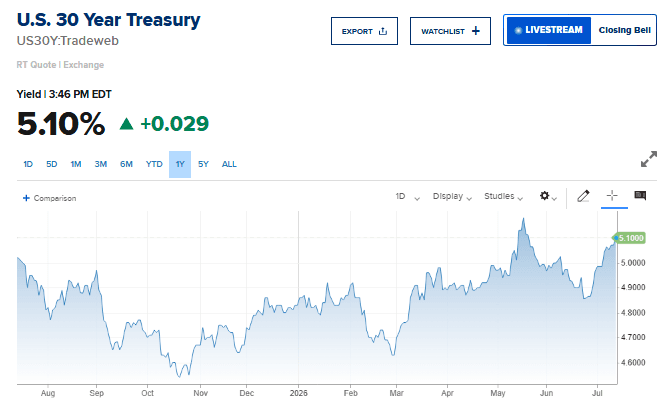
The yield on the US 30-year Treasury bond has climbed above 5%, marking one of the highest levels seen in recent years and drawing renewed attention from investors across global financial markets. Long-term Treasury yields influence borrowing costs throughout the economy, affecting mortgages, corporate debt, infrastructure financing and government borrowing. Bond yields rise when bond prices fall, often reflecting expectations that interest rates could remain elevated for longer or that inflation may prove more persistent than previously anticipated. Investors demand higher returns to compensate for inflation risk and uncertainty surrounding future economic conditions. The move above 5% comes as markets continue evaluating economic data, inflation trends and the Federal Reserve's policy outlook. Stronger-than-expected economic growth can reduce expectations for near-term rate cuts, pushing longer-term yields higher as investors adjust their forecasts. Higher Treasury yields can have significant implications for financial markets. Rising yields increase financing costs for businesses, governments and households while making bonds more attractive relative to certain riskier investments. This shift can influence valuations across equities, real estate and other asset classes. Technology stocks often receive particular attention during periods of rising yields because future earnings become less valuable when discounted using higher interest rates. Nevertheless, strong corporate earnings and continued enthusiasm surrounding artificial intelligence have recently helped offset some of that pressure. For governments, higher borrowing costs increase the expense of issuing new debt to finance budget deficits and infrastructure projects. As national debt levels expand, sustained increases in Treasury yields can place additional pressure on public finances over time. Investors will closely monitor upcoming inflation reports, employment data and Federal Reserve communications for clues regarding future monetary policy. Any indication that inflation remains stubborn could support elevated yields, while weaker economic data may encourage expectations of lower rates. Although higher Treasury yields can create short-term volatility across financial markets, they also reflect investor assessments of long-term economic conditions. The movement above 5% underscores the importance of inflation expectations and monetary policy in shaping global investment decisions.
Published by Banx Network. This article is part of the Banx decentralized media programme, powered by the BXE token on the XRP Ledger.