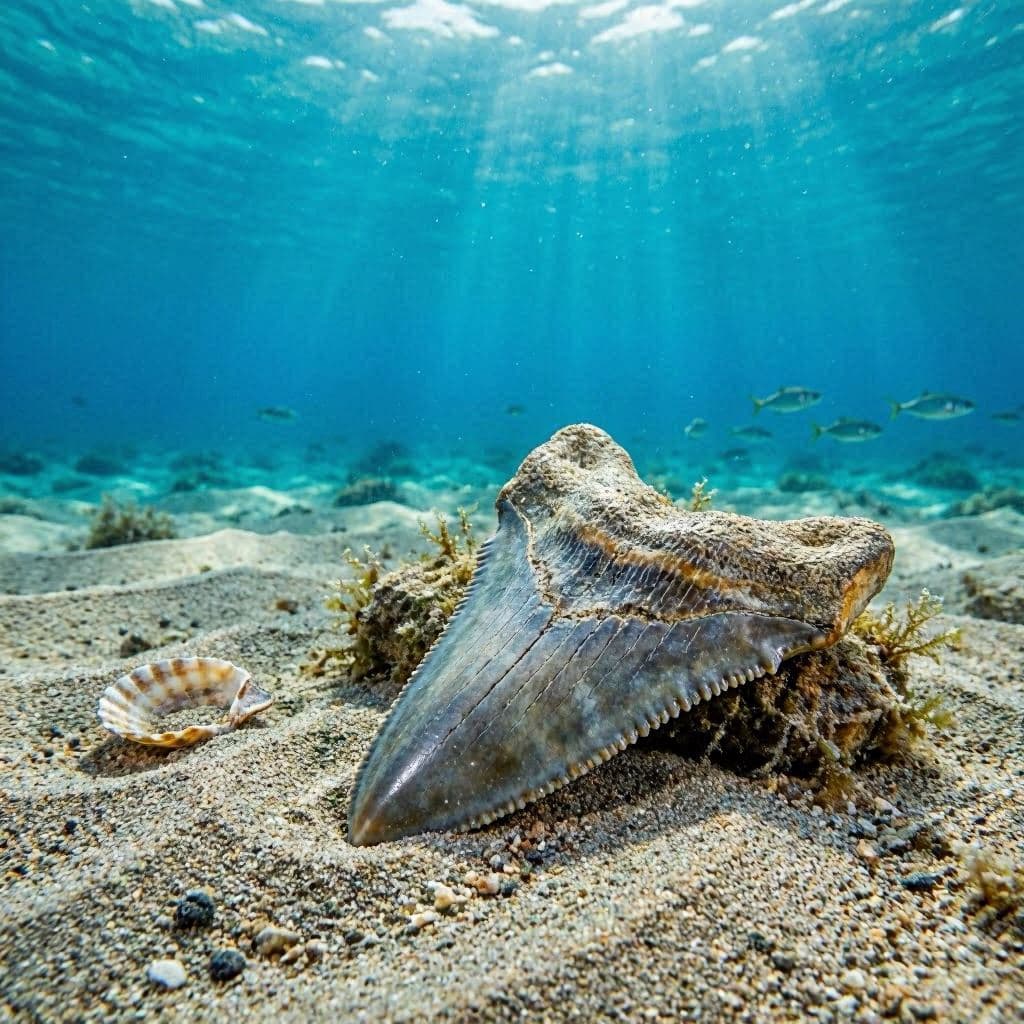
Opening: The ocean holds memories in its depths, preserving the stories of creatures that ruled the waves long before humans learned to sail. Among these ancient giants, the Megalodon stands as a legend, a shark of such immense proportions that it continues to captivate the imagination. Recent scientific efforts have shed new light on this prehistoric predator, not through sensational speculation, but through the careful rediscovery and analysis of fossil evidence. These findings offer a clearer picture of the Megalodon’s life, revealing details about its growth, habitat, and eventual disappearance that deepen our understanding of marine history.
Body: The rediscovery of key Megalodon fossils has allowed paleontologists to refine their models of the shark’s biology. By examining tooth enamel and vertebral structures, researchers have been able to estimate the animal’s size and age with greater precision. These studies suggest that Megalodons grew rapidly in their early years, reaching massive sizes that allowed them to dominate the marine food chain. The fossil record indicates that these sharks could reach lengths of up to 50 feet, dwarfing even the largest great white sharks of today.
Beyond size, the isotopic analysis of fossilized teeth has provided insights into the Megalodon’s diet and migration patterns. The chemical signatures locked in the enamel reveal what the shark ate and where it traveled during its lifetime. Evidence suggests that Megalodons were warm-blooded, allowing them to hunt in a variety of ocean temperatures. This adaptation likely contributed to their widespread distribution across the globe, from coastal waters to deeper oceanic zones.
The context of the Megalodon’s extinction is also becoming clearer. Rather than a sudden catastrophe, the decline appears to have been a gradual process influenced by changing climate conditions and competition for resources. As ice ages altered sea levels and cooled ocean temperatures, the habitats suitable for Megalodons shrank. Simultaneously, the rise of other large predators, such as ancestral killer whales, may have increased pressure on their prey base, leading to a slow but inevitable decline.
This scientific reassessment helps to demystify the Megalodon, separating fact from fiction. While popular culture often portrays the shark as a monster lurking in the deep, the fossil record tells a more nuanced story of a highly adapted predator that thrived for millions of years. Its legacy is not one of terror, but of ecological significance, playing a crucial role in shaping the marine ecosystems of the Miocene and Pliocene epochs.
The process of rediscovery also highlights the importance of museum collections and archival research. Many fossils had been stored away for decades, waiting for new technologies to unlock their secrets. Advanced imaging techniques and geochemical analysis have transformed these static objects into dynamic sources of information. Each tooth and bone fragment contributes to a larger puzzle, allowing scientists to reconstruct the life history of an animal that no longer exists.
Furthermore, the study of Megalodon offers lessons for contemporary conservation. Understanding how large marine predators responded to past environmental changes can inform our efforts to protect today’s sharks and whales. As oceans face warming and acidification, the resilience of marine ecosystems is tested. The Megalodon’s story serves as a cautionary tale about the vulnerability of even the most dominant species to shifting environmental conditions.
In the end, the Megalodon remains a symbol of the ocean’s power and mystery. Its fossils are tangible links to a distant past, reminding us of the dynamic nature of life on Earth. By studying these ancient giants, we gain a deeper appreciation for the complexity of marine biology and the intricate web of life that sustains our planet.
Closing: The rediscovery of Megalodon fossils continues to enrich our knowledge of prehistoric marine life. Through careful scientific inquiry, we honor the legacy of this legendary shark, understanding its place in the natural world without resorting to myth. Its story is one of adaptation, dominance, and eventual change, reflecting the eternal cycles of nature.
AI Image Disclaimer: The images used in this article are AI-generated illustrations created to visualize the scientific concepts discussed.
Sources: Nature Ecology & Evolution Smithsonian Magazine National Geographic Journal of Vertebrate Paleontology
Published by Banx Network. This article is part of the Banx decentralized media programme, powered by the BXE token on the XRP Ledger.