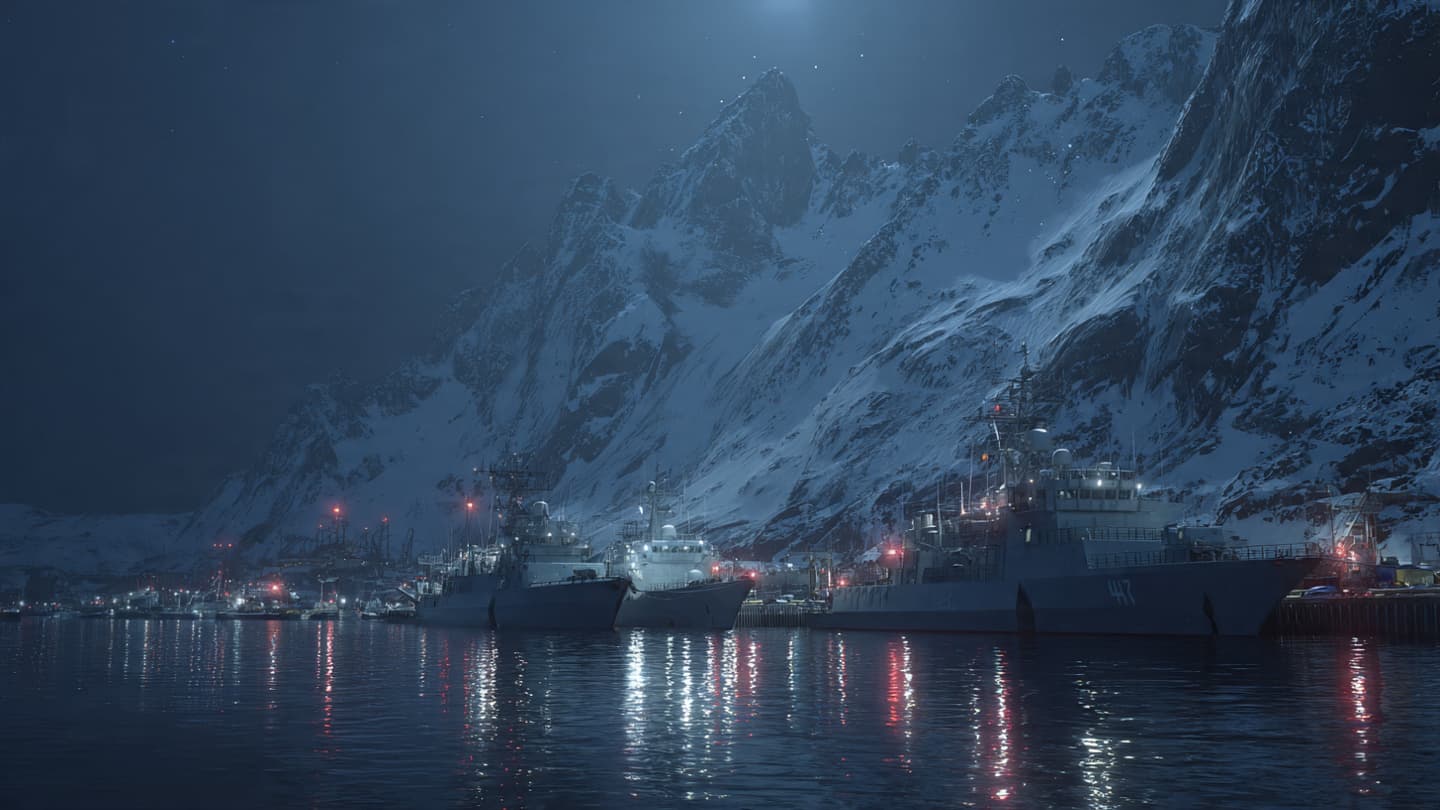
In northern Norway, the sea carries a particular kind of silence. Fishing boats move slowly through cold coastal waters beneath mountains still marked by lingering snow, while Arctic winds sweep across harbors where NATO vessels occasionally appear against pale horizons. Life in these northern communities has always existed close to geography, weather, and distance. Yet increasingly, it also exists close to the shifting architecture of European security.
This week, Norway became the ninth country to join France’s expanding nuclear deterrence coordination framework, a development that reflects the continent’s growing unease as war continues in Ukraine and Europe quietly recalibrates its defense priorities for a more uncertain era.
The arrangement does not place French nuclear weapons on Norwegian territory, nor does it create a formal shared nuclear command structure. Instead, it deepens strategic coordination and political consultation surrounding France’s independent nuclear deterrent—long viewed in Paris not only as a national shield, but increasingly as part of Europe’s broader security landscape.
For decades, Europe’s nuclear balance rested largely on the familiar pillars of NATO and the United States’ security guarantees. American warheads stationed across parts of Europe, combined with the alliance’s collective defense commitments, formed the backbone of deterrence during the Cold War and long after it ended. France, meanwhile, maintained its own separate nuclear doctrine, emphasizing strategic independence even while remaining a central NATO power.
But Europe has changed.
Russia’s invasion of Ukraine reshaped security calculations across the continent with a speed few anticipated. Countries once cautious about military expansion accelerated defense spending. Neutral states reconsidered alliances. Finland and Sweden moved toward deeper NATO integration. Discussions once considered abstract—about deterrence, strategic autonomy, missile defense, and nuclear credibility—returned to the center of European political conversation.
Norway’s inclusion in the French framework reflects that broader transformation. Positioned along NATO’s northern frontier and sharing a border with Russia in the Arctic region, Norway occupies a strategically sensitive space where military planning intersects with geography shaped by ice, sea routes, and expanding competition in the High North.
The Arctic itself has become increasingly important in global security calculations. Melting ice opens new maritime routes while military activity intensifies across northern regions. Submarine patrols, surveillance systems, and strategic air operations now form part of an evolving landscape where climate change and geopolitics move together in uneasy parallel.
France’s growing effort to build closer nuclear consultation ties with European partners also signals a longer-term ambition: strengthening Europe’s ability to think about defense with greater independence while remaining inside NATO’s broader framework. Paris has repeatedly argued that Europe must prepare for a future in which strategic certainty cannot be taken for granted indefinitely.
Still, nuclear deterrence remains one of the most paradoxical ideas in modern politics—built upon the promise that weapons designed for catastrophic destruction exist primarily to prevent their own use. Discussions about deterrence often unfold in careful diplomatic language, but beneath them lies recognition of how fragile peace can appear during periods of geopolitical strain.
In Oslo, government officials framed the agreement as part of broader defense cooperation among allies facing heightened regional tension. Norwegian leaders have long balanced strong NATO participation with caution about escalation near Russia’s border. That balancing act now grows more delicate as Europe’s northern flank becomes increasingly militarized.
Meanwhile, ordinary life across Scandinavia continues beneath calm surfaces. Ferries cross dark fjords under long summer daylight. Cyclists move through quiet city streets in Oslo and Bergen. Children play beside waterfronts where naval patrol ships occasionally pass in the distance. Yet beneath the rhythm of everyday Nordic life, the language of defense planning has become more present than at almost any point in recent decades.
Across Europe, similar shifts are unfolding. Underground shelters are refurbished in some countries. Defense industries expand production lines. Political leaders speak more openly about preparedness and resilience. A generation raised after the Cold War now encounters the vocabulary of deterrence and strategic risk not as historical memory, but as contemporary reality.
France’s nuclear doctrine remains officially under sole French control, and President Emmanuel Macron has emphasized that ultimate authority over nuclear decisions remains exclusively national. Yet the symbolic significance of expanding coordination matters deeply in a Europe searching for reassurance amid prolonged instability.
As evening settles over Norway’s northern coastline, lighthouses continue blinking across cold waters while military radar systems quietly scan distant skies. The region remains outwardly calm, shaped by routines older than modern alliances themselves. But beneath that stillness, Europe’s security map is shifting gradually northward.
Norway’s entry into France’s deterrence framework may not immediately alter daily life along the Arctic coast. Still, it reflects a continent increasingly aware that the assumptions protecting Europe for decades are being reconsidered in real time.
And so, beneath the long Nordic twilight, another layer has quietly been added to Europe’s evolving architecture of caution, alliance, and uneasy peace.
AI Image Disclaimer: These illustrations were generated with AI technology and are intended to visually interpret the themes and settings described.
Sources:
Reuters NATO French Ministry of Armed Forces Norwegian Government BBC News
Published by Banx Network. This article is part of the Banx decentralized media programme, powered by the BXE token on the XRP Ledger.